Lead Generation Funnel: How a Service Business Builds One

A lead generation funnel is the path a stranger takes from first seeing your business to handing you their contact details and becoming a lead. For a service business, that path runs through your website, your forms, your phone and your follow-up. If any one of those is weak, the leads leak out before anyone talks to you. As a Delray Beach web design studio, we build these paths for service businesses, and the pattern below is the one we work from.
TL;DR
- A lead generation funnel covers attracting visitors, capturing their contact details and qualifying their interest. Sales starts after that.
- Most funnels have three stages: awareness, consideration and decision. Each needs a different message and a different page.
- Most funnel leaks for local service businesses are fixable: unclear offers, long forms, slow replies and a website that was built from a template.
- Track a few numbers monthly: visitors, form submissions, qualified leads and how fast you answer.
- A free website audit shows where your own funnel loses people.
Table of Contents
- What a lead generation funnel is, and what it is not
- The three stages, in plain words
- How to build the funnel, step by step
- Where the funnel leaks
- Measuring the funnel
- A worked example
- Our perspective
- Build the funnel with a team that does both halves
- FAQ
- Sources
What a lead generation funnel is, and what it is not
The funnel is a picture of attrition. Many people notice you, fewer visit your site, fewer still call or fill in a form, and a smaller group becomes paying customers. The shape narrows because each step loses people.
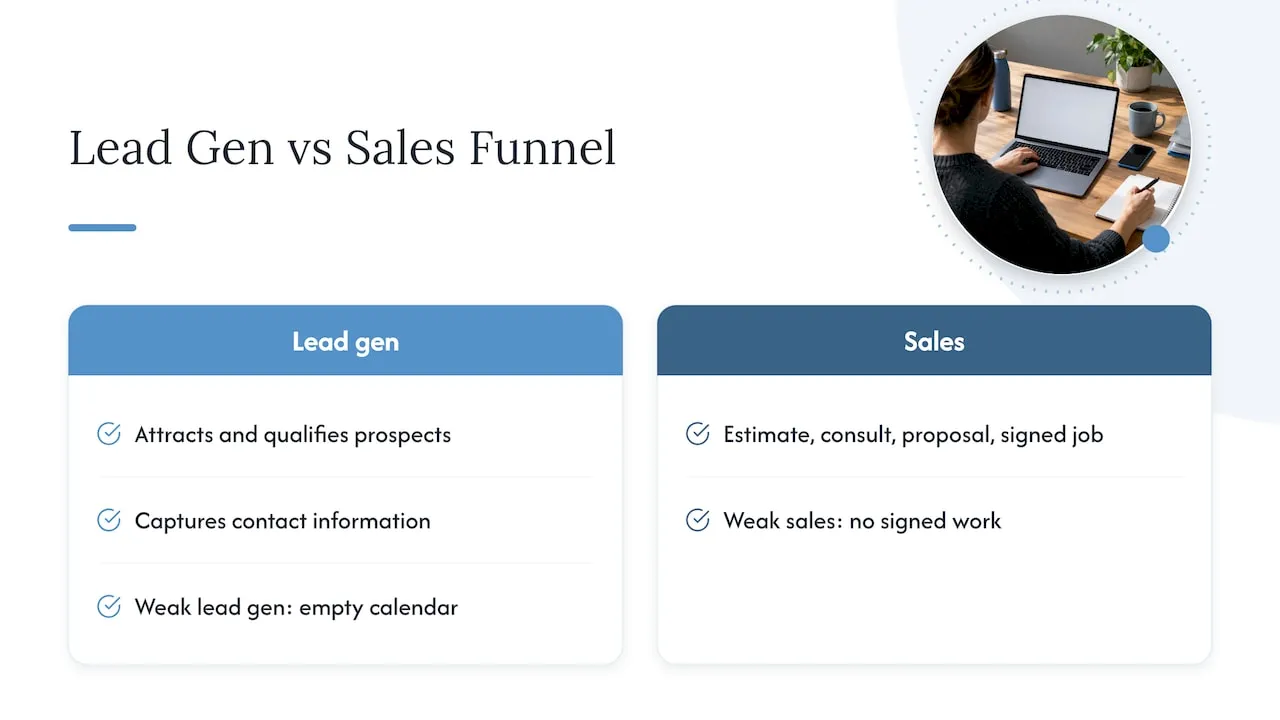
The lead generation funnel is the top part of that picture. It is the marketing side: getting attention, earning contact information and sorting out who is a real prospect. The sales funnel is what happens next: the estimate, the consultation, the proposal, the signed job. Keeping the two apart matters because they break in different places. A weak lead generation funnel gives you an empty calendar. A weak sales funnel gives you a full calendar and no signed work.
The classic way to describe the buyer’s mindset is the AIDA model. Business News Daily lists the stages as awareness, interest, decision and action, and notes that each stage needs different messaging. That last point is the one most small business websites miss. They put one message in front of everyone, whether the visitor has known them for five seconds or five weeks.
The three stages, in plain words
Marketers call these top, middle and bottom of the funnel. Here is what they mean for a business like a Boca Raton contractor, a Miami med spa or a West Palm Beach law practice.
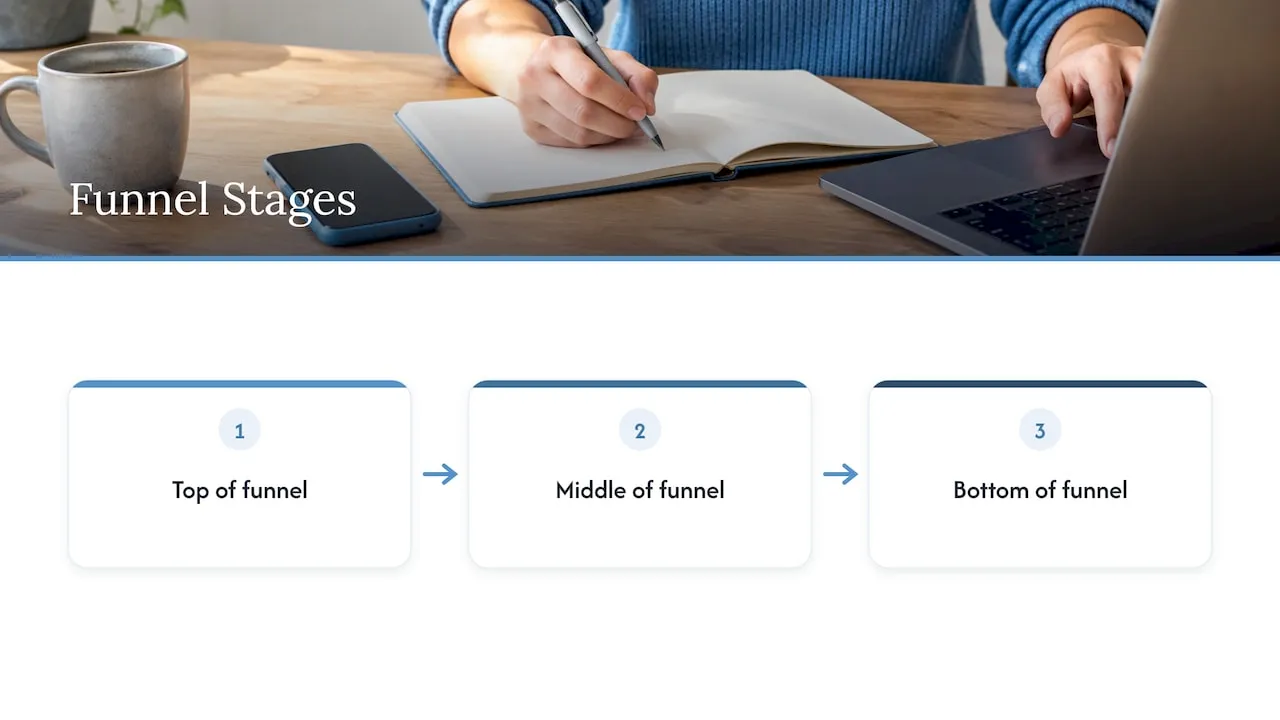
Stage 1: Awareness (top)
The person has a problem and does not know you yet. They search “how much does a kitchen remodel cost” or “med spa near me” and read what comes up. They are not ready to buy. They want an answer.
What works here:
- A Google Business Profile that is complete and current
- Service pages and articles that answer real questions in plain language
- Local search presence for the cities you serve
- Paid ads that send people to a page about the exact thing they searched for
The goal at this stage is not a sale. It is a visit, and a good first impression.
Stage 2: Consideration (middle)
Now the visitor knows you exist and is comparing. They look at your work, your reviews, your prices or price ranges, and how you handle their kind of job. This is where you ask for contact details, but you have to give something back.
What works here:
- A clear “get a quote” or “book a consultation” form
- A useful offer, such as a pricing guide, a checklist or a short assessment
- Case studies and project photos from jobs like theirs
- A short email series that answers the objections people raise before hiring
The American Marketing Association notes that inbound content lets prospects engage on their own timeline and can generate leads over the long term. In practice, that means the person who reads your page today may not call for three weeks. Your funnel has to still be there when they are ready.
Stage 3: Decision (bottom)
The prospect is ready to pick someone. They want to remove the last bit of doubt: Is this business real? Will they answer? What happens after I reach out?
What works here:
- A fast, human reply to every inquiry
- A clear next step: a call, a site visit, an estimate appointment
- Visible proof: licenses, reviews, guarantees, real photos
- A booking process with no friction
This is where many Florida service businesses lose the most leads, and not because of marketing. They lose them because nobody called back for two days.
How to build the funnel, step by step
You do not need a complicated system. You need each stage to work and each handoff to hold. Here is the order we would build it in.
1. Define who you want
Write down the customer you want more of. Not “homeowners.” Something like “owners of homes over $1 million in Palm Beach County planning a full renovation.” The tighter the description, the easier every later step becomes: which keywords to target, what to say on the page, what to ask on the form.
2. Give each service its own page
A single “Services” page that lists everything is a weak landing spot. Someone searching for one service wants a page about that service, with proof, a price range if you can give one, and a clear action. We cover the choices that shape those pages in our guide to service page structure.
3. Decide where paid traffic lands
If you run ads, the page the click lands on decides whether the money works. Sending ad traffic to a home page full of menu options is a common way to waste budget. Whether you need a dedicated landing page or a full website page is a real decision, and we walk through it in landing page vs website.
4. Make the form easy
Every extra field costs you submissions. Ask for what you need to make the first call useful: name, phone or email, what they need and where. If you need more detail, a short multi-step form can collect it without scaring people off. We explain how to build one that feeds your CRM in our piece on multi-step forms.
The same applies to a phone number. On a phone, a tap-to-call button should be visible without scrolling.
5. Capture where the lead came from
When a form is submitted, you should know which page, search or ad produced it. Without that, you cannot tell which part of the funnel is working. If you are starting from nothing, our guide to web analytics for lead generation covers tracking leads rather than just traffic.
6. Respond fast and follow up
Set a rule for how quickly every inquiry gets a reply, and who owns it. Then set a follow-up schedule for people who did not answer the first time. Many service businesses call once, leave a voicemail and stop. Buyers often need more than one contact before they respond.
Automation helps here: an instant text or email confirming the request, an alert to the right person, a reminder when a lead has sat untouched. If you are weighing how much to automate, see our AI lead qualification playbook.
7. Sort leads by quality
Not every lead deserves the same attention. A homeowner with a budget and a timeline is different from someone browsing. A simple rule set (location, service type, budget range, timeline) lets you call the best leads first. Our lead quality improvement guide lays out a practical system for this.
Where the funnel leaks
Most owners think they have a traffic problem. Often they have a leak problem. These are the leaks we see most often described in funnel guidance and the ways to close them.
| Leak | What the visitor experiences | Fix |
|---|---|---|
| Unclear offer | They cannot tell in five seconds what you do or who it is for | Put the service, the area and the action at the top of the page |
| Thin proof | No reviews, no photos, no names | Add real project photos, reviews, licenses |
| Long forms | Too many fields, so they leave | Cut to the essentials, or split into steps |
| Mismatched pages | The ad says one thing, the page says another | Match the landing page to the ad or search |
| Slow reply | They contact three businesses and the first to answer wins | Set a reply-time rule and automate the first response |
| No follow-up | One call, no second attempt | Schedule follow-up for every unanswered lead |
| Template site | Slow, generic, hard to adjust | Build pages around how your customers actually decide |
That last row is where we differ from most agencies. Many web designers start from a template or a page builder, then fit your business into it. We write fully custom-coded sites, so the layout, the forms and the handoff to your CRM follow your actual workflow, not the template’s. Our lead generation website design templates show the page patterns we start from.
Measuring the funnel
You do not need a dashboard with forty charts. Track these once a month:
- Visitors to your key service pages, and where they came from
- Inquiries: form submissions, calls and texts
- Inquiry rate: inquiries divided by visitors
- Qualified leads: inquiries that match the customer you want
- Reply time: how long the first response takes
- Booked jobs or consultations from those leads
The point is to see which stage loses the most people. If visitors are plentiful but inquiries are few, the problem is the page or the offer. If inquiries are plentiful but few get booked, the problem is follow-up or lead quality.
One rule makes the numbers useful: define terms once and keep them the same. If “lead” means a form fill in one report and a qualified call in another, the percentages will mislead you. Change one thing at a time, so you know what caused any improvement.
For businesses selling to other companies, measurement has one extra wrinkle. A single deal can involve several people. Forrester research, reported in Forbes, says B2B buying groups can average five to seven people, with at least two often becoming leads before purchase. Counting those people as separate leads can make your conversion numbers look worse than they are, so it helps to group them by company. Approaches to B2B content syndication also lean on account-level tracking for the same reason. The American Marketing Association describes account-based marketing the same way: research the company, know the decision-makers and measure at the account level.
A worked example
Take a hypothetical Fort Lauderdale pool remodeler. These are made-up numbers, used only to show how to read a funnel.
- 1,000 visitors a month reach the “pool remodeling” page
- 20 submit the form (a 2% inquiry rate)
- 10 of those match the type of job the company wants
- 4 get a reply within an hour; 6 wait until the next day
- 3 book an estimate
The numbers point to two fixes. The first is the reply time, since the leads that waited are the most likely to have gone elsewhere. The second is the page itself, because a 2% rate leaves room to test a clearer headline or a shorter form. Buying more ads would raise the visitor count and leave both leaks in place.
That is how most funnel work goes: find the narrowest point and fix it first.
Our perspective
Most of the service businesses that come to us believe they need more traffic. When we look at their funnel, the traffic is usually fine. The leak is in the middle: a page that does not say what they do, a form that asks too much, a lead that sits for two days.
Our founder spent years building CRM and lifecycle marketing systems at companies including Amazon and Verizon. Those systems were built around one idea: every person who shows interest should get the right next step at the right time. Small service businesses need the same discipline, at a scale that fits them.
That is why we write custom code instead of fitting you into a template. The funnel should match how your customers decide and how your team works. Better lead quality means fewer wasted calls and more of the jobs you want.
Jeremy
Build the funnel with a team that does both halves
A funnel needs a website that converts and a system behind it that routes and follows up on leads. We are a Delray Beach web design studio that builds both: custom-coded websites with conversion-focused design and SEO structure, email and CRM systems, lead routing and AI workflow automation. You can see the full range on our services page.
Once the site is live, it needs to stay fast and secure, because a slow or broken page loses leads quietly. Our website maintenance plans are published: Managed Hosting at $99 per month, Webmaster at $250 per month and Performance Plus at $750 per month. If you are in Palm Beach County, our Boca Raton and West Palm Beach pages cover local work. For Florida-specific tips, read our plain guide to website lead generation in Florida.
FAQ
What are the stages of a lead generation funnel?
Most guides use three: awareness, consideration and decision. Some split them into four or five, such as awareness, interest, decision and action. The labels change, but the idea is the same: people move from learning about you, to comparing you, to contacting you.
What is the difference between a lead generation funnel and a sales funnel?
The lead generation funnel is the marketing part: attracting visitors, capturing their contact details and judging their interest. The sales funnel starts once someone is a qualified lead and runs through estimates, proposals and closing. Different people often own each part, so each needs its own numbers.
How long does it take to see results from a funnel?
It depends on where the leaks are. Fixing a slow reply time or a long form can change results within weeks. Search-driven traffic from new service pages builds over months. Review your numbers monthly and change one thing at a time.
Do I need a new website to build a funnel?
Not always. If your current site is fast, clear and easy to update, you may only need better service pages, a shorter form and a follow-up routine. If the site is built on a template that limits what you can change, a custom rebuild is often the faster route.
What is the first thing to fix?
Start with the narrowest point in your funnel. For most small service businesses, that is how fast and how often they respond to new inquiries, followed by the clarity of the service page the lead lands on.
Sources
- How to Build a Sales Funnel, Business News Daily
- Inbound Marketing Vs. Outbound Marketing, American Marketing Association
- What is Account-Based Marketing (ABM)? A Guide for Beginners, American Marketing Association
- Why Should You Care About A New Waterfall?, Forbes
- B2B Content Syndication: A Demand-Gen Playbook, Storyline Pros
Want to see where your own funnel loses people? Request your free website audit at forefrontindustries.io/website-audit.