Lead Quality Improvement: A Practical System for Service Businesses

Lead quality improves when you change four things: who your website attracts, what your forms capture, how leads are scored, and how they move from marketing to sales. Ad copy alone rarely fixes it. In most service businesses the cause is structural: a generic site, a thin form, and a CRM that does not tell sales which leads to call first.
This guide lays out the system in order. Each step has a check you can run this week.
TL;DR
- Define “quality” in writing first: a qualified lead is one that matches your ideal customer profile and shows real purchase intent.
- Audit the last 90 days of leads by source. Cut or fix the sources that produce volume but no revenue.
- Capture fit data (firmographic or demographic) at the form. Capture intent data (behavior) in the CRM. Score both.
- Connect web forms directly to the CRM with routing rules, so no lead is lost between marketing and sales.
- Review the numbers with sales monthly and let reps feed their qualification knowledge back into the system.
Table of Contents
- 1. Define what a quality lead is
- 2. Audit the leads you already have
- 3. Fix the website so it attracts the right visitors
- 4. Design forms that qualify
- 5. Connect the form to the CRM and route every lead
- 6. Score leads on fit and intent
- 7. Nurture the leads that are not ready
- 8. Close the loop with sales
- Metrics to track
- Our perspective
- Work with Forefront Industries
- FAQ
- Sources
1. Define what a quality lead is
Most lead quality problems start with two teams using two definitions. Marketing counts form fills. Sales counts conversations that lead to revenue. Gartner research notes that sales organizations prioritize lead quality, while marketing-sourced leads are often generated to meet quantity goals.
Write one definition. It needs three parts:
- Fit. Industry, company size or household profile, location, budget range, service type.
- Intent. Actions that signal a buying decision: a quote request, a pricing page visit, a booked call, a reply to an email.
- Timing. How soon the lead needs the service.
A plumbing contractor, a wealth management firm and a yacht broker will each weight these differently. The point is that the definition is explicit and that sales signs off on it.
2. Audit the leads you already have
Before changing anything, measure the current state. Export the last 90 days of leads from your CRM or spreadsheet and add these columns:
| Column | What to record |
|---|---|
| Source | Organic search, paid, referral, social, direct, directory |
| Landing page | The first page the lead saw |
| Contacted within | Minutes or hours to first response |
| Outcome | No answer, unqualified, qualified, proposal, won, lost |
| Revenue | Closed value, if any |
Then calculate, per source: lead count, qualified rate, close rate and revenue per lead. Rank sources by revenue per lead, not by volume. A source that sends 40 leads and one customer often loses to a source that sends 8 leads and three.
Two patterns show up often:
- Volume sources with near-zero qualification. Fix the targeting or cut the budget.
- Leads with no outcome recorded. This is a process problem, covered in step 5.
3. Fix the website so it attracts the right visitors
A site that speaks to everyone attracts everyone. Lead quality improves when the page filters before the form does.
Match pages to a specific buyer
A single “services” page is a weak filter. A page built for one buyer type states who the service is for, what it costs to work with you, and what the process looks like. Visitors who do not fit leave. Visitors who fit are more ready to act. Our industry pages follow this pattern, for example web design for wealth management firms and web design for luxury home builders, where the language, proof and calls to action are written for one audience.
State qualifiers on the page
Useful qualifiers include:
- Minimum project size or typical engagement range
- Service area (cities, counties, states)
- Who you do not serve
- Timeline from first call to start
This reduces unqualified inquiries without adding form friction.
Remove template limits
Template and page-builder sites constrain what you can change: field logic, conditional steps, tracking events, page speed. Custom-coded sites let you build the exact path a qualified buyer should take and measure every step. That is the reason we build custom React frontends rather than templates.
4. Design forms that qualify
A form is the first qualification step. Too few fields and you collect noise. Too many and good prospects leave.
A workable pattern:
- Short first step. Name, email or phone, and one qualifying question (service needed, or budget range).
- Conditional second step. Show only fields relevant to the first answer.
- Clear expectation. Tell the person what happens next and when.
Qualifying questions that tend to work for service businesses:
- What service do you need?
- When do you want to start?
- What is your approximate budget range?
- Where is the property or business located?
Every answer should map to a CRM field, not a free-text note. Structured data is what makes scoring and routing possible later.
5. Connect the form to the CRM and route every lead
Research on B2B lead management describes a “sales lead black hole”: marketing generates leads that never reach sales, because of misaligned internal systems rather than poor leads. A thesis on lead qualification in CRM systems recommends connecting web-to-lead forms directly to the CRM so there is end-to-end visibility and accountability.
Build these in order:
- Direct write. Each form submission creates a CRM record with source, landing page and every answer mapped to a field.
- Routing rules. Assign by service type, location, deal size or round robin.
- Response alerts. Notify the owner immediately. Escalate if no contact is logged within your target window.
- Required outcomes. Reps must set a status on every lead. No status, no report.
- Reporting. A dashboard of source, qualified rate and revenue by landing page.
This is CRM engineering work, not a plugin setting. On enterprise platforms such as Salesforce Marketing Cloud and Braze, and on smaller stacks, it means modular data models, templates and journeys that match how your team actually works. Our Email & CRM Development and AI automation services cover this build.
6. Score leads on fit and intent
Scoring ranks leads so sales calls the best ones first. Two findings from the research shape how to build it.
Do not treat effort as intent. Gartner’s lead scoring guide says organizations often mistake high buyer effort for readiness to buy, and recommends that marketing and sales agree on objective scoring benchmarks. Ten email opens from a student is not a buying signal.
Combine fit and behavior. Gartner also advises that application leaders integrate sales and marketing through the CRM, capturing behavioral data for purchase intent and firmographic data for ideal customer fit in one scoring framework.
A study on profiling before scoring adds that most machine learning models lean on behavioral data that exists only after first contact, and that adding demographic or firmographic profiling in an earlier stage improves prioritization. In practice: score fit at form submission, then add intent points as behavior accumulates.
A starting scorecard
| Signal | Type | Example points |
|---|---|---|
| In service area | Fit | +20 |
| Budget in your range | Fit | +25 |
| Target industry or property type | Fit | +15 |
| Requested a quote or call | Intent | +25 |
| Visited pricing or service page twice | Intent | +10 |
| Free email domain with no company | Fit | -5 |
| Outside service area | Fit | -30 |
The point values are placeholders. Set them from your own audit in step 2, then compare scores to outcomes after 60 to 90 days and adjust.
Manual rules versus predictive models
A 2025 B2B study found that a Gradient Boosting Classifier outperformed traditional manual scoring for conversion prediction, using lead source and status data. A literature review of lead scoring models also frames scoring as a way to measure lead quality and support sales performance.
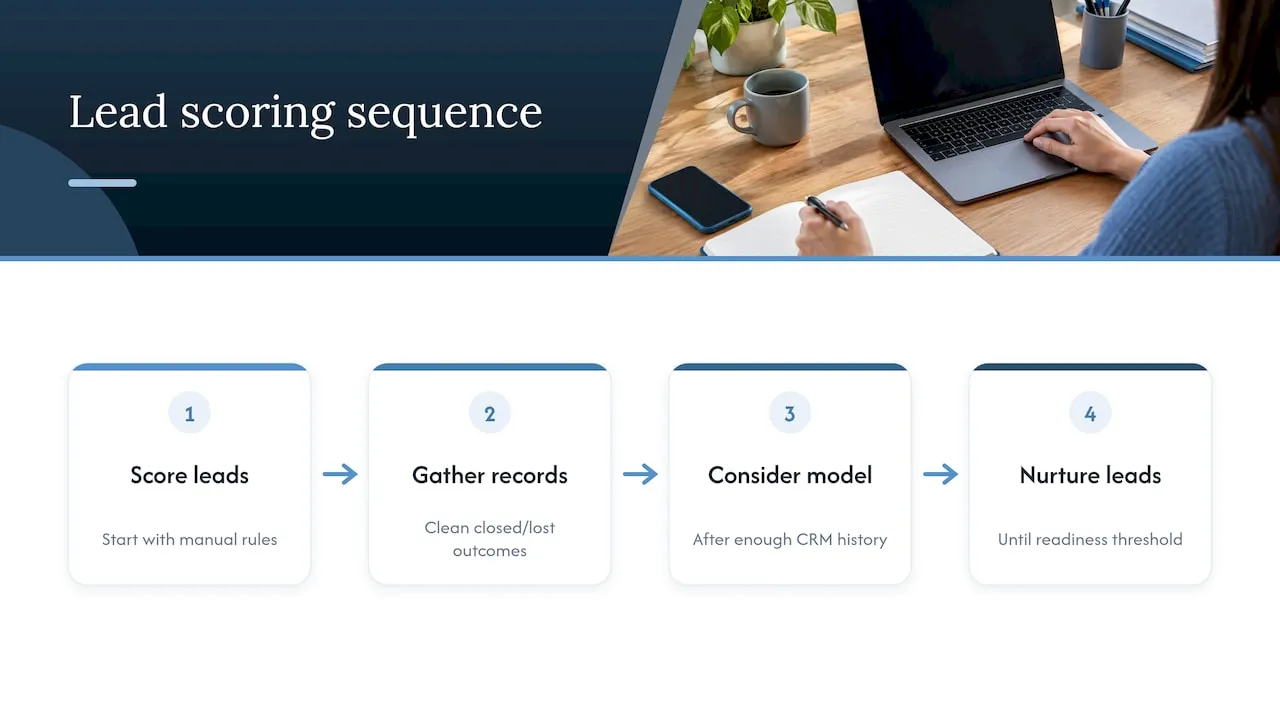
For most service businesses, the sequence is: start with a manual scorecard, collect clean outcome data for a few months, then consider a predictive model once you have enough closed and lost records to learn from. Models need history. Clean CRM fields from steps 4 and 5 provide it. Once a lead is scored but not yet ready, lead nurturing strategies keep it warm until its score crosses your threshold.
7. Nurture the leads that are not ready
A good-fit lead with low intent is not a bad lead. It is an early one. Build lifecycle journeys that move it forward:
- A confirmation email within minutes that restates what happens next
- A short sequence with proof relevant to the service they asked about (case examples, process, pricing guidance)
- A re-engagement trigger when the lead returns to a key page
- A handoff to sales when the score crosses the threshold
For ecommerce-adjacent or customer-lifecycle email, we also build on Klaviyo; see our Klaviyo email development services.
8. Close the loop with sales
Scoring models fail when they ignore the people who talk to leads. The same Trepo thesis points out that tacit knowledge held by individual sales reps is often missed in CRM design, and that letting reps contribute to qualification criteria improves standardized lead quality more effectively than automated scoring alone.
Run a 30-minute monthly review:
- Pull the top 10 leads that closed and the top 10 that scored high but did not.
- Ask reps what they noticed on the first call that the form did not capture.
- Turn each answer into a form question, a CRM field or a scoring rule.
- Retire rules that do not correlate with revenue.
Metrics to track
| Metric | What it tells you |
|---|---|
| Qualified rate by source | Whether a channel sends the right people |
| Speed to first contact | Whether leads are lost to delay |
| Lead-to-opportunity rate | Whether scoring matches sales judgment |
| Close rate by score band | Whether the scorecard predicts revenue |
| Revenue per lead by landing page | Which pages filter well |
Gartner’s guidance on conversion metrics for demand generation makes the same point: steer investment from conversion metrics that show what campaigns produce, not from incomplete data or historical comparisons.
Our perspective
We see the same pattern across service businesses. Owners buy more traffic when the real leak is downstream: a template site that attracts everyone, a form that asks nothing, and a CRM where leads sit unassigned. Fixing those three raises lead quality without raising ad spend.
Our background is in enterprise CRM and lifecycle marketing, including work for large consumer brands such as Amazon and Verizon. The discipline carries over to smaller companies: structured data in, clear routing, scoring that sales trusts, and reporting tied to revenue.
The order matters. Define quality, fix capture, connect the CRM, then score. Teams that start with scoring on messy data get a confident-looking number that means nothing.
- Jeremy
Work with Forefront Industries
If your site and CRM are the weak points, we build both. We design and code custom websites for service businesses, engineer the CRM and email systems behind them, and automate lead routing and internal workflows. After launch, our website maintenance plans start at 99 USD per month for Managed Hosting, with Webmaster at 250 USD per month and Performance Plus at 750 USD per month. To discuss a build, start from our services overview.
FAQ
What is lead quality improvement?
It is the process of increasing the share of your leads that match your ideal customer and are likely to buy. It covers targeting, website messaging, form design, scoring, routing and follow-up. The goal is more revenue per lead, not more leads.
How do I know if my lead quality is low?
Look at the qualified rate and close rate by source. If many leads are unreachable, outside your service area or below your budget range, quality is low. Slow response times and unrecorded outcomes can also make good leads look bad.
Should I use lead scoring or a predictive model?
Start with a manual scorecard built on fit and intent signals. Research shows machine learning can beat manual scoring in B2B conversion prediction, but it needs clean historical data. Collect that data first.
Do longer forms improve lead quality?
Only when the extra fields are qualifying questions that sales will use. Long forms can filter out weak leads but also lose good ones. A short first step with conditional follow-up questions is a safer balance.
Who owns lead quality, marketing or sales?
Both. Gartner describes it as a joint effort in which sales and marketing work through the CRM to share behavioral and fit data. One shared definition and one shared report keep both teams accountable.
Sources
- Gartner: Quick Answer: How to Improve Lead Quality by Aligning With Marketing
- Gartner: Ignition Guide to Getting Started With Lead Scoring
- Gartner: Quick Answer: Optimize Demand Generation With Conversion Metrics
- Trepo: Lead Qualification Management in a CRM System
- Profiling before scoring: a two-stage predictive model for B2B lead prioritization
- The relevance of lead prioritization: a B2B lead scoring model based on machine learning (PMC)
- The state of lead scoring models and their impact on sales performance (PMC)