AI Lead Qualification: A CRM-First Playbook For 2026

AI lead qualification uses machine learning models to score, rank, and route leads based on their likelihood to convert, replacing static point systems with predictions built from real conversion history. Teams with high-volume inbound flow, multi-channel data, and existing CRM infrastructure should adopt it now.
Start here:
- Audit your CRM for at least 500 to 1,000 historical won/lost records with clean timestamps.
- Identify your actual conversion event (demo booked, opportunity created, deal closed) before touching any model.
- Confirm your CRM can accept a writable lead score field.
Key Takeaways
AI lead qualification works because it replaces static scoring rules with models trained on your own conversion history, then wires the output directly into CRM automation.
| Point | Details |
|---|---|
| Start with clean data | Audit conversion events and CRM fields before selecting any model or vendor. |
| Choose the right algorithm | Use logistic regression for smaller datasets, escalate to XGBoost or LightGBM at scale. |
| Validate with time splits | Test models on a time-based split and track lift on your top-scoring decile. |
| Keep humans in the loop | Require review for high-impact actions and give reps override controls. |
| Consider a custom build | Forefront Industries delivers custom CRM integrations for teams whose scoring needs outgrow SaaS defaults. |
Table of Contents
- What Is AI Lead Qualification And When Should You Use It?
- How Does The AI Lead Scoring Pipeline Actually Work?
- How Do You Implement AI Lead Qualification Step By Step?
- What Are The Most Common AI Agent Patterns For Lead Qualification?
- What Metrics Prove Your Model Is Actually Working?
- What Risks Come With AI Lead Qualification, And How Do You Manage Them?
- How Long Does Implementation Take, And What Does It Cost?
- When Should You Choose SaaS Versus A Custom Build?
- Ready To Deploy AI Lead Qualification In Your CRM?
- Where To Read More On AI Lead Scoring And CRM Integration
- Frequently Asked Questions About AI Lead Qualification
- Sources
What Is AI Lead Qualification And When Should You Use It?
AI lead qualification runs a lead’s data, behavior, and conversation signals through a trained model that outputs a score, then triggers an action. That’s different from rules-based scoring, where a marketer manually assigns points (“+10 for downloading a whitepaper”) with no learning loop. According to The GTM with Clay Blog, the process typically breaks into four steps: define your ideal customer profile, research and segment leads, engage to gather signals, then score.
AI earns its keep when you have volume, cross-channel signals (web, email, chat, ad platforms), and a sales motion complex enough that static rules go stale within a quarter. Skip it, for now, if you’re converting fewer than a few hundred leads a year or operate under strict data regulations that limit what you can model on.
- High volume, multi-channel inbound: strong AI candidate.
- Fewer than 500 historical conversions: wait and keep collecting data.
- Simple, single-rep sales motion: rules-based scoring may still be enough.
Pro Tip: Before you touch a model, get sales and marketing to agree on one shared definition of a “qualified” lead. Mismatched definitions between teams will poison your training labels before the first model even runs.
How Does The AI Lead Scoring Pipeline Actually Work?
Every AI lead qualification system runs on three layers, and understanding them prevents you from buying a tool that only solves one.
The data layer pulls from form fields, behavioral events (page visits, email opens), third-party enrichment, and increasingly, conversation transcripts from chat or calls. The model is only as good as your conversion labels, so a messy CRM with inconsistent stage definitions will undercut everything downstream.
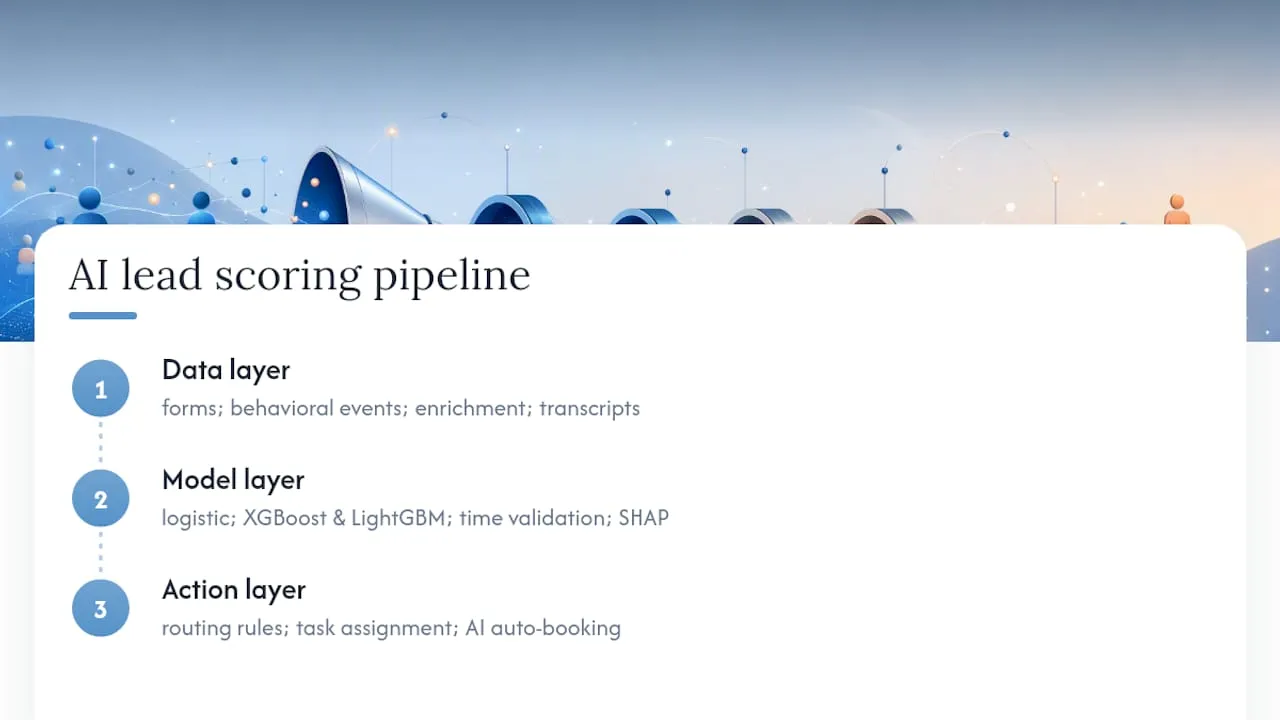
The model layer turns raw data into features and runs them through an algorithm. Kissmetrics recommends starting with logistic regression for interpretability, then escalating to XGBoost or LightGBM once you have enough conversions to benefit from a gradient-boosted tree’s accuracy. Time-based validation splits (train on older data, test on newer) catch overfitting that a random split would miss. Reason codes or SHAP values then explain why a lead scored high, which matters when a rep asks “why did this get top priority?”
The action layer turns a score into something that happens: a routing rule, a task assignment, or an AI agent auto-booking a meeting.
A typical flow: inbound form submission → enrichment API adds firmographic data → model scores the lead → a threshold routes it to auto-booking or a human rep for manual follow-up.
How Do You Implement AI Lead Qualification Step By Step?
- Define stakeholders and metrics. Get sales, marketing, and ops to agree on what “qualified” means and pick one north star metric, usually conversion rate on top-scored leads.
- Inventory your data. Map every conversion event, lead identifier, and data source you have, including gaps.
- Build the labeled dataset. Deduplicate records, enrich missing fields, and set a clear time window and outcome definition (e.g., “converted within 90 days of first touch”).
- Choose your model. Start with logistic regression on smaller datasets; move to gradient-boosted trees like XGBoost as conversion volume grows. Validate with a time-based split and track lift on your top decile.
- Deploy into your CRM. Push the score as a writable field, connect automation rules, and set human-in-the-loop thresholds for high-stakes decisions. Salesforce’s Einstein Lead Scoring rescores leads hourly and updates its underlying model monthly, a useful benchmark for your own cadence.
- Monitor post-launch. Run monthly or quarterly reviews, audit a sample of false positives and false negatives, and build a feedback loop with reps who work the leads directly.
Pro Tip: Don’t skip the rep feedback loop. A model can hit strong statistical accuracy and still get ignored by your sales team if nobody asks them whether the “hot” leads it flags actually feel hot on the phone.
What Are The Most Common AI Agent Patterns For Lead Qualification?
Most production deployments fall into a handful of repeatable patterns rather than one-off custom builds.
- Conversational qualification agents ask follow-up questions in chat or email to infer budget, timeline, and objections, then feed those signals back into the score. Swiftex describes this as combining conversation, enrichment, and behavioral data with reason-code explainability.
- Auto-booking flows skip the handoff entirely for high-confidence leads, sending them straight to a rep’s calendar.
- Background enrichment pipelines silently append firmographic and technographic data the moment a form is submitted.
- Predictive prioritization surfaces likely converters to reps before they’d otherwise notice them in a queue.
Real-time scoring fits fast-moving inbound channels; batch scoring fits nightly list processing. HubSpot’s AI scoring, for instance, evaluates historical lifecycle changes and can take up to an hour to appear as a contact property, which matters if you’re expecting instant routing. Every agent action should write to an audit trail, and confidence thresholds should trigger human escalation rather than fully autonomous handling.
What Metrics Prove Your Model Is Actually Working?
Track model performance separately from operational impact.
- Lift and top-decile conversion: how much better your top 10% of scored leads convert versus a random sample.
- AUC and precision/recall: standard classification metrics for how well the model separates converters from non-converters.
- Calibration: whether a “70% likely to convert” score actually converts around 70% of the time.
- Speed-to-lead and rep adoption rate: operational signals that the score is actually changing behavior, not just sitting in a CRM field.
Testing methodology matters as much as the metrics themselves:
- Use a time-based train/test split, never a random split, to avoid leaking future information into training.
- Run an A/B or holdout rollout before full deployment.
- Generate lift charts monthly to visualize where the model adds the most value.
- Kissmetrics recommends quarterly retraining as a baseline cadence, with alerts set to trigger earlier review if lift or precision drops below your target band.
What Risks Come With AI Lead Qualification, And How Do You Manage Them?
Every AI scoring system inherits the biases of its training data. If your historical conversions skew toward one channel or region, your model will keep favoring that pattern even when it’s wrong.
- Bias: audit training data for skew across channel, region, and deal size before deploying.
- Bad inference from conversational agents: scope what an agent can do autonomously, and require human approval for high-impact actions like auto-disqualifying a lead. AI-sourced leads can convert less reliably than human-verified ones if quality checks aren’t in place.
- Privacy and compliance: apply data minimization, encryption, and role-based CRM access controls.
- Rep distrust: give reps override controls and visible reason codes so the model reads as a tool, not a black box.
Pro Tip: Give every rep the ability to flag a score as wrong in one click. That single feedback signal does more to fix a drifting model than any dashboard.
How Long Does Implementation Take, And What Does It Cost?
A configurable SaaS pilot can go live in two to six weeks; a custom integration tied to a complex CRM or multiple data sources usually runs eight to sixteen weeks or more, because of the data cleanup and validation work involved.
- SaaS pilots: fastest path, limited to what the vendor’s native fields and integrations support.
- Custom builds: slower, but built around your actual sales motion and CRM architecture.
- Cost drivers: engineering time, data cleanup, integration complexity, licensing fees, and ongoing retraining.
Choose SaaS when your CRM setup is standard and your engineering bandwidth is thin. Choose a custom build, the kind Forefront Industries delivers for enterprise-grade Salesforce Marketing Cloud and Braze environments, when your scoring signals, lifecycle stages, or app orchestration are too specific for an off-the-shelf tool.
When Should You Choose SaaS Versus A Custom Build?
Quick SaaS pilots make sense when engineering bandwidth is thin and you need fast proof-of-value. A custom Forefront Industries integration fits better when your CRM is complex, your scoring signals are specific to your business, or you need multiple apps orchestrated together. Forefront Industries’ enterprise CRM background is built for exactly that complexity.
Ready To Deploy AI Lead Qualification In Your CRM?
Most teams don’t fail at AI lead qualification because the model is wrong. They fail because the score never gets wired into a system reps actually use. Forefront Industries builds custom AI automation and CRM integrations that turn the checklist above into a live pipeline, not a slide deck.
That means a discovery audit of your current lead data and CRM setup, a pilot implementation scoped to your actual conversion events, and ongoing monitoring so the model doesn’t quietly drift out of accuracy six months later. If your CRM already holds the conversion history but nobody’s turned it into a working score, that’s the gap worth closing first. Explore Forefront Industries’ AI automation services and start with a discovery audit of your current pipeline.
Where To Read More On AI Lead Scoring And CRM Integration
- Einstein Lead Scoring datasheet for a production CRM scoring example.
- HubSpot’s AI scoring documentation for setup and evaluation timing.
- Predictive lead scoring guidance on integrating predictions into workflows.
Frequently Asked Questions About AI Lead Qualification
What is AI lead qualification in simple terms? It’s the process of using a trained model, instead of manual point rules, to predict which leads are most likely to convert and to automatically route them to the right next action.
How is AI lead scoring different from traditional lead scoring? Traditional scoring assigns fixed points to actions manually. Automated lead scoring learns patterns from historical conversions and updates as new data comes in, which is why it adapts faster to changing buyer behavior.
Do I need a data scientist to implement AI lead qualification? Not necessarily for a SaaS pilot, since platforms like HubSpot and Salesforce handle the modeling internally. A custom build with specific scoring signals usually benefits from engineering support to integrate cleanly with your CRM.
How often should an AI lead scoring model be retrained? Quarterly retraining is a reasonable baseline, though high-volume teams may benefit from monthly updates similar to Einstein’s cadence, with alerts set to catch performance drift earlier if needed.
Can AI lead qualification replace my sales team’s judgment entirely? No. Every credible implementation keeps a human-in-the-loop step for high-impact decisions, since even strong models carry bias risk and need rep feedback to stay accurate over time.
Sources
- Einstein Lead Scoring
- AI-Powered Lead Scoring: Building a Workflow That Learns From Your Data
- Build contact lead scores with AI - HubSpot Knowledge Base