Stop Bleeding Ad Spend: Landing Page vs Website for Service Businesses

A website is a multi-page brand home built for discovery and long-term SEO. A landing page is a single-purpose conversion page built to close one offer. The rule for choosing between them is simple: match the page to the traffic source. Paid ads, email campaigns, and retargeting belong on a landing page; organic search, direct visits, and referrals belong on a website. If you’re running an ad or email push, build a dedicated landing page. If you need people to find you and trust you over time, invest in the website.
TL;DR:
- Landing pages outperform general website pages in conversion rates by providing a single, focused call to action with no navigation to minimize exits.
- Paid advertising campaigns benefit most from dedicated landing pages, which can improve conversion rates by up to double compared to using homepages.
- Websites are essential for organic discovery, trust-building, and ranking for hundreds of specific search queries over time.
- Use a website when the goal is ongoing discovery or trust, and a landing page when promoting a specific offer through paid ads or email campaigns.
- Building both a website and targeted landing pages, integrated with CRM and automation, significantly enhances lead quality and overall conversion success.
Table of Contents
- What Is a Website? Definition, Core Parts, and Primary Jobs
- What Is a Landing Page? Anatomy and Primary Uses
- Key Differences: A Practical Side-by-Side Comparison
- When to Use a Landing Page vs a Website: A Three-Question Framework
- How to Build and Optimize an Effective Landing Page
- Industry and Use-Case Guidance: Which Page Type Fits Your Situation
- How Forefront Industries Approaches Websites and Landing Pages Together
- Ready to Fix Your Lead Generation Setup?
- Sources
What Is a Website? Definition, Core Parts, and Primary Jobs
A website is a permanent, multi-page property organized around navigation. It typically includes a homepage, individual service or product pages, a blog, an about page, and a contact page, all linked through a consistent menu structure. The job of a website is not to close one transaction. It’s to let different visitors, arriving with different intents, find the specific page that answers their question.
That structure is exactly what makes websites strong for organic search. Google indexes each page separately, and a site with dozens of specific, well-written pages gives the algorithm more surface area to match against search queries. A single landing page can rank for one narrow phrase at best. A website with service pages, location pages, and a blog can rank for hundreds.
Websites also carry the weight of ongoing trust-building. A visitor who lands on a plumbing company’s homepage after a Google search isn’t ready to buy yet. They want to see the service list, check reviews, browse past projects, and confirm the business operates in their area before they call. A multi-page site built for a specific service audience does that work continuously, without a campaign budget behind it.
What a website does well:
- Supports discovery through organic search and backlinks accumulated over years, not weeks
- Presents multiple services, audiences, or product lines without forcing a single message on every visitor
- Builds credibility through depth: case studies, testimonials, detailed service pages, and a blog that answers real questions
- Serves as the permanent home a visitor returns to after clicking away from an ad or email
A website is the right and only answer when your goal is discovery, not a single conversion event. If someone searches “landscaping company near me” or types your business name directly into the address bar, they need a website waiting for them, not a stripped-down offer page.
What Is a Landing Page? Anatomy and Primary Uses
A landing page is a single, focused page built around one offer and one call to action, with the messaging matched precisely to whatever brought the visitor there. Click a Facebook ad for a free consultation, and the landing page you hit should repeat that exact promise in the headline. That message match between ad and page is what keeps cost-per-click efficient and conversion rates high.
The anatomy is deliberately narrow. A strong landing page includes a headline that mirrors the ad or email subject line, a hero section that states the offer in plain terms, one dominant call to action, minimal or no navigation menu, some form of proof (a testimonial, a client count, a guarantee), and a form or checkout flow that asks for only what’s necessary.
Core elements of a converting landing page:
- One headline that matches the traffic source’s exact promise, not a generic tagline
- A single, repeated call to action rather than competing buttons or offers
- No main navigation menu, so there’s nowhere else for attention to go
- Proof elements placed close to the form: reviews, logos, results, or a short guarantee
- A form or checkout that collects the minimum fields needed to qualify a lead
Landing pages are the correct tactical choice whenever traffic is paid, matched, and time-limited: Google Ads, Facebook campaigns, email blasts, and retargeting sequences all perform better when they route to a dedicated page instead of a general homepage. Industry benchmarks show landing pages outperform general website pages on matched paid traffic, with medians running in the 3 to 6 percent range compared to roughly 1 to 3 percent for general site pages absorbing the same traffic.
A high-converting setup for a webinar campaign looks like this: an email drives to a page with the webinar title as the headline, one form field for email address, a countdown to the live date, and zero links to anywhere else on the site.
Key Differences: A Practical Side-by-Side Comparison
The two formats aren’t competing versions of the same tool. They’re built for opposite jobs, and the differences show up on every axis that matters for planning a campaign or a rebuild.
| Axis | Website | Landing Page |
|---|---|---|
| Primary purpose | Discovery, trust, multi-service presentation | One conversion: sign up, buy, book, register |
| Structure | Multi-page, navigation-driven | Single page, minimal or no navigation |
| Attention ratio | Many links and exits (low ratio) | Near 1:1, one action available |
| SEO potential | High, built for organic ranking over time | Low unless paired with substantial content |
| Typical traffic | Organic search, direct, referral, backlinks | Paid ads, email, retargeting |
| Lifespan & maintenance | Ongoing, updated for years | Campaign-length, often days to months |
| Measurement | Site-wide analytics, multi-touch attribution | Single conversion rate, UTM-level tracking |
Landing pages built for a matched offer convert at 3 to 6 percent on average, against roughly 1 to 3 percent for general website pages absorbing the same paid traffic, according to industry benchmark data compiled by Leadpages. That gap comes down to attention ratio: a landing page with no navigation gives a visitor exactly one thing to do. Testing referenced in that same benchmark data found that removing navigation links can double conversion rates in controlled A/B tests, because every exit link you remove is one less way for a paying visitor to leave before converting.
The SEO axis deserves a caveat many guides skip: for practical examples on SEO and landing-page design specific to service-driven lead capture, see SEO for lawyers and law firms. Since recent search algorithm updates, thin single-offer landing pages carry real organic ranking risk if they’re mistaken for a page meant to rank organically. Service pages built for search visibility perform better with 1,000 to 2,000 words of substantive content. A landing page stripped down for paid conversion was never meant to compete for organic rankings, and treating it that way is where a lot of businesses waste effort.
Decision cheat sheet:
- Need people to find you cold through Google? Website.
- Running a paid campaign with a specific offer? Landing page.
- Need both discovery and a conversion event? Build both, and connect them.
When to Use a Landing Page vs a Website: A Three-Question Framework
Skip the debate and run three questions before building anything.
- Where is the traffic coming from? Paid search, paid social, and email point to a landing page. Organic search, direct type ins, and referral links point to a website or a specific service page.
- Is the visitor already pre-matched to an offer? Someone who clicked an ad promising “$500 off HVAC installation” already knows what they want. Send them to a page that repeats that exact offer, not a homepage with six other services competing for attention.
- Does this page need to exist after the campaign ends? If yes, it’s a website page. If the answer is “only for the next six weeks,” it’s a landing page, and you can retire it without disrupting anything else.
The traffic-source mapping is the single most reliable heuristic here: paid and email traffic convert better on a dedicated landing page nearly every time, while organic and discovery traffic need the depth a full website provides.
Warm visitors, people who already know your brand from a referral or a past purchase, tolerate more navigation and context. Cold visitors from a paid ad want the shortest possible path to the offer. That’s why some brands use a hybrid pattern: a branded landing page for the campaign, with one small, de-emphasized link back to the main site that opens in a new tab. It captures most of the conversion benefit while still giving skeptical visitors an escape route to verify you’re legitimate.
A PR mention linking to your brand is a good example of when the hybrid pays off: the visitor didn’t click an ad, so a stripped landing page feels thin. Route that link to a real service page instead.
Pro Tip: Build a separate landing page for every distinct ad group or audience segment, even if the offer is nearly identical. Advertisers running multiple targeted landing pages generate materially more leads in aggregate than accounts running one generic page for everything, because each variant lets you tighten the message match to that specific audience.
How to Build and Optimize an Effective Landing Page
Start with the fundamentals, then layer in testing once the page is live and collecting real traffic.
- Write the headline first. It should mirror the exact promise made in the ad, email subject line, or referral link. Mismatched messaging is the single fastest way to inflate bounce rate.
- Strip the navigation. No main menu, no footer full of links, no sidebar. One page, one path forward.
- Put proof near the form. A testimonial, a client logo row, or a specific result belongs within scrolling distance of the call to action, not buried at the bottom.
- Prioritize page speed and Core Web Vitals. A slow-loading landing page bleeds paid clicks before the message even loads, especially on mobile where most ad traffic lands first.
- Design mobile-first. Build the layout for a phone screen, then scale up, since most paid social and search traffic arrives on mobile.
- Tag every campaign with UTM parameters and build a separate URL per ad group so you can calculate conversion rate and lead quality at the campaign level, not just the site level.
On testing priority: run your first A/B test on the headline and call-to-action copy before touching design elements. Removing friction points like extra form fields or competing links can double conversion rates in controlled tests, which makes friction removal a higher-leverage first test than a color or layout change.
Industry and Use-Case Guidance: Which Page Type Fits Your Situation
- Ecommerce: Use landing pages for seasonal promos and flash sales; keep permanent product catalog pages built for organic SEO and repeat search traffic.
- High-ticket professional services: Website-first, since trust and depth close the sale, not speed. Reserve landing pages for specific lead magnets, like a free consultation offer.
- Events and webinars: A landing page handles simple registration. A multi-session conference or complex event benefits from a microsite with a few supporting pages.
- Local businesses: A website covers discovery, hours, and location. A landing page handles a limited-time offer tied to a specific campaign.
How Forefront Industries Approaches Websites and Landing Pages Together
Most service businesses don’t need to pick one format and abandon the other. Forefront Industries builds the website first as permanent infrastructure. Custom-coded pages, SEO architecture, and service pages sit at the core, then dedicated landing pages get attached for each specific campaign, wired into CRM and email automation so lead quality gets tracked from first click to closed deal. That integration is where the numbers show up: clients working with Forefront Industries have seen a 30 percent improvement in inbound lead quality once the site and campaign pages share the same tracking backbone.
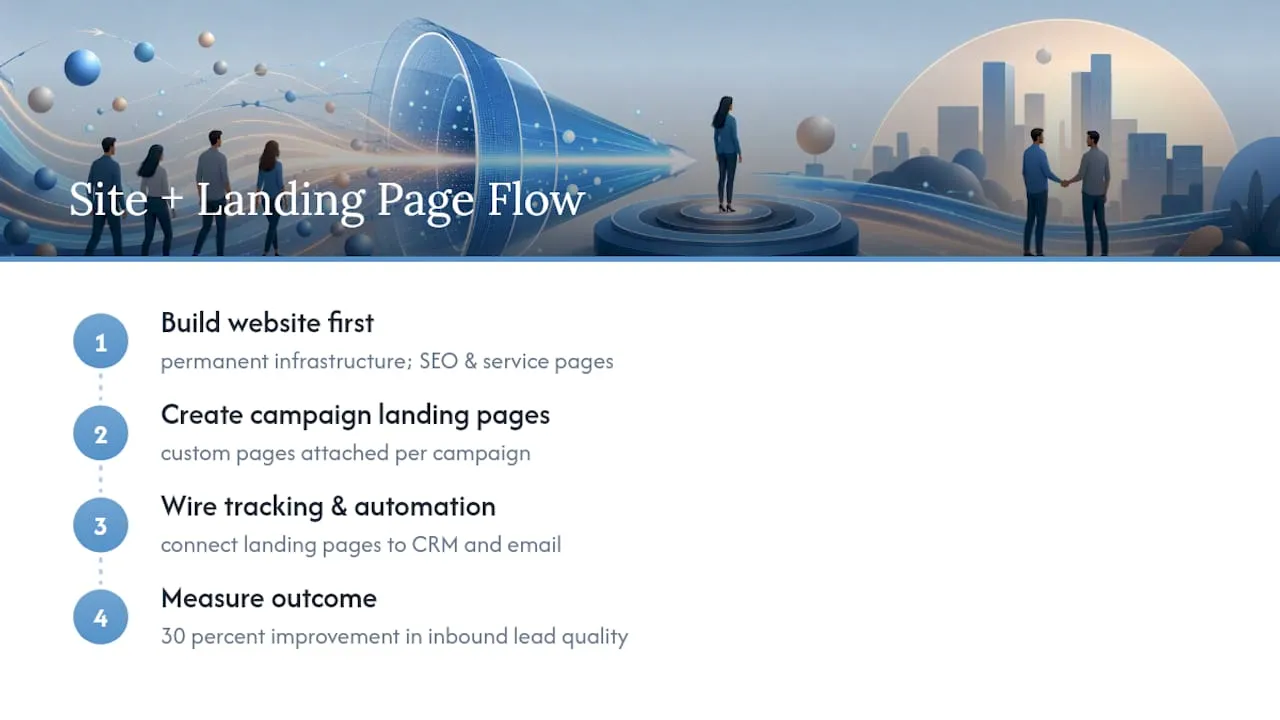
When a business has no site at all, Forefront Industries recommends website-first. When the site already exists and a specific campaign is underperforming, a targeted landing page gets built and connected to existing automation.
A quick diagnostic: if your ads are driving traffic to your homepage and conversion feels flat, that’s a landing page gap. If your organic traffic is thin and nobody finds you outside of paid spend, that’s a website gap.
- Jeremy
Ready to Fix Your Lead Generation Setup?
If your ads are bleeding budget into a homepage that was never built to close a single offer, that’s a fixable, specific problem. Custom-coded websites paired with conversion-focused landing pages and CRM automation on platforms can work as one integrated system instead of two disconnected projects.
The team has a background in enterprise CRM and lifecycle marketing applied to service businesses aiming to fix outdated systems losing leads. Whether you need a full site rebuild, a landing page attached to your next campaign, or both wired into a shared automation layer, the custom web development services page walks through what that build looks like. Start by requesting a consultation through Forefront Industries to get a specific read on whether your gap is a website problem, a landing page problem, or both.
Sources
- Do You Need a Website or a Landing Page? A Decision Guide for Paid Traffic | Leadpages Blog
- Difference between Landing Page and Website
- Landing Page vs Homepage: When Each One Actually Wins