CRM Implementation Cost in Florida: What to Budget in 2026

For a Florida service business with fewer than 100 employees, CRM implementation averages about $3,000. That is the cost of setting the system up, not the monthly software fee. Companies with 1,000 or more employees average $174,000 for the same job. Most Florida owners land at the low end of that range, but the final number depends on how clean your customer data is, how many other tools must connect, and how much of your daily workflow the system has to follow.
A CRM (customer relationship management system) is the place where every lead, call, email and job is recorded so nobody drops a follow-up. This guide explains what the setup price covers, what pushes it up, what you pay after launch, and how to build a budget you can defend. We are a Delray Beach web design studio that builds websites and CRM and email systems for service businesses, so the advice comes from that work.
TL;DR
- Implementation averages about $3,000 for businesses under 100 employees and $174,000 at 1,000+ employees, based on one national analysis. There is no separate Florida price list.
- The software license is only the start. Setup, data migration, training, connections to other tools and renewals make up the rest of the bill.
- Setup fees typically run 20% to 50% of the first-year license cost.
- Timelines run from about one month for a lean small business to 18 months for a complex enterprise.
- Messy customer data is the most common reason a CRM project goes over budget. Clean it before you ask for quotes.
Table of Contents
- What CRM implementation costs by company size
- What the price actually includes
- Why the same CRM costs one business $3,000 and another $30,000
- Configuring an existing CRM versus building one from scratch
- What you pay after launch
- How long implementation takes
- A worked example: a 10-person Florida contractor
- How to build your own CRM budget
- Perspective
- Where to start in South Florida
- Work with a Delray Beach web design studio
- FAQ
- Sources
What CRM implementation costs by company size
The most useful single predictor of price is headcount. The figures below come from ZoomInfo’s analysis of CRM implementation costs. They are national averages, so treat them as a starting range for a Florida quote, not a promise.
| Company size | Average implementation cost |
|---|---|
| Under 100 employees | About $3,000 |
| 1,000+ employees | About $174,000 |
| 10,000+ employees | About $450,000 |
| Enterprise rollouts with 100+ users | $180,000 to $420,000 total, including migration, training, customization and integration |
Most Florida service businesses sit in the first row: a roofing company in Fort Lauderdale, a med spa in Boca Raton, a real estate team in Miami, a law or dental practice in West Palm Beach. For a 10-person team, the same analysis puts the first-year cost between $3,000 and $15,000, and it suggests adding another 20% to 30% for training and data migration.
Two things to read into that range:
- The low end assumes a standard setup of an existing product with few custom fields and one or two connections.
- The high end is what happens when your process does not fit the product’s defaults and someone has to reshape one or the other.
What the price actually includes
A CRM budget has five parts. A good proposal lists each one separately. According to a CRM implementation white paper, these are the standard categories:
- Software licensing. The monthly or annual fee per user.
- Implementation services and consulting. Someone configures the system to match how you sell and serve customers.
- Data migration. Your existing contacts, deals and notes move from spreadsheets, email inboxes or an old CRM into the new one.
- Training. Your staff learn to use it the way it was built.
- Ongoing maintenance. Updates, fixes and changes as the business changes.
The same source names data quality problems as the most common driver of cost overruns. That matters for a small business. If your leads live in three places (a spreadsheet, a shared inbox and someone’s phone), consolidating them is real work, and it is billed by the hour.
The 10% cushion
Budget guides for CRM projects commonly recommend adding a contingency of about 10% on top of the quote, because each extra custom field or connection adds labor. Build that cushion into your number before you talk to anyone. It is easier than going back for approval halfway through.
Why the same CRM costs one business $3,000 and another $30,000
Four factors move the price more than anything else.
Data condition
Duplicates, missing phone numbers, old customers mixed with current ones and half-typed notes all have to be sorted before they go in. Clean data loads in hours. Messy data takes days of review.
Number of connections
Your CRM rarely works alone. It may need to receive form entries from your website, send follow-up emails, sync with your calendar or log calls. Each connection is another thing to set up and test. Analysts point to integration fees as one of the places budgets routinely overrun.
How custom your process is
If you follow the way the product is designed to work, setup is quick. If you have a three-step estimate approval, a referral partner program and different follow-up rules by service line, someone has to build that. Every “yes” to a custom requirement adds hours.
Number of users
More users means more licenses, more training and more permissions to set up. It also means the analysis above shows size as the strongest single predictor of total cost.
Configuring an existing CRM versus building one from scratch
There are two routes, and they are priced very differently.
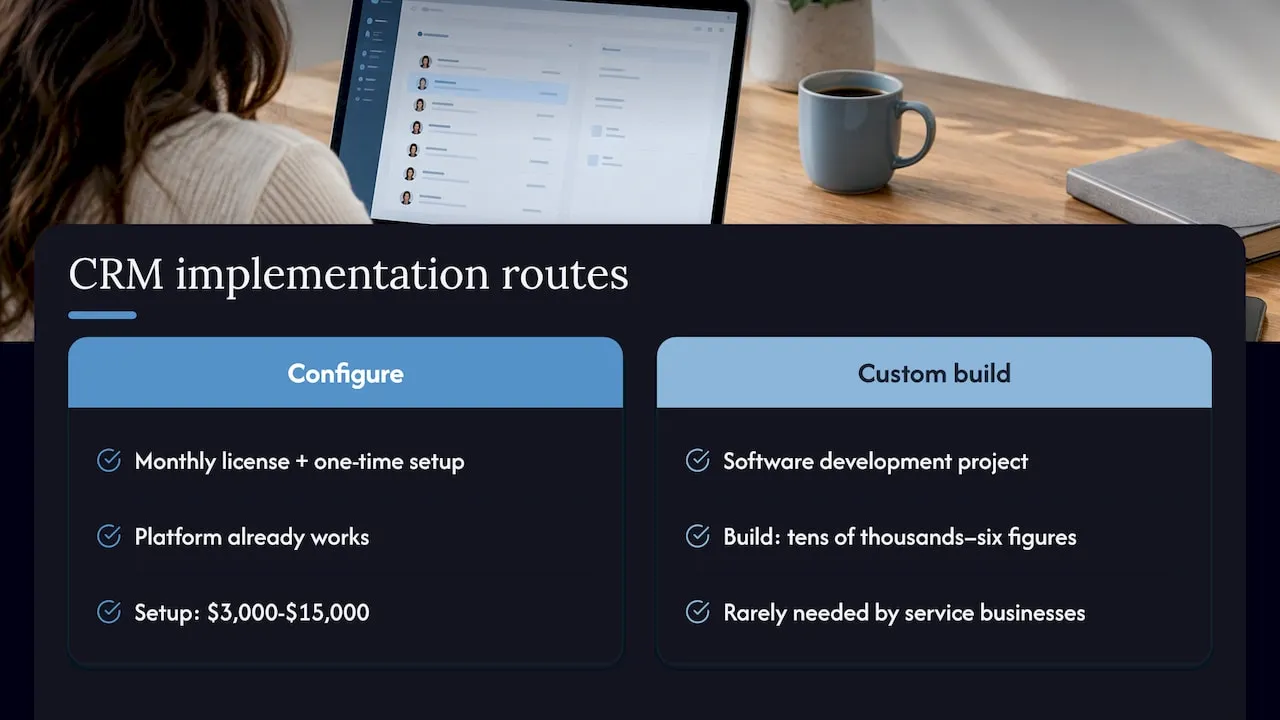
Configuring an existing platform. You pay a monthly license and a one-time setup. The platform already works. The setup work is organizing fields, stages, automations and email templates around your business. This is the right route for almost every service business in Florida, and it is where the $3,000 to $15,000 range above applies.
Building a custom CRM. Custom software is a different category of project. Published agency price guides for building a CRM from nothing start in the tens of thousands of dollars and rise to six figures for advanced systems. That is a software development project, and a service business with a normal sales process rarely needs one.
What many Florida businesses do need is the middle path: a proven platform, set up in a way that matches their actual workflow. That is what our email and CRM work covers. We build on platforms such as Salesforce Marketing Cloud and Braze, with modular email templates, lead routing and automated follow-up journeys. Our Delray Beach Email & CRM Development | Forefront Industries shows how that work is organized.
What you pay after launch
The setup invoice is not the last one. Plan for these recurring costs, all listed in the cost analysis:
- Annual renewals. These typically match the initial license cost.
- Extra users. Seats added in the middle of a contract can be billed at full list price.
- Storage overages. Large files, call recordings and long email histories can push you past your plan.
- Premium support tiers. Faster help costs more.
- Training for new hires. Staff turnover means repeat training.
The same analysis says setup and implementation fees typically run 20% to 50% of first-year license cost. If your first-year license is $6,000, a setup fee between $1,200 and $3,000 is in the normal range. That is a simple way to sanity-check a quote.
One more cost owners forget is the technology your team uses every day. A CRM only helps if laptops, logins and backups work. Fixed per-user pricing is how managed IT services for small businesses are commonly priced, which makes it easy to add to a CRM budget as one predictable line.
Your website is part of the system
A CRM is only as good as what feeds it. If your website form sends leads to an inbox nobody checks, the CRM sits empty. Website upkeep belongs in the same budget. Our website maintenance plans are published: Managed Hosting at $99 per month, Webmaster at $250 per month and Performance Plus at $750 per month.
How long implementation takes
Timelines in published implementation research range from about one month for a lean small business deployment to 18 months for a complex enterprise rollout. For a Florida service business with a single office and a handful of users, the short end is realistic when three things are true:
- You know your sales or service stages before the project starts.
- Your contact data is in one place and has been cleaned.
- One person on your side can make decisions quickly.
When those are missing, the project slows. The slowest part is almost never the technical setup. It is waiting for the owner to decide what a “qualified lead” is, or which of three duplicate records is the right one.
If you are moving off an existing system, plan the cutover carefully. Our CRM migration plan lays out the checkpoints before you switch over, and our CRM implementation cost guide goes deeper on how budgets are built.
A worked example: a 10-person Florida contractor
Take a general contractor in Boca Raton with 10 office and field staff. Leads come from the website, Google and referrals. Today they sit in a spreadsheet and a shared email inbox.
A realistic budget, using the ranges above:
| Line | Reasoning |
|---|---|
| First-year total | Within the $3,000 to $15,000 range for a 10-person team |
| Training and data migration | Add 20% to 30% on top |
| Contingency | Add about 10% |
| Renewal in year two | Plan for a license cost similar to year one |
That contractor should also decide, before the project starts, what the CRM must do on day one: capture website leads, assign each to a person, send an automatic reply, and remind staff to follow up. Anything beyond those four can be phase two. Starting small keeps the first invoice low and the system usable.
How to build your own CRM budget
Follow these steps before you ask anyone for a quote.
- List where your leads come from. Website forms, phone calls, Google Business Profile messages, referrals, ads. Each source is a connection.
- Count users. Include part-time staff who need to see customer records.
- Write down your stages. For example: new lead, contacted, estimate sent, booked, completed, review requested.
- Audit your data. Open the spreadsheet. Count duplicates and records with no phone or email. This is the single best way to predict migration cost.
- Decide what must be automated. Instant reply, lead assignment, follow-up reminders, review requests.
- Ask for itemized quotes. Setup, migration, training, licenses and renewal should each be a line.
- Add the cushion. Ten percent for contingency and 20% to 30% for training and migration if they are not already itemized.
When you bring this list to a quote conversation, you get comparable numbers instead of a single total you cannot test.
Perspective
Most of the CRM projects that go wrong in service businesses do not fail on software. They fail because the system was set up around a generic sales process and nobody on the team recognized their own business in it.
That is why we start with the workflow, not the platform. A lead comes in from your website, who gets it, how fast, what they say and what happens if nobody answers. Once that is written down, the setup is straightforward, and the price is easier to predict because the scope is clear.
We build custom-coded websites and the CRM and email systems behind them, so the form on your site and the follow-up that goes out afterward are designed together. For an owner, that means fewer calls wasted on people who were never going to buy.
If you are comparing quotes, ask each provider to explain in plain words what your team will do differently on the first Monday after launch. The best answer is a short, specific list.
Jeremy
Where to start in South Florida
If you run a service business in Delray Beach, Boca Raton, West Palm Beach, Fort Lauderdale or Miami, the starting point is the same: know what your website and your follow-up are doing today. We build web and CRM systems for businesses across the region, including Boca Raton, Fort Lauderdale, West Palm Beach and Miami.
Work with a Delray Beach web design studio
Forefront Industries is a Delray Beach web design studio. We build custom-coded websites, set up CRM and email systems on platforms such as Salesforce Marketing Cloud and Braze, automate lead routing and follow-up, and keep your site running afterward. Our services page lists everything we do, from web design and development to email and CRM development and AI automation.
If your leads are slipping through a spreadsheet, an inbox or an old system, start with the free website audit at forefrontindustries.io/website-audit.
FAQ
How much does CRM implementation cost for a small Florida business?
For a business under 100 employees, the average is about $3,000 for implementation, according to a national cost analysis. A 10-person team typically spends $3,000 to $15,000 in the first year including licenses. Add 20% to 30% for training and data migration.
How long does a CRM implementation take?
Research puts the range at one month to 18 months, with one month typical of a lean small business. Your timeline depends on data quality, how many tools connect to the CRM and how fast you make decisions. Cleaning your contact list first is the quickest way to shorten it.
Why do CRM projects go over budget?
The most common cause is data quality: duplicates, gaps and scattered records take extra labor to fix, as the implementation white paper notes. Other causes are extra connections, training, storage overages and mid-contract user additions. An itemized quote and a 10% cushion protect you from most of them.
What ongoing costs should I plan for after launch?
Expect annual license renewals, which typically match the first-year license cost, plus extra users, storage overages and any premium support tier. Setup fees alone typically run 20% to 50% of the first-year license, so keep that ratio in mind when you read a quote. Training for new hires also recurs.
Sources
- CRM Implementations Cost an Estimated $4.6 Billion: ZoomInfo cost analysis
- Transforming the CRM From a System of Record: implementation white paper
- Managed IT services for small businesses