Website Redesign Cost in 2026: What SMBs Should Budget

Most small-to-mid businesses should budget a moderate amount for a professional website redesign, with the typical range varying widely depending on specific needs. The range swings this wide because page count, integrations, and content readiness change the labor hours far more than design polish does.
Recommendation: Target the mid-tier band unless you have a specific reason to go cheaper or more custom.
That budget typically includes:
- A CMS-based redesign with 8 to 15 unique templates
- Core integrations (CRM, forms, analytics, basic SEO migration)
- Ninety days of post-launch support built into the quote
Key Takeaways
Most SMB website redesigns cost between $5,000 and $45,000, and the final number depends far more on integrations and content readiness than on visual design choices.
| Point | Details |
|---|---|
| Target the mid-tier band | Budget $15,000–$45,000 for a redesign with real integrations and post-launch support. |
| Watch for hidden exclusions | Copywriting, SEO migration, and photo licensing often aren’t included in the headline quote. |
| Match approach to stage | Use templates to validate, hybrid to differentiate, and custom code when ownership and integrations demand it. |
| Hold cash for year one | Reserve 15–20% of your build cost for hosting, maintenance, and security after launch. |
| Consider a custom partner for complex needs | Forefront Industries builds fully custom-coded sites for service businesses that need CRM-integrated redesigns, stronger conversion paths, and full code ownership. |
Table of Contents
- How Much Does a Website Redesign Cost by Business Size?
- What Drives the Price of a Website Redesign?
- How Is a Website Redesign Budget Broken Down?
- Should You Choose a Template, Hybrid, or Fully Custom Build?
- What Extra Costs Come With an E-Commerce Redesign?
- How Does Pricing Work: Fixed, Hourly, or Retainer?
- How Long Does a Website Redesign Take?
- How Can You Reduce Redesign Costs Without Losing Quality?
- How Do You Justify Redesign Costs to Stakeholders?
- What Does a Website Cost After Launch?
- What Questions Should You Ask Before Signing a Redesign Contract?
- When Does a Custom Agency Build Make Sense?
- Do Website Redesign Costs Vary by Region?
- What Hidden Costs Catch Businesses Off Guard?
- An Agency’s View on Cost, Quality, and Growth
- How Forefront Industries Prices Redesign Projects
- Sources
How Much Does a Website Redesign Cost by Business Size?
Three practical tiers cover almost every SMB scenario, and knowing which one you’re in prevents both overpaying and getting burned by a quote that’s missing half the work.
Entry/freelancer tier ($3,000–$12,000): A solo developer or small shop handles the build, usually on a proven CMS with limited custom coding. You get a handful of page templates, basic on-page SEO, and minimal QA. This tier fits a service business with a simple site structure and no complex integrations. According to Windmark’s 2026 breakdown, freelancer redesigns commonly land in this exact range, though support after launch is often limited to a few weeks.
Mid-tier agency ($15,000–$45,000): This is where most SMB redesigns actually happen. A small team runs discovery, custom design comps, a CMS build with 10 to 20 templates, standard integrations (email marketing, CRM, live chat), and a real QA pass across devices. Post-launch support usually runs one to three months.
Specialist/custom tier ($40,000–$120,000+): Reserved for businesses with complex integrations, custom-coded frontends, or conversion-critical funnels where a template genuinely can’t do the job. OxelLab’s pricing breakdown notes this tier includes fully custom interactions, deep CMS architecture, and dedicated QA cycles.
| Tier | Budget Range | Typical Timeline | Best Fit |
|---|---|---|---|
| Freelancer/entry | $3,000–$12,000 | 3–6 weeks | Simple brochure sites, single-location services |
| Mid-tier agency | $15,000–$45,000 | 8–20 weeks | Growing SMBs with lead-gen goals |
| Specialist/custom | $40,000–$120,000+ | 4–7 months | Complex integrations, enterprise CRM, high-stakes conversion |
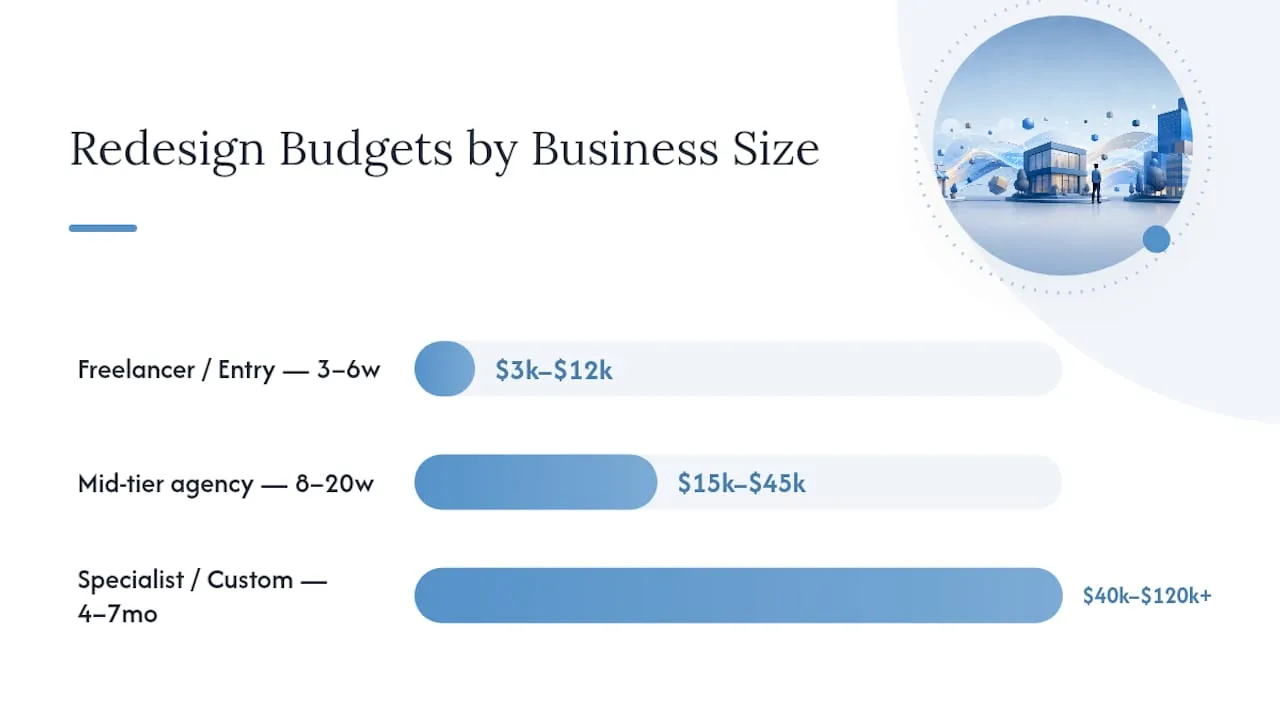
Notice the jump between tiers isn’t linear. Doubling your page count rarely doubles your price, but adding a single complex integration, like a custom CRM sync, can.
What Drives the Price of a Website Redesign?
The dollar figure on a quote comes down to a short list of variables, and most of them are things you actually control.
- Page count and unique templates. A 40-page site with five unique layouts costs far less than a 15-page site with 12 unique layouts. Unique design work is the real cost driver, not raw page count.
- CMS depth. A simple blog-and-pages setup is cheap. A CMS with custom content types, role-based permissions, or multi-language support adds real development hours.
- Integrations. Each connection to a CRM, booking tool, payment processor, or marketing platform adds testing time and ongoing maintenance risk.
- E-commerce functionality. Product catalogs, variants, and checkout flows multiply QA hours.
- Custom interactions and animations. Anything beyond stock component behavior requires custom front-end development.
- SEO migration risk. Moving a site with existing search rankings requires redirect mapping and structured data work that a from-scratch build doesn’t need.
OxelLab identifies seven specific factors that explain price spreads within the same tier, and content readiness is consistently underestimated. A business that shows up with polished copy and final images can shave weeks off a timeline and thousands off a quote.
Pro Tip: Ask for a written content-readiness assessment before you get a final quote. Agencies often pad estimates for content creation because clients rarely deliver final copy on time, and that padding can add 15 to 20 percent to the number you see first.
How Is a Website Redesign Budget Broken Down?
A responsible quote itemizes labor by phase, not just a lump sum. That transparency is what separates a quote you can negotiate from one you have to take on faith.

Typical allocation across a mid-tier project looks like this:
| Line Item | Typical Share of Budget | What It Covers |
|---|---|---|
| Discovery and strategy | 8–12% | Stakeholder interviews, competitive audit, sitemap |
| Design (wireframes + UI) | 20–25% | Wireframes, visual design, revision rounds |
| Development | 30–40% | CMS setup, templates, custom code, integrations |
| Content and migration | 10–15% | Copywriting, content entry, redirect mapping |
| SEO and performance | 5–10% | Metadata, schema, Core Web Vitals tuning |
| QA and launch | 5–8% | Cross-browser testing, staging review, go-live |
Forbes Advisor’s cost guide puts professional design starting around $1,500 on the low end, which lines up with the entry tier once you strip out development and content work.
When you request a quote, ask the agency to break it into these same categories rather than accepting a single number. Watch specifically for exclusions buried in the fine print: many quotes exclude copywriting, professional photography, stock licensing, and the redirect mapping work that protects your search rankings. Windmark’s analysis points out that these excluded items are exactly what turns a $15,000 quote into a $22,000 invoice by the time the project closes.
Should You Choose a Template, Hybrid, or Fully Custom Build?
A premium template gets you live fastest and cheapest, but you’re renting someone else’s structure. A hybrid approach (template foundation, custom components layered on top) balances speed against differentiation. Fully custom code costs the most and takes the longest, but you own every line of it and scale without fighting a theme’s limitations.
ProjectCostEstimator’s analysis found custom builds often run three to ten times a template approach, and the decision usually hinges on whether the remaining differentiation actually moves revenue.
- Choose a template when you’re validating a new offer or market and need to move in weeks, not months.
- Choose hybrid when your brand needs distinct visual identity but your functional needs are standard.
- Choose custom when integrations, conversion complexity, or ownership requirements make a template a long-term liability.
Run that math before you default to the cheapest option.*
What Extra Costs Come With an E-Commerce Redesign?
E-commerce redesigns carry cost drivers a brochure site never touches, and they’re the reason two “redesign” quotes can differ by $30,000 for what looks like the same scope on paper.
- Catalog size and complexity. Migrating 50 products is a few hours. Migrating 5,000 SKUs with variants is a project on its own.
- Payment gateway setup. Integrating Stripe, Shopify Payments, or a merchant processor adds configuration and compliance testing.
- Shipping and tax logic. Multi-region shipping rules and sales tax calculation require custom logic or a paid app.
- Subscription or B2B pricing. Tiered pricing, quote requests, and account-based catalogs add development time well beyond a standard cart.
- Inventory sync. Connecting your storefront to an existing inventory or ERP system is often the single most expensive integration on the project.
Beyond the build, budget for recurring platform and transaction fees. Most e-commerce platforms charge a monthly subscription plus a percentage per transaction, and payment processors add their own per-transaction cut on top. These recurring costs belong in your total cost of ownership calculation, not just your launch budget.
How Does Pricing Work: Fixed, Hourly, or Retainer?
Agencies typically price projects one of four ways, and knowing which model you’re being quoted under changes how you should negotiate.
- Fixed-price scope: A set price for a defined deliverable list. Best when scope is well understood and you want budget certainty.
- Time and materials: You pay for hours worked. Common when scope is likely to evolve, but it shifts risk onto you.
- Retainer: A recurring monthly fee for ongoing work, common for maintenance or continuous optimization rather than the initial build.
- Blended: Fixed price for the core build, hourly for scope additions.
A typical milestone schedule:
- 25–30% deposit at signing
- 25–30% at design approval
- 25–30% at development completion
- Remaining 10–20% at launch
How Long Does a Website Redesign Take?
A typical redesign moves through four phases: discovery (1 to 3 weeks), design (2 to 4 weeks), development (4 to 10 weeks), and launch (1 to 2 weeks). Total timelines usually run 8 to 20 weeks depending on scope.
- Content and asset delivery is the most common delay. Clients underestimate how long copywriting and photo sourcing take.
- Approval cycles slow projects when more than two stakeholders review each round.
- Third-party integrations (CRM, payment, custom APIs) frequently reveal scope surprises mid-build.
How Can You Reduce Redesign Costs Without Losing Quality?
Cutting your budget doesn’t have to mean cutting conversion performance. It means being deliberate about where you spend.
- Phase the project. Launch core pages first, add secondary features (blog, resource center) in a second release.
- Audit and reuse existing content. Rewriting everything from scratch costs more than editing what already ranks.
- **Choose a hybrid template approach for phase one, then invest in custom components once traffic validates demand.
- Reduce unique page templates. Consolidate similar page types into one flexible template instead of designing five near-identical layouts.
Pro Tip: Before requesting quotes, build a one-page scope document listing your must-have pages, integrations, and content status. Agencies quote faster and more accurately when they aren’t guessing at your scope, and that document alone can tighten quotes by thousands.
How Do You Justify Redesign Costs to Stakeholders?
The strongest budget conversations use dollar terms, not design language. Frame the ask around conversion rate, average order value, and customer lifetime value rather than “modern design.”
- Conversion lift: even a small percentage increase compounds against total site traffic.
- Lead value: multiply new leads generated by your average close rate and deal size.
- Customer lifetime value: a redesign that improves retention pays back over multiple years, not one quarter.
Sample calculation: If your site generates 1,000 monthly visitors converting at 2%, that’s 20 leads. A conversion lift to 2.6% (a common outcome cited across redesign benchmarking data) yields 26 leads, a 30% increase in monthly lead volume at no added ad spend.
Frame the investment as staged: propose a phased build so stakeholders see results before committing to the full budget.
What Does a Website Cost After Launch?
Launch day isn’t the finish line. Budget for hosting ($15 to $150 monthly depending on traffic and app needs), domain renewal, security monitoring, and a maintenance plan, according to Forbes Advisor’s cost data.
- Hosting and third-party apps may incur typical monthly costs within a broad range, varying by service and traffic needs.
- Maintenance and updates: $20–$100/month for basic plans, more for active development
- Security monitoring and backups: often bundled into maintenance retainers
A maintenance retainer generally beats ad-hoc hourly support because your site gets consistent monitoring instead of reactive fixes after something breaks.
What Questions Should You Ask Before Signing a Redesign Contract?
Run through this checklist on every vendor call before you sign anything:
- What exactly is included in this quote, line by line?
- Who owns the code and design files after the project ends?
- What’s the SEO migration plan, including redirects and schema?
- How many design revision rounds are included?
- What’s the testing process before launch?
- How is post-launch support scoped, and for how long?
- What triggers a change order and additional fees?
- What’s the payment schedule and deposit requirement?
- How is content migration handled, and by whom?
- What happens if the timeline slips on our end?
- Can we see a similar project’s actual final invoice versus original quote?
- What’s excluded from this price that we should budget separately?
A good answer names specifics. A vague answer to any of these is a warning sign.
When Does a Custom Agency Build Make Sense?
Custom development earns its price when integrations are genuinely complex, conversion performance directly drives revenue, or you need full code ownership rather than a rented template. Forefront Industries builds fully custom-coded sites for service businesses, with CRM and lifecycle marketing experience shaped by in-house enterprise work at Amazon across Ring, Blink, and Audible.
- You need CRM or lifecycle marketing systems integrated directly into the site experience
- Your current template is capping conversion performance, not just aesthetics
- You need to own your codebase outright rather than depend on a platform’s licensing terms
Do Website Redesign Costs Vary by Region?
Yes, and the swing is larger than most business owners expect.
That premium isn’t purely overhead. Metro agencies often carry deeper bench strength: senior developers, dedicated QA staff, and specialists in integrations that a two-person shop in a lower-cost market simply doesn’t staff. If your project needs custom CRM work or complex e-commerce logic, that premium buys real capability, not just a higher invoice.
Remote and distributed agencies complicate the picture further. A team based in a lower-cost region but staffed with senior talent can beat local pricing while matching quality, which is why geography alone shouldn’t be your deciding factor. What matters more is whether the team’s portfolio matches your project’s complexity.
If you’re comparing quotes across regions, normalize for what’s actually included rather than the sticker price alone. A $20,000 quote from a boutique agency in a competitive metro market might include a full SEO migration and three months of support, while a $15,000 quote from a lower-cost region might exclude both. Businesses in dense competitive markets, like Palm Beach or Boca Raton, often see this play out directly: higher local competition raises the bar for what “professional” needs to include, which pushes the realistic budget up even before custom features enter the conversation.
What Hidden Costs Catch Businesses Off Guard?
The number on the proposal is rarely the number on the final invoice. A few categories account for most of the gap.
Licensing fees are the most commonly missed line item. Premium themes, stock photo subscriptions, plugin licenses, and font licensing can add hundreds to thousands of dollars that a quote sometimes assumes you’ll handle separately.
Third-party app costs stack up fast. A booking widget, a live chat tool, a review aggregator, and an email marketing integration each carry their own monthly fee, often $15 to $50 apiece, that never appears in the build quote because it’s a separate subscription.
Training and handoff time gets skipped in cheaper quotes entirely. If your team needs to learn a new CMS, budget for training sessions or documentation, because an untrained team makes costly mistakes in the first few months after launch.
Extended support gaps are a quiet trap. Many quotes include 30 or 90 days of free support, then jump straight to hourly billing with no warning about the rate. Ask for that rate in writing before you sign.
SEO migration shortfalls cause real damage. Skipping redirect mapping, sitemap updates, or schema markup during a platform switch can cause a measurable traffic drop post-launch, and fixing that after the fact costs more than doing it right the first time.
An Agency’s View on Cost, Quality, and Growth
The biggest mistake we see is business owners chasing the lowest quote without asking what’s excluded from it. The cheapest bid almost always defers cost to later, either through hourly overages or a rebuild in eighteen months. The smarter move is matching team size to actual complexity: don’t hire a specialist shop for a five-page brochure site, and don’t hand a CRM-dependent lead-gen engine to a freelancer working nights and weekends.
How Forefront Industries Prices Redesign Projects
Forefront Industries prices by scope, not by hours logged, which means you know your total investment before development starts, not after. We work in three models depending on what you need: fixed-scope for a defined redesign, phased engagements for businesses that want to launch core pages first and expand later, and retainer arrangements for ongoing CRM and automation work after launch.
Every engagement starts with a scoping call where we map your integrations, content status, and growth goals before quoting a number, so there’s no guessing about what’s included. If you’re weighing whether your business needs a custom-coded site or a CRM system that actually talks to your marketing stack, start with a scoping conversation about custom web development and get a scope-based number instead of a rough estimate.
Sources
- How Much Does a Website Redesign Cost? (2026 Breakdown) - Windmark
- Custom Website Cost Real 2026 Pricing, $10K–$100K - ProjectCostEstimator
- How Much Does a Custom Website Cost in 2026? Real Pricing Breakdown - OxelLab Blog