3 Ready Reengagement Sequences for Marketers: Swipe Lines & CAN-SPAM

A reengagement email campaign is a short, triggered series that reconfirms opt-in interest and measures whether a quiet contact will return before you suppress them. The starting tactic we recommend is a staged sequence: two or three plain messages, a clear call to action, a visible opt-out, and a tracked reactivation metric. CAN-SPAM guidance and deliverability best practice both support this structure, and it matches how we build lifecycle systems for service-business clients at Forefront Industries.
TL;DR:
- Reengagement campaigns should be run between 60 and 180 days of inactivity, depending on your send frequency and industry.
- Segments should distinguish near-inactive contacts from long-term nonresponders and lapsed buyers to tailor messaging effectively.
- A staged sequence of three to four emails with clear, small asks generally outperforms a single message, especially when escalated based on responder behavior.
- Subject lines that evoke curiosity or warmth perform better, and body copy should focus on reminders of value, simple asks, and single clear calls to action.
- Always implement pre-send hygiene checks like list cleaning, authentication, and seed testing to ensure legal compliance and optimal deliverability.
Table of Contents
- Understand reengagement campaigns: goals and expected outcomes
- Identify and segment inactive contacts
- Design the reengagement sequence: templates for cadence and triggers
- Write email copy that reactivates: subject lines, preview text, body and CTAs
- Offers, incentives and alternative asks
- Deliverability and legal pre-send checklist (CAN-SPAM + technical hygiene)
- Examples and a subject-line swipe file
- When to stop: suppression, reconfirmation and archive rules
- Jeremy’s practitioner perspective
- How Forefront Industries can help run reengagement campaigns
- FAQ
- Sources
Understand reengagement campaigns: goals and expected outcomes
A reengagement campaign is not an acquisition push. It targets people already on your list who stopped opening, clicking, or buying, and it exists to answer one question: does this contact still want to hear from us? That answer determines whether you keep mailing them or move them to suppression.
Most marketers run reengagement sequences on a schedule tied to typical open windows, commonly somewhere between 60 and 180 days of no activity, though the right window depends on your send frequency and industry. A retailer that emails daily defines inactivity faster than a B2B firm that emails monthly.
Before launch, decide what you are measuring:
- Open rate: confirms the message reached an inbox and got noticed.
- Click rate: shows real interest beyond a glance.
- Conversion: purchase, reply, or account login, the real signal of reactivation.
Deliverability best practice recommends a staged, gradual approach rather than one blast to the whole inactive segment, since that protects your sender reputation while you test what actually revives engagement.
Identify and segment inactive contacts
Not every quiet contact is equally dead. Treating them the same wastes sends and risks your domain reputation.
- Near-inactive: no opens or clicks in roughly 60 to 90 days. These contacts respond best to a light nudge.
- Long-term inactive: 6 to 12 months or more with no engagement. These need a stronger message and a clear exit path if they stay silent.
- Lapsed buyers: no purchase within a defined window even if they still open emails. They need a different message than someone who never engages at all.
Build these segments using engagement scoring (a composite of opens, clicks, and site visits) alongside last-click and last-purchase dates. Behavioral signals outside email, like app logins or site sessions, often catch activity that email metrics miss entirely.
Before sending anything, clean the list: remove hard bounces, suppress role-based addresses like info@ or sales@, and confirm your authentication records are in place. HubSpot’s reengagement framework starts with exactly this preparation step before any message goes out, because sending to a dirty segment undermines the whole campaign.
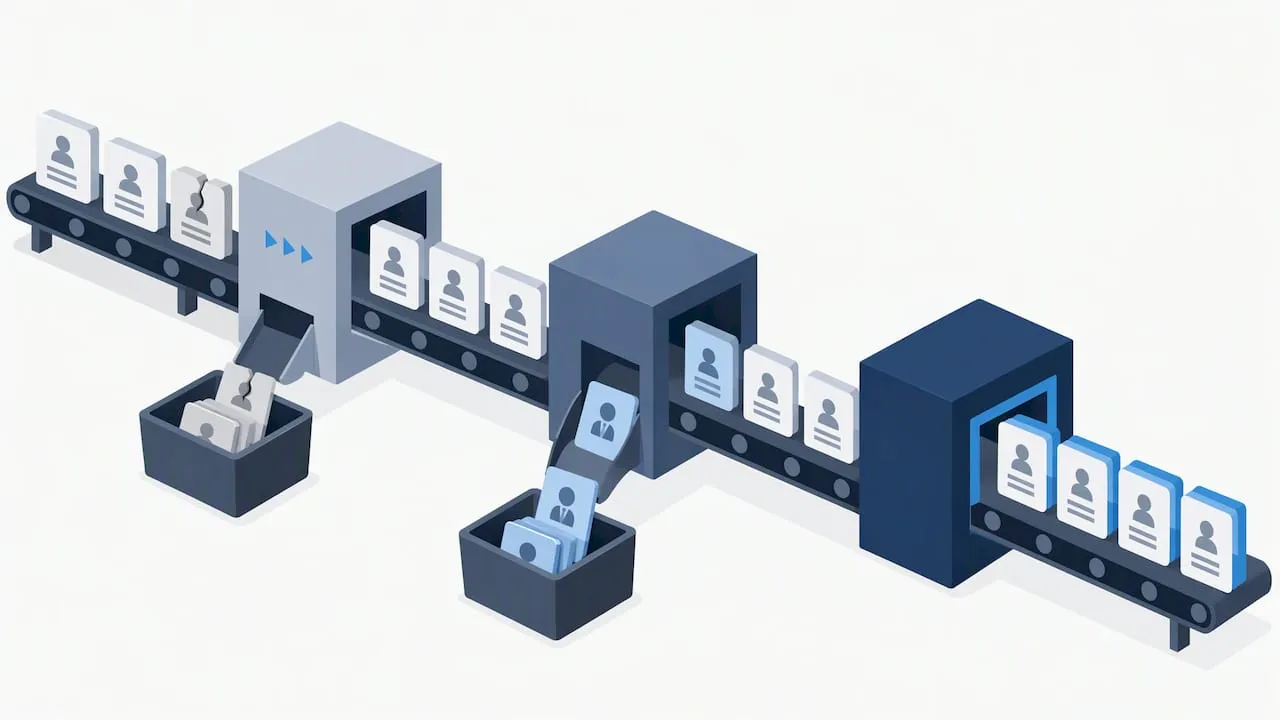
Pro Tip: Pull your segment lists a few days before launch, not the morning of, so you have time to spot-check for obvious data errors.
Design the reengagement sequence: templates for cadence and triggers
A sequence works better than a single email because it gives contacts more than one chance to respond without overwhelming their inbox. Three structures cover most use cases.
- Light nudge (3 emails, 7 to 10 days apart): simple check-in, a value reminder, then a final “still want to hear from us?” message with an opt-out link. Best for near-inactive segments.
- Offer-led comeback (3 emails, 5 to 7 days apart): value reminder, then a discount or incentive, then a last-chance version of the same offer. Best for lapsed buyers where lost revenue justifies the cost.
- Enterprise or B2B high-touch (4 touches over 3 to 4 weeks): a product-update email, a relevant case note, a personal outreach trigger for sales, and a preference-center invite. Best for long-term inactive accounts with real deal value.
Escalate to an offer only after a no-offer message fails to move the contact. Route persistent non-responders to a preference center before you suppress them entirely. Test subject lines, send timing, and offer versus no-offer variants separately rather than changing several elements at once, so you know which change moved the needle.
Write email copy that reactivates: subject lines, preview text, body and CTAs
Subject lines for reengagement tend to fall into four buckets: a direct question (“Still interested?”), a “we miss you” statement, a plain update (“Here’s what’s new”), or an incentive tease. Across a large sample of real reengagement emails, the length of subject lines often runs around three dozen characters, and most avoid the literal phrase “re-engagement” in favor of curiosity or warmth, according to NitroSend’s collection of 396 examples. Short, human phrasing outperforms anything that reads like a system-generated label.
Preview text should extend the subject line rather than repeat it. If the subject asks a question, the preview can hint at the answer or add a reason to open.
Body copy follows a simple formula:
- Remind them of the value they originally signed up for, in one sentence.
- Reduce friction by making the ask small (one click, one reply).
- Use a single CTA, not three competing buttons.
- Design mobile-first, since most inbox opens happen on a phone.
- Add a personalization token (first name, last product viewed, last visit date) where your data supports it accurately.
Offers, incentives and alternative asks
Whether to lead with a discount depends on what you are trying to recover. High-value lapsed buyers often justify an incentive because the revenue at stake outweighs the margin cost. Low-cost acquisition segments rarely need one; a value reminder alone often does the job.
Non-offer alternatives work well and cost less:
- Preference center invite: let contacts choose frequency or topics instead of unsubscribing entirely.
- Product or feature update: reminds them why they signed up without discounting anything.
- Account summary: shows usage, savings, or activity data that re-establishes relevance.
Offers affect both lifetime value and deliverability. A contact who only returns for discounts trains your list to expect them, which compresses future margins. When data suggests dollar amounts outperform percentage discounts for your audience, use the dollar figure.
Deliverability and legal pre-send checklist (CAN-SPAM + technical hygiene)
A few checks before launch protect you from both legal exposure and spam-folder placement.
- Clear opt-out mechanism: every commercial email needs one that works.
- Valid postal address: required in every message, not just the first.
- Honor opt-outs fast: the CAN-SPAM Act requires processing opt-out requests within 10 business days, with no fee or extra step demanded of the contact.
- Authentication records: SPF, DKIM, and DMARC all need to be correctly configured, not just present.
- Warm the sending domain or IP gradually rather than blasting a large inactive segment all at once.
- Run a seed list test before the real send to catch spam-folder placement early.
For messages that mix transactional and promotional content, the Federal Register’s CAN-SPAM rule sets a primary-purpose test: if the subject line or early body reads as promotional, the whole message is treated as commercial and must meet commercial-message requirements, including the opt-out and postal address rules above.
Examples and a subject-line swipe file
Real reengagement subject lines cluster into a few reliable patterns, each suited to a different moment in the sequence.
- We-miss-you: “It’s been a while, how have you been?”
- Curiosity: “Did we do something wrong?”
- Offer-led: “Come back for 20% off, just for you.”
- Preference-check: “What would you like to hear from us about?”
Three short templates cover most needs. A no-offer nudge: “Hi [First Name], we noticed you haven’t opened our emails in a while. Here’s what you might have missed: [recent update]. Still want these in your inbox?” An offer-led comeback: “We miss you, [First Name]. Here’s [$10 / 20%] off your next order, good through [date].” A preference center: “Want fewer emails, or different topics? Tell us what works for you: [link].” For a larger pool of real examples, NitroSend’s collection and ReallyGoodEmails’ reactivation gallery both offer further inspiration.
When to stop: suppression, reconfirmation and archive rules
Every reengagement sequence needs a defined exit, or it just keeps mailing people who will never respond.
- Run the staged sequence described earlier and track who opens, clicks, or converts at each step.
- Send one final reconfirmation to anyone who hasn’t responded, asking them to confirm they still want to hear from you, with a dedicated landing page that records the consent timestamp.
- Move non-responders to a long-term hold, often around one year, or suppress them permanently depending on your list policies, following the staged suppression approach deliverability guidance recommends.
Archiving versus deleting is a judgment call: archived records support future win-back attempts, but every address you keep carries a small ongoing cost in storage and risk if it’s ever reactivated carelessly.
Jeremy’s practitioner perspective
Staged reengagement only works when it’s wired into the same system that runs your lifecycle automation, not bolted on as a side project. At Forefront Industries, we build email, CRM, and web infrastructure as one connected system so reactivation lift shows up in the same reporting as every other campaign, not in a separate spreadsheet nobody checks.
- Jeremy
How Forefront Industries can help run reengagement campaigns
Running a reengagement sequence well requires more than copy. It requires a CRM that segments correctly, automation that triggers on the right signals, and a site that converts once someone clicks back in. We build all three as one system rather than stitching together disconnected tools.
Our relevant services include:
- Email & CRM Development: building the segmentation logic and sequences described here directly into your platform.
- AI Automation & Consulting: automating segment updates, suppression rules, and trigger logic so nothing relies on manual list pulls.
- Website Maintenance: keeping the landing pages and preference centers your sequences link to fast and current.
If your current setup can’t support staged sequences or clean segmentation, see our services and get a direct read on what rebuilding that infrastructure would involve.
FAQ
What is a reengagement email campaign?
A reengagement email campaign is a short, triggered series sent to contacts who have stopped opening, clicking, or buying, designed to reconfirm their interest before you suppress them. It typically combines a value reminder, a clear call to action, and a visible opt-out across two or three messages.
How do I write a reengagement email?
Start by reminding the contact of the value they originally signed up for, keep the ask small, and use a single clear call to action. Pair a short, human subject line (questions and “we miss you” phrasing both test well) with mobile-first body copy and one personalization token where your data supports it.
What is the 30 30 50 rule for cold emails?
This isn’t a standard, documented email marketing rule, and definitions of it vary depending on the source. Rather than rely on an unverified formula, focus on the tested fundamentals covered here: clean segmentation, staged sends, and a clear opt-out on every message.
What is the 60 40 rule in email?
Like the 30 30 50 rule, this isn’t an established industry standard with a consistent definition. For reengagement specifically, the more reliable guidance is a staged approach, light nudge first, escalate to an offer only if needed, documented in deliverability best practice.
Sources
- CAN-SPAM Act: A Compliance Guide for Business | Federal Trade Commission
- Re-engagement best practices | Adobe Experience Cloud
- Re-engagement email examples: 58 real emails and subject lines - NitroSend
- Run a re-engagement email marketing campaign - HubSpot Knowledge
- Definitions and Implementation Under the CAN-SPAM Act - Federal Register