Email Consent Management: U.S. Marketers Need More Than a Yes

Consent management for email means three things: capture clear opt-in, record proof of that opt-in with purpose and source, and honor opt-outs without delay. CAN-SPAM does not require prior consent for commercial email, but it does require accurate headers, a working unsubscribe link, and opt-outs honored within 10 business days. Check your opt-in wording, test your opt-out link, and confirm an audit log exists before you send another campaign.
TL;DR:
- Keep transactional permission separate from marketing, and give product updates, partner offers, and event invitations distinct consent flags so each campaign matches the subscriber’s purpose.
- Use single opt in for low risk, high volume signups when speed matters; choose double opt in when list quality and deliverability matter more.
- Store each consent as an event with its timestamp, source, exact form version and wording, capture method, message purpose, and lawful verification details.
- For European Union residents, GDPR generally requires specific prior opt in; store jurisdiction with purpose so domestic opt out rules do not govern every subscriber.
- Consider a consent platform when you manage multiple channels or purposes, or face audit pressure; a single email tool and purpose can often suffice.
Table of Contents
- What consent management is and why it matters for email
- Email rules and legal baseline that marketers must follow
- How to collect valid email consent through forms and microcopy
- Documenting, storing, and enforcing consent for auditability
- When to adopt a consent management platform versus in-house recording
- Forefront Industries’ practitioner perspective on consent in lifecycle systems
- How GDPR and other international rules affect U.S. email programs
- Best practices for segmenting email lists by consent level
- Managing consent across multi-channel campaigns that include email
- What most consent advice gets wrong
- Building consent-ready email and CRM systems with us
- FAQ
- Sources
What consent management is and why it matters for email
Consent management is the practice of linking a specific permission to a specific purpose, then keeping proof of that link. It covers who agreed, to what, when, and through which channel. A consent record without a purpose attached is not useful for compliance or for marketing operations.
Consent and preference management solve different problems. Consent is the legal permission to contact someone; preferences are the operational settings, such as frequency, topic, or channel, that a subscriber sets once consent exists. Treating the two as one field creates confusion when a subscriber wants fewer emails rather than none at all.
Clean consent records reduce spam complaints and support better inbox placement, since mailbox providers weigh engagement and complaint rates heavily. Strong consent practices also give a business a defensible position if a regulator or a subscriber disputes how an address ended up on a list.
- Consent ties a permission to a purpose and a timestamp, not just a yes or no.
- Preferences govern frequency and topic once consent is already established.
- Lower complaint rates from engaged, consenting subscribers tend to support better deliverability.
Email rules and legal baseline that marketers must follow
CAN-SPAM sets the floor for commercial email in the United States, and it applies whether or not a recipient gave prior consent. The core obligations are consistent regardless of list size or industry:
- Headers must accurately identify the sender, with no misleading “From,” “To,” or routing information.
- Subject lines cannot be deceptive about the message’s content.
- Every message needs a valid physical postal address.
- A clear, easy opt-out mechanism must appear in every commercial message.
- Opt-outs must be honored within 10 business days, and the mechanism must keep working for at least 30 days after the message was sent.
One figure worth keeping on a checklist: the FTC requires opt-outs to be processed within 10 business days, which means suppression updates cannot wait for a quarterly list cleanup.
Affirmative consent changes less than many marketers assume. The FTC’s own guidance on CAN-SPAM questions clarifies that consent mainly affects a narrow labeling requirement in some cases, not the core duties. Accurate sender identification, a valid postal address, and a working unsubscribe link remain mandatory even when a subscriber opted in affirmatively. The full text of the CAN-SPAM Act lays out these sender obligations and the penalties for deceptive practices.
A practical compliance checklist for any sending team: verify the postal address on every template, confirm the unsubscribe link resolves correctly on mobile and desktop, route opt-out requests to suppression within days rather than weeks, and keep subject lines aligned with message content.
How to collect valid email consent through forms and microcopy
Valid consent starts with how the request is presented, not just whether a checkbox exists. A checkbox pre-checked by default is not affirmative consent; the subscriber has to take the action themselves.
- Separate consent controls from account creation or purchase steps so agreeing to email isn’t bundled with agreeing to terms of service.
- Leave every consent checkbox unchecked by default and require an active click.
- Label each purpose plainly: “Send me product updates” reads differently than “Send me partner offers.”
- Choose single opt-in for low-risk, high-volume signups like content downloads, and double opt-in for lists where deliverability and list quality matter more than speed.
- Confirm the double opt-in email states clearly what the subscriber is confirming, not just “click to verify.”
Single opt-in adds a contact to the list the moment they submit a form. Double opt-in requires a second confirmation click before the address becomes active, which filters out typos, bots, and people who never really intended to subscribe. Deliverability guidance from Spamhaus favors confirmed opt-in because it produces lower complaint rates and cleaner engagement data over time.
Consent capture varies by channel: a web form logs a URL and timestamp automatically, an API-based signup needs the same metadata passed explicitly by the integrating system, an in-person signup needs a digital record created at the point of entry rather than days later, and an imported list needs a re-permission campaign before it’s treated as consented at all.
Pro Tip: Write consent checkboxes as a direct sentence addressed to the subscriber, such as “Yes, send me the weekly product digest,” rather than a vague “Subscribe to updates.”
Documenting, storing, and enforcing consent for auditability
A consent record only holds up under scrutiny when it captures enough detail to reconstruct exactly what happened at the moment of opt-in. The record should function like an event log, not a single field that gets overwritten.
- Timestamp of the consent action, recorded in a consistent time zone across systems.
- Source URL or touchpoint where the consent was captured, such as a specific landing page or in-person form.
- Form version and a snapshot of the exact copy shown to the subscriber at that time.
- Method of capture: web form, API, imported list, or point-of-sale.
- Purpose granted, mapped to a specific message category rather than a generic “marketing” flag.
- IP address and user agent where lawful to collect, supporting later verification.
Purpose-level consent matters because a subscriber who agreed to transactional receipts has not agreed to promotional campaigns. Mapping each consent record to a message category, rather than one blanket flag, lets a marketing team send relevant content without overstepping what was actually granted.
Global suppression lists enforce opt-outs across every tool that touches an address. Once someone unsubscribes, that status needs to propagate to the CRM, the email service provider, and any automation platform within the window CAN-SPAM requires, and that suppression needs to persist for as long as the business is obligated to retain it. A webhook or API connection between the consent store and the sending platforms keeps that sync real-time instead of batch-dependent, which matters most when a subscriber unsubscribes from one campaign tool while another system keeps sending.
When to adopt a consent management platform versus in-house recording
A consent management platform centralizes what otherwise lives in scattered spreadsheets and ESP tags. It typically includes a centralized consent store, APIs and webhooks for real-time updates, a user interface for banners and capture forms, audit logs, and version control on consent language.
Before adopting one, confirm the integration requirements with existing systems:
- Bi-directional sync between the CRM and the email service provider, so a change in either place reflects everywhere.
- Enforced suppression that blocks sends to opted-out addresses regardless of which tool initiated the campaign.
- Consent purpose mapping that aligns with how marketing segments and sends messages.
A few signals suggest a dedicated platform is worth the investment: sending across more than two or three channels, managing multiple consent purposes per subscriber, or facing audit and regulatory pressure that a spreadsheet can’t satisfy. A business running a single email tool with one purpose category can often manage consent fields directly inside the ESP or CRM without adding another system.
Pro Tip: If your team can’t answer “when did this person consent and to what” in under a minute, that’s the clearest sign your current setup needs a dedicated consent store.
Forefront Industries’ practitioner perspective on consent in lifecycle systems
When we build CRM and email architecture for service businesses, consent fields get mapped directly into the lifecycle journeys that trigger messages, not bolted on afterward. A purpose-level consent flag tied to a journey step means a transactional confirmation and a promotional nurture sequence pull from different permission records, which keeps suppression logic consistent across Salesforce Marketing Cloud, Braze, or whatever platform a client runs.
Our background building lifecycle systems for enterprise clients, including Amazon and Verizon, shapes how we structure these records: immutable, timestamped, and versioned so a compliance review doesn’t turn into a reconstruction project.
- Jeremy
How GDPR and other international rules affect U.S. email programs
Readers who only send to U.S. addresses still run into international rules the moment a subscriber signs up from outside the country or a parent company operates across borders. GDPR applies to the personal data of people in the European Union regardless of where the sending company is based, and it sets a higher consent bar than CAN-SPAM: consent generally has to be specific, informed, and freely given before most marketing emails go out, not just before the address becomes active.
That gap matters operationally. A U.S. business relying on CAN-SPAM’s opt-out model can still violate GDPR if it emails EU residents without prior opt-in. The practical fix is building consent records flexible enough to store jurisdiction alongside purpose, so a European subscriber’s record can require the stricter opt-in standard while a domestic one follows CAN-SPAM’s opt-out framework.
Other markets layer on their own requirements, and a single global “consent” flag can’t account for differences in retention periods, withdrawal mechanics, or what counts as a valid record. The safer approach is to treat jurisdiction as another dimension in the consent record, alongside purpose and timestamp, and apply the strictest applicable standard when a subscriber’s location is unclear. For a business operating primarily in the United States, this mostly affects any list segment that includes international sign-ups, trade show leads, or global SaaS customers rather than a purely domestic customer base.
Best practices for segmenting email lists by consent level
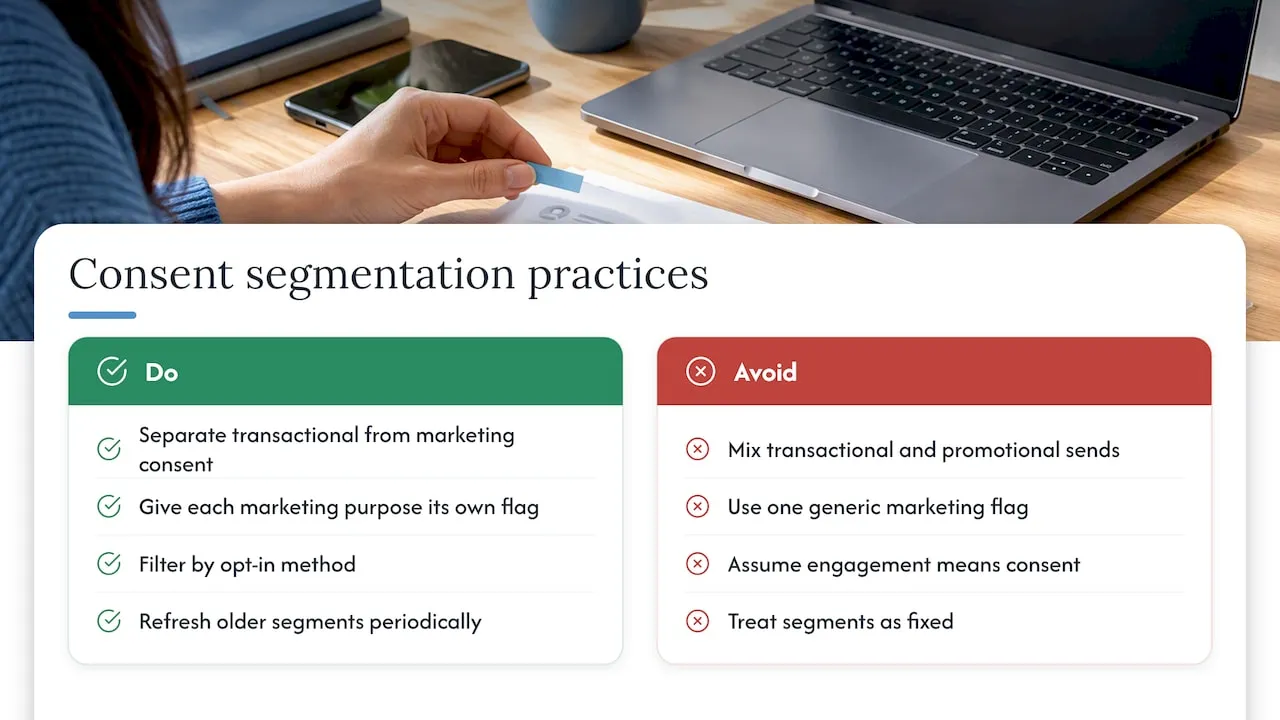
Segmenting by consent level means separating subscribers by what they actually agreed to, not by assumed engagement. A list built this way prevents a transactional-only subscriber from landing in a weekly promotional send.
Start with the broadest distinction: transactional versus marketing consent. Transactional messages, like order confirmations, generally don’t require the same opt-in as promotional campaigns, so mixing the two into one send list risks emailing people who never agreed to marketing content.
Within marketing consent, split further by purpose: product updates, promotional offers, partner communications, and event invitations each deserve their own flag rather than a single “marketing” checkbox. A subscriber who wants product updates but not partner offers should never see a partner campaign because the system only checked one generic field.
Layer in opt-in method as a secondary filter where deliverability matters most. A segment built from confirmed double opt-in addresses tends to show lower complaint rates than one built from single opt-in or imported contacts, which makes it a reasonable candidate for higher-frequency sends. Addresses captured through single opt-in or list imports warrant more conservative frequency until engagement data builds confidence.
Review consent segments on a schedule rather than treating them as fixed. A consent refresh campaign, sent periodically to older segments, confirms continued interest and lets a business retire addresses that no longer engage, which keeps both compliance posture and sender reputation intact over time.
Managing consent across multi-channel campaigns that include email
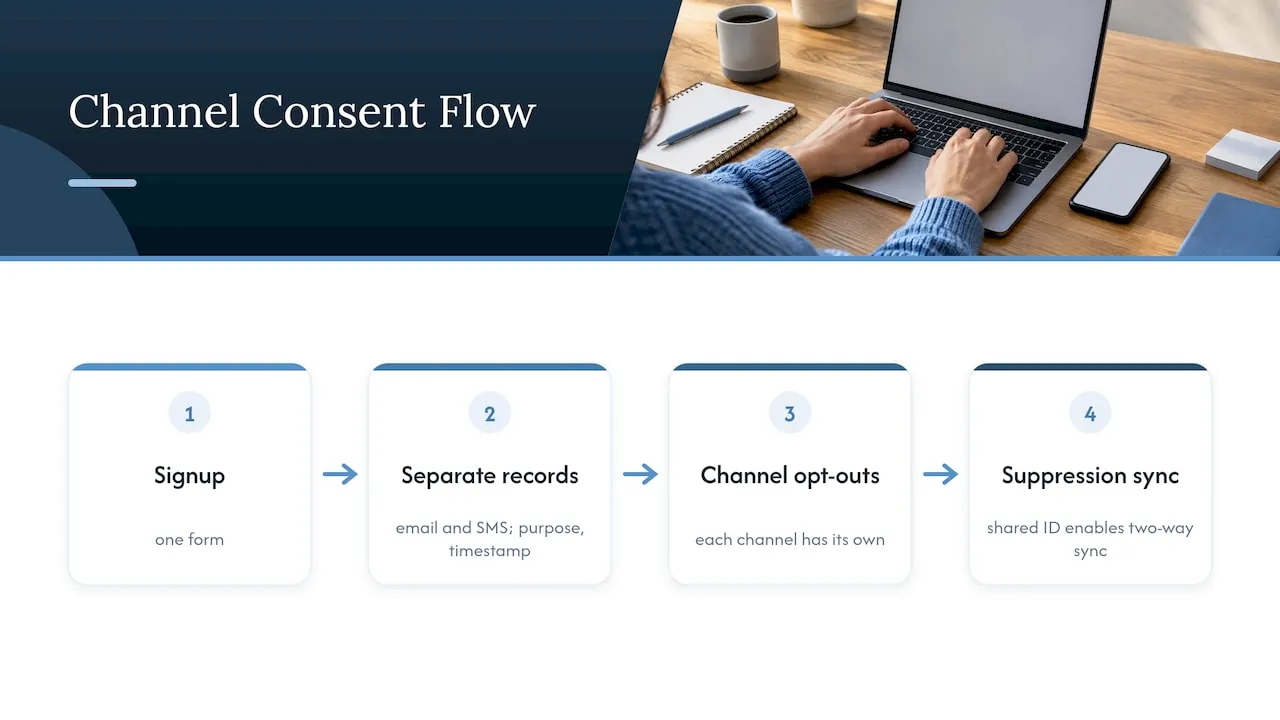
A campaign that spans email, SMS, and paid social retargeting needs consent tracked per channel, because agreeing to one does not imply agreement to another. A subscriber who opts into email updates hasn’t automatically consented to text messages, even when both come from the same signup form, unless the form made that scope explicit.
The practical fix is a consent record structure that stores channel as its own field alongside purpose and timestamp. A single signup event might generate two separate consent records, one for email and one for SMS, each with its own opt-out mechanism and its own suppression list. When a subscriber opts out of email, that action shouldn’t silently cancel their SMS consent, and the reverse holds too.
Coordination between channels matters most at the suppression layer. If a CRM manages email consent but a separate SMS platform manages text consent, the two systems need a shared identifier, like email address or customer ID, so an opt-out in one channel doesn’t get missed when building an audience for the other. Running these channels through platforms with bi-directional sync, rather than exporting static lists between tools, reduces the chance that an outdated segment gets reused in a later campaign.
Paid social retargeting built from an email list carries its own consent question, since uploading a hashed list to an ad platform still constitutes processing a contact for marketing purposes. The safer approach treats retargeting as its own purpose requiring its own consent flag, rather than assuming email marketing consent extends to every channel built on top of that same list.
What most consent advice gets wrong
Most consent guidance treats compliance as a one-time checkbox problem: add an unsubscribe link, store a yes or no, move on. That framing misses the operational reality. Consent decays, purposes multiply, and systems drift out of sync unless someone owns the record as an active dataset rather than a form field filled in once at signup.
The bigger gap is that CAN-SPAM’s opt-out model lulls U.S. marketers into underbuilding their consent infrastructure, right up until a GDPR-covered subscriber, a multi-channel campaign, or an audit exposes the gap. Teams that build purpose-level, versioned consent records from the start spend far less time reconstructing history under pressure than teams retrofitting it after a complaint.
If there’s one priority worth acting on before anything else, it’s this: stop treating consent as a boolean. A single “subscribed: yes” field cannot answer what a subscriber agreed to, when, or through which channel, and that question is exactly what a regulator, a partner, or your own deliverability team will eventually ask.
- Jeremy
Building consent-ready email and CRM systems with us
We build the infrastructure that makes consent operational rather than aspirational: custom Email & CRM Development that wires purpose-level consent fields directly into your lifecycle journeys, AI automation that keeps suppression lists synced across platforms in real time, and ongoing Website Maintenance that keeps your capture forms and opt-out links working as intended.
A typical engagement starts with an audit of your current consent fields and sync gaps, moves into building the consent store and CRM/ESP integration, and continues with monitoring once the system is live.
- Audit existing consent fields, forms, and suppression logic across your CRM and ESP.
- Build versioned, purpose-level consent records tied into your lifecycle automation.
- Monitor sync accuracy between systems so opt-outs enforce everywhere, not just in one tool.
If your current setup can’t tell you when a subscriber consented or to what, our website maintenance plans start at $99 a month for Managed Hosting, with Webmaster and Performance Plus tiers available for teams that need deeper ongoing support.
This article is general information, not a substitute for advice from a qualified lawyer. Consult a qualified legal professional about your own circumstances before acting on anything here.
FAQ
How do you write a consent email?
A consent email, typically sent as a double opt-in confirmation, states plainly what the subscriber is agreeing to receive and includes one clear action to confirm. Keep the purpose specific, such as “confirm your subscription to our product updates,” rather than a generic “click to verify,” and include a visible way to decline.
Can written consent be by email?
Yes, an email confirmation click or a reply can serve as a documented record of consent, provided the system logs the timestamp, source, and purpose tied to that action. The FTC’s CAN-SPAM guidance does not mandate this record for every commercial email, but it supports stronger compliance positioning for marketing sends.
How do I give consent via email?
A subscriber typically gives consent by clicking a confirmation link in a double opt-in email after submitting a signup form, which activates their subscription and creates a timestamped record. This two-step process confirms the address is valid and that the person intended to subscribe, rather than relying on form submission alone.
What is consent management?
Consent management is the practice of capturing, recording, and enforcing a subscriber’s permission to be contacted for a specific purpose. It includes documenting when and how consent was given and making sure opt-outs are honored promptly across every system that sends to that address.
What’s the difference between consent and preference management?
Consent is the legal permission to send a message at all, while preference management covers settings like frequency or topic that a subscriber adjusts after consent already exists. A subscriber can keep their consent intact while changing preferences, such as moving from weekly to monthly emails.