Choosing a Web Development Company in Florida

A good web development company in Florida builds a site that brings in customers, not just one that looks finished. Judge each company on four things: what it builds, who writes the code, what happens to your leads after a form is submitted, and who looks after the site once it is live. This guide covers all four, plus what shapes the price, so you can compare studios from Miami to Jacksonville on facts.
TL;DR
- A web development company builds, connects and maintains your site. A web design company mostly handles how it looks. Ask which one you are hiring.
- Custom code suits businesses with specific workflows, many service pages or listings. Templates suit a simple, short-term site.
- Price depends on page count, features, content and integrations. Ask for a written scope, not a single number.
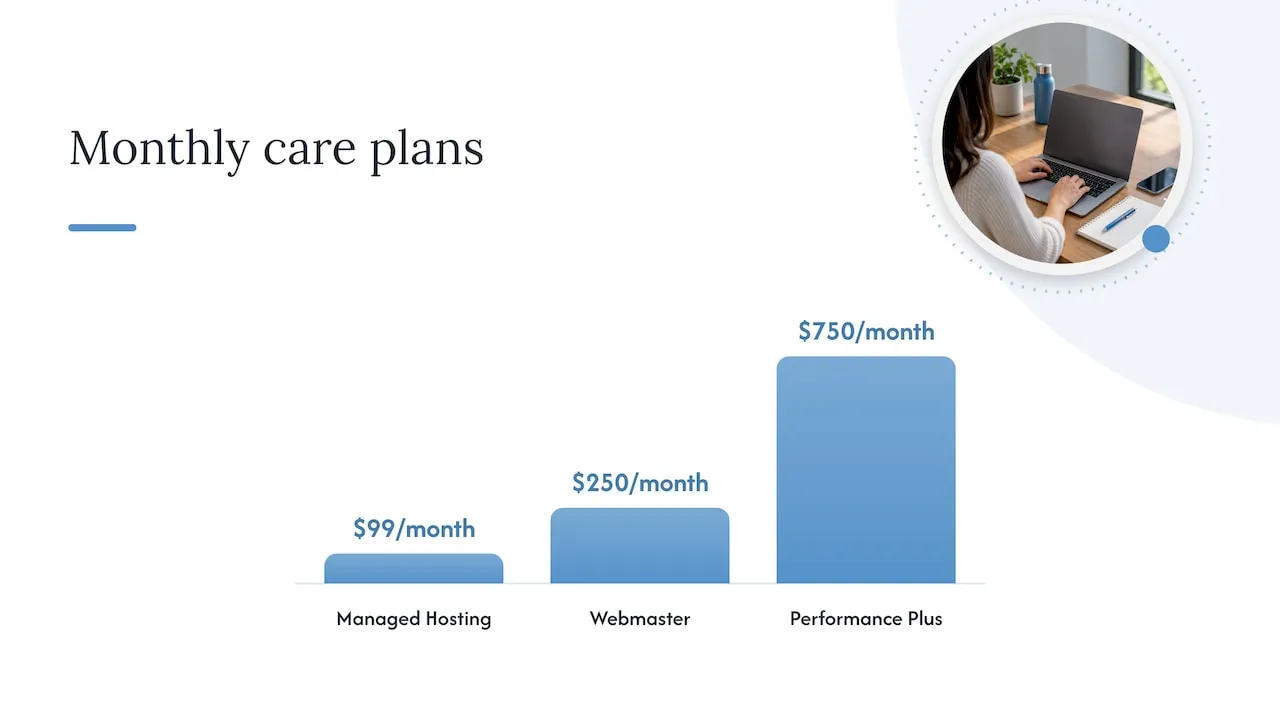
- Plan for ongoing care. Our maintenance plans run $99, $250 or $750 per month.
- Ask every company what happens to a lead after the form is submitted. That answer separates builders from decorators.
Table of Contents
- What a Florida web development company actually does
- Custom website or template: how to decide
- What affects the price
- How a website project runs
- Seven questions to ask before you hire
- Why a website fails to produce leads
- Custom sites for specific Florida industries
- Connecting the site to email and customer records
- Our perspective
- Keeping the site healthy after launch
- Work with a Delray Beach web design studio
- FAQ
- Sources
What a Florida web development company actually does
The phrase covers a wide range. At one end is a freelancer who installs a theme and swaps your logo in. At the other is a studio that plans the site, writes the code, connects it to your email and customer records, and keeps it running.
Most full-service companies offer some mix of these:
- Planning and strategy. Goals, audience, the pages you need, the action each page should drive.
- Design. Layout, branding, mobile screens, photography and copy placement.
- Development. Building the pages, forms, search features and any listings or booking tools.
- Search setup. Page structure, titles, speed and the technical basics that let Google read the site.
- Lead handling. Where form submissions go, who is notified, and what the visitor receives back.
- Maintenance. Hosting, updates, backups, speed checks and small changes after launch.
Steps 5 and 6 are where cheap projects fall short. A site that collects leads into an inbox nobody checks is losing money, however good it looks. A site left without updates slows down and eventually breaks.
We are a Delray Beach web design studio. Our services cover custom web design and development, email and CRM systems, AI workflow automation and ongoing website maintenance, all for service businesses.
Custom website or template: how to decide
This is the first real decision, and it changes the quote more than anything else.
What a template site is
A template site starts from a pre-made layout. A designer changes colors, fonts and content. It is fast to launch and the upfront cost is lower. The tradeoff is that your site is limited to what the template allows. Pages carry code you do not use, and every change has to fit the template’s structure.
What a custom-coded site is
A custom site is built from your requirements. Every page, form and feature exists because your business needs it. That means a page structure shaped around how your customers search, and forms that send leads where your team will see them.
A simple way to choose
| Situation | Better fit |
|---|---|
| New business, one or two services, small budget | Template |
| Need a site live in a few weeks for a short-term purpose | Template |
| Many service pages, locations or specialties | Custom |
| Property listings, quote requests or booking flows | Custom |
| Leads must flow into a CRM or email system | Custom |
| High-value clients who judge you by your site | Custom |
| Current site is slow, hard to edit or losing leads | Custom |
If three or more of the custom rows describe you, a template will probably cost you more later in lost leads and rebuilds. We build fully custom-coded sites for exactly this reason, and we do not use templates or page builders.
What affects the price
No honest studio can quote a Florida website from the keyword alone. The price depends on a handful of factors, and you can use them to compare proposals line by line.
- Number of pages. A five-page site and a 40-page site are different projects.
- Features. Contact forms are simple. Property search, booking, calculators and client portals are not.
- Content. Who writes the copy and who supplies photos? If the studio does it, it is in the quote. If you do it, it is in your schedule.
- Connections to other tools. Sending leads to a CRM, triggering follow-up emails or syncing with a calendar adds work, and it is where much of the payoff sits.
- Search setup. Page structure and technical groundwork built in from the start cost less than fixing them afterward.
- Timeline. Rushed projects cost more.
We do not publish a fixed build price, because the scope decides it. We scope each project in writing after we understand your business. What we do publish is the cost of looking after a site once it is live: Managed Hosting at $99 per month, Webmaster at $250 per month and Performance Plus at $750 per month.
Be cautious with any quote that is a single line item. A proposal should list pages, features, revision rounds, who owns the code and what is excluded.
How a website project runs
Website projects follow a similar path whoever builds them. The University of Chicago’s website development process is a clear public example. It includes a kickoff, hosting selection, discovery, a sitemap, content strategy, wireframes, design, coding, content entry or migration, quality checks and pre-launch requirements.
For a small or mid-size business, that translates to:
- Kickoff and discovery. You and the studio agree on goals, scope, budget, timeline and who is responsible for what.
- Sitemap and content plan. Which pages exist, what each says and who writes it. Content is the most common cause of delay, so settle it early.
- Wireframes and design. Rough layouts first, then the finished look.
- Build. The pages are coded and the forms and features are connected.
- Testing. The site is checked on different browsers and devices before launch.
- Launch and handoff. The site goes live, and you learn how to edit it or who does it for you.
- Care after launch. Updates, backups, speed and small changes.
The same source stresses choosing hosting early and being clear about who supplies content. Both are worth asking any Florida studio about on the first call.
Timelines vary with scope. A short brochure site moves quickly. A site with listings, integrations or many pages takes longer. Treat any promise of a fixed number of days without a scope as a warning sign. The schedule should come from the sitemap and the content plan.
Seven questions to ask before you hire
Use these on every company you speak with.
- Who writes the code? Ask whether the site is custom-coded or built on a template or page builder. Neither answer is wrong, but the price should match.
- Can I see work for businesses like mine? Look for service businesses, not only restaurants or retail.
- What happens when someone fills out a form? You want a clear path: who is notified, how fast, and what the visitor receives.
- Who owns the site? Make sure you own the domain, the content and the code you paid for, in writing. This is a good point for a Florida attorney to read. Business lawyers who handle agreement drafting for Florida businesses can review a contract before you sign.
- How is speed handled? Slow pages lose visitors. The Small Business Administration notes that slow-loading pages may lose visitors.
- What does it cost after launch? Ask for the monthly figure for hosting and updates, not only the build price.
- Who do I call when something breaks? You want a named person and a response time.
A company that answers these directly and in writing is likely to be easy to work with. One that dodges them is giving you a preview of the project.
Why a website fails to produce leads
Most Florida owners who contact a developer already have a site. It looks fine and it brings in nothing. The causes are usually the same few.
No clear next step
The SBA advises identifying the main action visitors should take and adding a call to action, such as filling out a lead form. Its guidance also calls for prominent contact information and images or video that show your business, team or products. See the SBA homepage checklist. Many sites bury the phone number or offer five competing buttons.
Slow or awkward on a phone
Most people check a business from their phone. If the page takes too long or the form is hard to complete, they leave. This applies to forms of every kind. The same logic is behind advice on how to improve booking completion rates: fewer steps, faster pages, less friction.
Leads that go nowhere
A form submission that lands in a shared inbox, or a call that goes to voicemail, is a lead you paid for and lost. The fix is not more traffic. It is routing each inquiry to the right person at once and sending the visitor an immediate reply.
Pages that do not match what people search for
A single “Services” page cannot rank for ten different services. Each service, and each city you serve, usually needs its own page with its own wording. A business in Boca Raton or Fort Lauderdale competes with dozens of others for the same searches, and generic pages lose.
No follow-up
A quote request that gets a reply in five minutes is a different lead from one that gets a reply the next afternoon. Automated acknowledgment and reminders keep prospects warm while your team is busy.
Custom sites for specific Florida industries
A site for a dentist is not a site for a yacht broker. Each industry has its own buyer, its own trust signals and its own way of making inquiries. We have built industry-specific pages for:
- luxury home builders and high-end contractors
- wealth management firms and family offices
- cosmetic dentists and dental implant practices
- plastic surgeons and cosmetic surgery practices
- yacht brokers and charter companies
- private aviation companies
Where a business sells high-value services, a visitor judges the company by the site before ever calling. Clean structure, fast pages and a clear inquiry path matter more than decoration.
Real estate agents
Agents in Miami, West Palm Beach and across the state have their own needs. Usually that means:
- Listing pages that load quickly and show photos well on a phone
- Search and filters by area, price and property type
- A lead form on every listing that goes to the agent immediately
- Neighborhood pages that give Google a reason to show you for local searches
- A way to follow up with buyers and sellers automatically
These are custom features. A template can display a few listings, but connecting each inquiry to follow-up is where custom work pays for itself.
Connecting the site to email and customer records
The site is the front door. What happens after someone walks through decides whether it was worth building.
When a visitor submits a form, a well-built system can:
- Record the inquiry with its source, so you know which page produced it
- Notify the right person right away
- Send the visitor a confirmation that sounds like your business
- Start a short follow-up sequence if nobody has replied
- Tag the lead so you can see which services bring in the best customers
Our background is in this area. Our founder spent years building email and customer-record systems for large consumer brands, and we bring the same discipline to small and mid-size service businesses. If your list is built on Klaviyo, we also offer Klaviyo email development.
Our perspective
We get asked the same thing by Florida owners: “Do I need a custom site, or will a template do?”
Our answer is that it depends on what the site has to do. If it is a business card online, a template is fine. If the site is how you get customers, it is part of your sales process, and it should be built like one.
The most expensive websites we see are not the custom ones. They are the cheap ones that were rebuilt twice. The owner paid for a template, found it could not do what the business needed, paid for another and then paid a third time to connect the form to anything useful.
Our advice is to start from the lead. Decide what a good inquiry looks like, who should receive it, and what should happen in the first five minutes. Then build the site around that. Everything else, the colors, the photos, the headline, is easier once that is clear.
We also tell owners to budget for care after launch. A site is not a one-time purchase. It needs hosting, updates and attention, the same as a vehicle or a storefront.
- Jeremy
Keeping the site healthy after launch
Launch day is the start. Hosting, backups, speed checks, small content changes and fixes are ongoing work. Three ways to handle it:
- Do it yourself. Fine if you have the time and the patience. Most owners do not.
- Keep a freelancer on call. Works until they are busy or unavailable.
- Use a maintenance plan. A fixed monthly fee, a named team and a response time.
Our plans are Managed Hosting at $99 per month, Webmaster at $250 per month and Performance Plus at $750 per month. Details are on the website maintenance page.
Work with a Delray Beach web design studio
If your site looks fine and brings in too few inquiries, the problem is usually in the structure, the speed or what happens after the form. We build custom-coded sites for service businesses across South Florida, from Delray Beach and Boca Raton to Fort Lauderdale and Miami, and connect them to the email and follow-up systems that turn visitors into booked work.
See how we work on our services page, or start with a Delray Beach web design consultation.
FAQ
How do I choose a web development company in Florida?
Start with who writes the code, what happens to a lead after a form is submitted, and what the site costs after launch. Ask for work in your industry and a written scope. Check that you will own the site and its content.
Is a custom website worth it for a small business?
It is when the site is a main source of customers, when you need listings, quotes or bookings, or when leads must reach your email or customer records. For a simple, short-term online presence, a template is often enough. The deciding factor is what the site must do for you.
What should a Florida web development proposal include?
It should list the pages, the features, the content responsibilities, the number of revision rounds, the timeline, who owns the code and what is not included. The University of Chicago’s project process points to aligned objectives, scope, budget, timeline and responsibilities as the foundation. A one-line quote is not a proposal.
Do I need ongoing website maintenance?
Yes. Sites need hosting, backups, updates and speed monitoring to stay fast and working. Our maintenance plans start at $99 per month for Managed Hosting, with Webmaster at $250 per month and Performance Plus at $750 per month.
Does the studio have to be in my city?
No, but local knowledge helps. A studio in South Florida understands how customers in Delray Beach, West Palm Beach or Miami search and what local competition looks like. Meetings can happen by video, and the work does not depend on distance.
Sources
- Website Development Process, University of Chicago Website Resources
- 7 Ways to Improve Your Website Homepage, U.S. Small Business Administration
- Ways to Improve Booking Completion Rates for Small Businesses
- Agreement Drafting Services for Florida Businesses
Not sure what your current site is costing you in missed leads? Request your free website audit at forefrontindustries.io/website-audit.