4–20 Process Score: Pick RPA, Hybrid, or AI for Service Businesses

Most enterprise processes need both: RPA for the stable, rule-based core and AI for the messy exceptions around the edges. The right call depends less on which technology is “smarter” and more on scoring the process itself, structure, judgment required, exception rate, and how often the workflow changes. Score below 9 and RPA alone usually wins; score above 14 and AI carries most of the weight. Everything in between is hybrid territory, which is where most real-world workflows land.
TL;DR:
- Processes with low input structure, minimal judgment, and infrequent change typically benefit from RPA, which accounts for 70 to 75 percent of ongoing costs.
- Hybrid automation suits processes with moderate complexity, where AI handles interpretation and RPA manages rule-based tasks, scoring between 9 and 14 points.
- High-variability workflows requiring significant judgment usually need AI, which should be the primary technology if process scores above 15.
- Prioritizing process stabilization with RPA before layering in AI reduces project risks and maintenance costs, increasing chances of success.
- Proper scoring based on input type, judgment, exception rate, and process change is essential, as most projects fail due to poor sequencing rather than technology choice.
Table of Contents
- RPA vs. AI: What Actually Separates Them?
- RPA vs. AI Automation: A Technical Comparison
- How Do You Score a Process for RPA, AI, or Hybrid?
- How Should You Sequence RPA and AI Implementation?
- Where Do RPA, AI, and Hybrid Actually Get Used?
- How Forefront Approaches Hybrid Automation for Service Businesses
- What the Framework Gets Right (and Where Most Advice Falls Short)
- Get a Process Score, Not a Sales Pitch
- Sources
- FAQ
RPA vs. AI: What Actually Separates Them?
RPA (robotic process automation) executes scripted steps against structured inputs. It clicks buttons, reads form fields, and moves data between systems exactly the way it was configured to, every time, with no interpretation involved. AI, covering machine learning, natural language processing, and increasingly LLM-based agents, works differently: it interprets unstructured inputs and produces probabilistic outputs rather than fixed ones.
- RPA handles structured, predictable inputs: spreadsheet rows, form fields, database records. It excels at high-volume, rule-based tasks where the steps never change.
- AI handles unstructured inputs: free text, scanned PDFs, customer messages, images. It makes a judgment call rather than following a fixed script.
- A bot that copies invoice totals from a known template into an ERP field is RPA. A system that reads a supplier invoice in an unfamiliar layout, figures out which number is the total, and flags anything ambiguous is AI.
That distinction, structured vs. unstructured, deterministic vs. probabilistic, is the entire foundation for everything that follows.
RPA vs. AI Automation: A Technical Comparison
Picking between them (or blending them) comes down to four practical axes: what kind of input you’re feeding the system, how much judgment each case demands, how the system behaves when something breaks, and what it costs to keep running.
RPA reads structured fields and follows deterministic rules, which makes its output easy to audit; every decision traces back to a specific line of logic. AI reasons probabilistically over unstructured input, which makes it more flexible but harder to explain after the fact. That trade-off shows up directly in governance: AI systems need confidence thresholds, human review queues, and logging built in from day one, not bolted on later.
Cost shapes differ too:
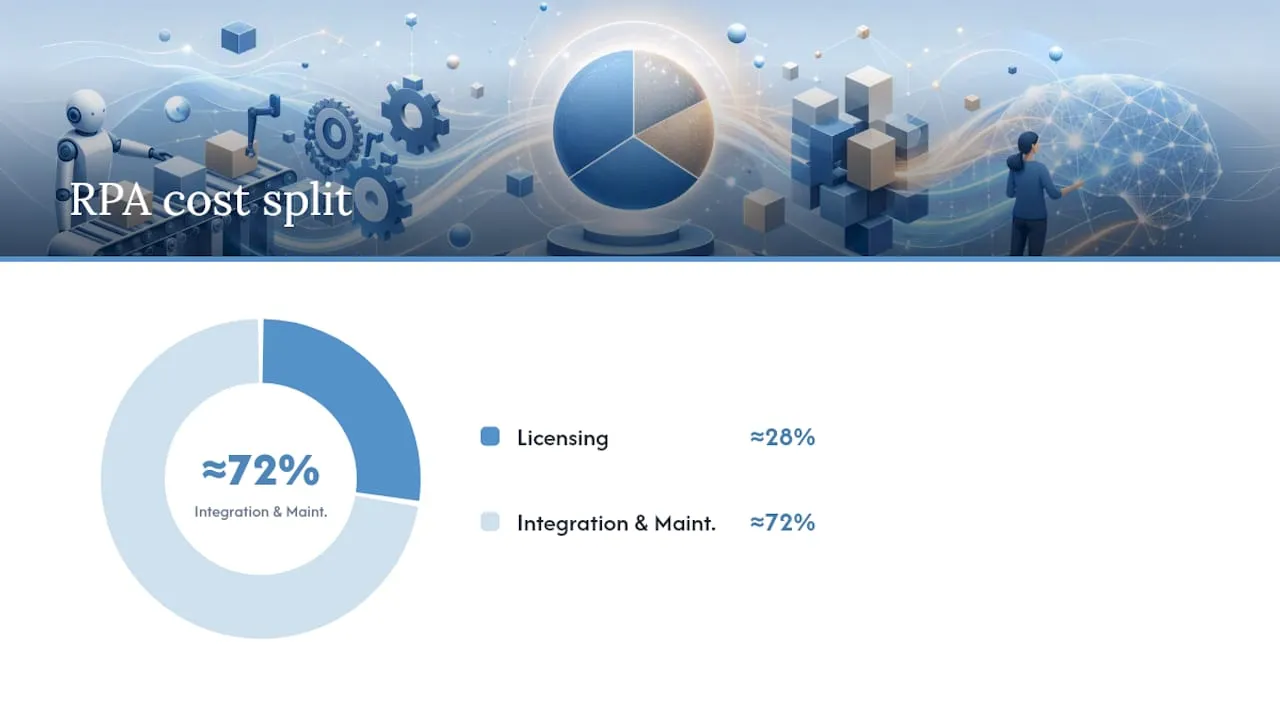
- RPA front-loads licensing and integration work, but maintenance frequently becomes the largest ongoing expense as UI changes break selectors.
- AI has lower fixed costs upfront but variable running costs tied to usage volume and model calls.
- AI agents that read screens semantically can adapt to UI changes that would otherwise break a traditional bot, cutting down break-fix cycles.
Statistic to remember: on a typical RPA rollout, licensing runs roughly 25 to 30 percent of total cost, while integration and maintenance eat 70 to 75 percent over the life of the deployment. Budget for maintenance like it’s the main expense, because for RPA, it usually is.
How Do You Score a Process for RPA, AI, or Hybrid?
A repeatable rubric beats gut instinct, and it’s what keeps automation projects from getting mis-scoped before they start. Score each candidate process on four dimensions, 1 to 5 points each, for a total range of 4 to 20.
- Input structure. Is the data in fixed fields (score low) or free-form text, images, and PDFs (score high)?
- Judgment per case. Does every case follow the same logic (low), or does each one require interpretation and context (high)?
- Exception rate. How often does a case fall outside the standard path? Rare exceptions score low; frequent ones score high.
- Rate of change. Does the process stay fixed for years (low), or does it shift with new formats, vendors, or rules (high)?
Add the four scores together. A practical scoring framework like this one maps the totals to a recommendation:
- 4 to 8: RPA. Structured, low-judgment, low-exception work. Automate it and move on.
- 9 to 14: Hybrid. Some structure, some judgment. AI handles interpretation; RPA executes the write.
- 15 to 20: AI. Heavy interpretation, high variability. RPA alone would break constantly here.
Pro Tip: Score the process before you score the vendor. Teams that pick a tool first and a process second almost always end up automating the wrong 20 percent of the workflow.
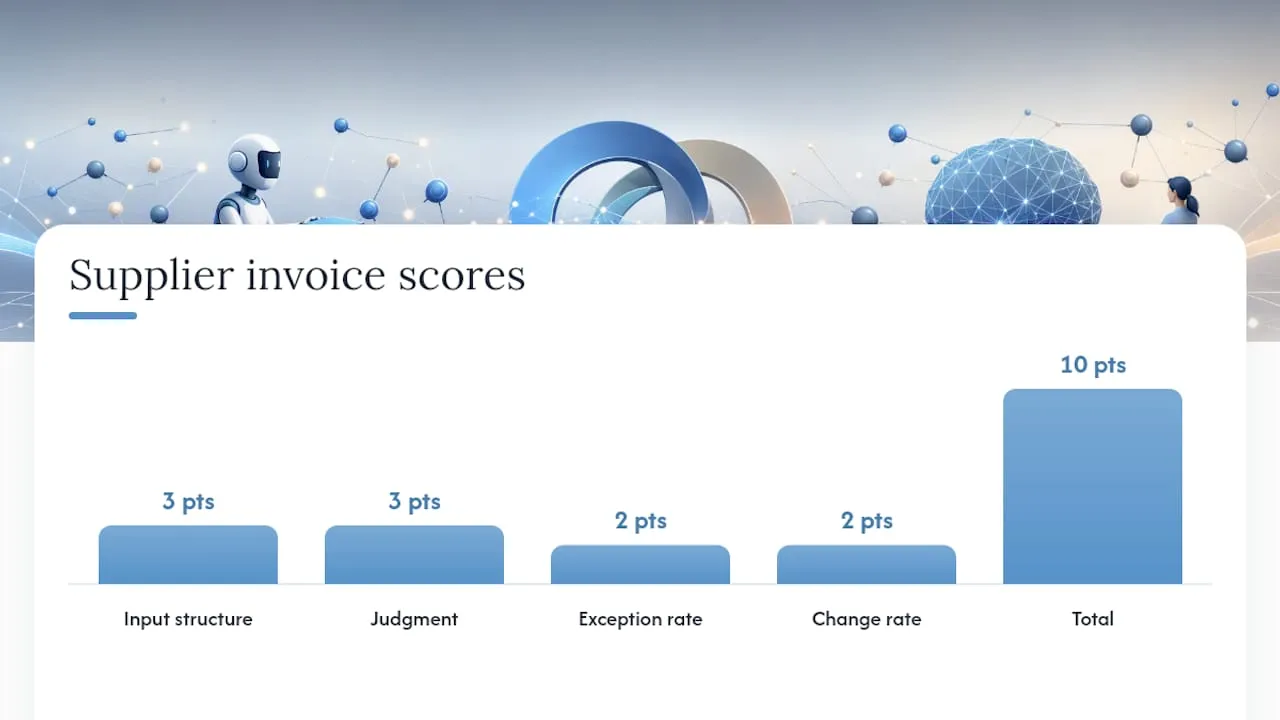
Worked example: a supplier invoice workflow with varied vendor formats scores moderate on input structure (3), moderate on judgment for flagging discrepancies (3), low on exception rate (2), and low on change rate (2), totaling 10. That lands squarely in hybrid: an AI model extracts and interprets the invoice fields, and RPA posts the validated data to the ERP.
How Should You Sequence RPA and AI Implementation?
Stabilize first, then layer in intelligence. Practitioners consistently report better ROI and lower maintenance costs when RPA standardizes a process before AI enters the picture, rather than trying to automate a messy workflow with AI from day one.
The sequence that works:
- Map and clean the process. Automating a broken workflow with AI alone produces brittle results that are hard to trust or fix.
- Deploy RPA on the deterministic core to stabilize inputs and outputs.
- Layer AI onto the exceptions and interpretation-heavy steps, with a confidence threshold and a human review queue for anything the model flags as uncertain.
- Log everything and build an evaluation dataset so you can monitor for model drift over time.
Two failure modes account for most cancelled projects. One is underestimating RPA maintenance until it eats the budget. The other is skipping AI governance entirely, which is a real risk: analysts at Gartner have flagged high cancellation rates for agentic AI projects tied to unclear business value and weak oversight.
Pro Tip: Treat the review queue as a permanent fixture, not a training-wheels phase you remove once the model “proves itself.” Confidence thresholds should tighten over time, not disappear.
Where Do RPA, AI, and Hybrid Actually Get Used?
Matching the technology to the actual job matters more than matching it to whatever is trending.
- RPA: bulk data entry, nightly account reconciliations, migrating records out of legacy systems with no modern API.
- AI: intelligent document processing on inconsistent formats, support ticket triage by intent, classifying unstructured text at scale.
- Hybrid: an AI model extracts fields from an incoming invoice, then RPA posts the validated result into the ERP, no human touches a routine invoice. This combination is often called intelligent process automation (IPA), and it’s how RPA and AI subdisciplines increasingly get bundled together in modern platforms.
- Agent-orchestrated hybrid: an AI agent reads a customer request, decides which internal system needs updating, and calls a deterministic RPA bot to execute the actual write, keeping the audit trail clean while the reasoning stays flexible.
How Forefront Approaches Hybrid Automation for Service Businesses
Some automation providers build automation by stabilizing the deterministic core first, then layering AI onto the exceptions. Experience with lifecycle marketing and CRM engineering on platforms like Salesforce Marketing Cloud and Braze can help keep lead-routing or intake workflows from breaking every time a form field changes.
Before hiring any automation partner, ask three questions: What’s their track record integrating with your existing CRM? What measurable outcome came from their last pilot? What governance do they build in for the AI components, not just the RPA ones? A workflow that stabilizes with RPA before AI enters tends to launch faster and break less often, exactly the outcome the sequencing model predicts.
What the Framework Gets Right (and Where Most Advice Falls Short)
The scoring rubric earns its keep because it forces a decision based on the process, not on which technology a vendor happens to sell. That’s the part most advice skips. Plenty of automation content treats RPA and AI as competitors, as if a business has to pick a side and defend it. In practice, the businesses getting real value are the ones asking a narrower question: does this specific step need a rule follower or a judgment maker?
Where conventional advice really falls down is on maintenance. Everyone talks about RPA’s low upfront cost and AI’s flashy capabilities. Almost nobody budgets seriously for the maintenance curve that eats 70 to 75 percent of RPA spend over time, or for the governance overhead, confidence thresholds, review queues, logging, that AI requires from day one, not as an afterthought.
If you take one thing from this, prioritize sequencing over technology choice. Fix the process, stabilize it with RPA, then add AI where judgment is genuinely needed. Skipping that order is the single most common reason automation projects get scrapped.
- Jeremy
Get a Process Score, Not a Sales Pitch
Forefront Industries approaches automation the way this article does: score the process first, then build the right mix of RPA and AI instead of forcing every workflow into one technology. That’s the practical edge over agencies that sell a single automation product regardless of what your process actually needs, you get a system built around your CRM, your exceptions, and your actual bottleneck.

If a lead-routing workflow, invoice process, or support queue feels like it’s held together with workarounds, that’s usually a scoring and sequencing problem before it’s a technology problem. Forefront Industries offers a diagnostic to score your highest-friction process, a pilot to prove the approach on one workflow, and a roadmap for what comes next. Start with the AI Automation & Consulting page to see how the sequencing model applies to your specific systems, and for organizations already seeing productivity gains from AI adoption, the pattern holds: agencies report meaningful ROI when automation is scoped to the right processes instead of applied everywhere at once.
Sources
- Differences Between AI And RPA - When To Use Both
- RPA vs AI vs Hybrid: Which Wins? (2026) | TECHSY
- AI automation vs RPA in 2026: how to actually decide | Codelevate
- RPA vs AI Automation: What’s the Difference? (2026)
FAQ
Will RPA Be Replaced by AI?
No. RPA remains the more reliable, auditable choice for structured, rule-based work, and AI is better suited to unstructured, judgment-heavy tasks. The practical trend is combining both into hybrid architectures rather than one replacing the other.
What Is the Difference Between Agentic AI and RPA?
RPA follows fixed, scripted steps with no independent reasoning. Agentic AI reasons about a task, decides which action to take, and can call deterministic tools like RPA bots to execute the actual write, keeping judgment and execution separate.
Is RPA a Form of AI?
No. RPA is rule-based automation with no learning or interpretation built in. When RPA is combined with machine learning, NLP, or computer vision to handle unstructured data, the result is intelligent process automation, a hybrid category rather than RPA itself becoming AI.
Is RPA a Good Career?
RPA skills remain valuable, especially as organizations move toward hybrid automation that pairs RPA execution with AI-driven decision making. Professionals who understand both the scoring and sequencing side, not just bot-building, are positioned for the roles companies are actually hiring for as automation programs mature.
How Do I Decide Between RPA, AI, or Hybrid for a Specific Process?
Score the process on input structure, judgment required, exception rate, and rate of change, each from 1 to 5. A total of 4 to 8 points favors RPA, 9 to 14 favors hybrid, and 15 to 20 favors AI, giving you a repeatable way to scope any candidate workflow.