Real Estate IDX Integration: How It Works, What It Costs

Real estate IDX integration puts live MLS listings on your own website through a licensed data feed. It is not a plugin you install on your own authority. Your broker applies to the MLS for a data license, the MLS approves you and your vendor, and a developer connects the feed and displays it under the MLS’s rules. This guide covers each step, the compliance details that fail MLS reviews, typical fees, and the choices that decide whether the result generates leads.
TL;DR
- IDX is a policy and a delivery system. The MLS grants access, your broker is the participant of record, and a vendor or developer wires the feed to your site.
- Modern feeds run on the RESO Web API. Legacy RETS is being retired, so confirm which standard your MLS and vendor use.
- Compliance is in the details: specific brokerage attribution, prominent contact information, required disclaimers on every page that shows listings, and a data refresh of at least every 12 hours.
- Budget for MLS fees plus vendor or build costs. The feed is the smaller part. Lead capture, speed, and CRM routing decide the return.
- A template widget works for basic search. A custom-coded site makes sense when you need your own UX, SEO structure, and lead routing.
Table of Contents
- What IDX is and what it does on a website
- The licensing sequence: paperwork comes before code
- RESO Web API, RETS, and why the standard matters
- Compliance: what MLS reviewers flag
- What IDX integration costs
- Where IDX sites lose leads
- Search visibility for IDX pages
- Our perspective
- Choosing a provider: criteria that matter
- Maintaining an IDX site
- A practical launch checklist
- Build the lead system, not just the feed
- FAQ
- Sources
What IDX is and what it does on a website
Internet Data Exchange (IDX) is the arrangement that lets MLS participants display each other’s listings on their own sites. MLSListings describes it as a system where brokers give each other permission to display listings under specific display guidelines and data use rules. Participants can opt in or out, and opting out means you lose the right to show other brokers’ listings.
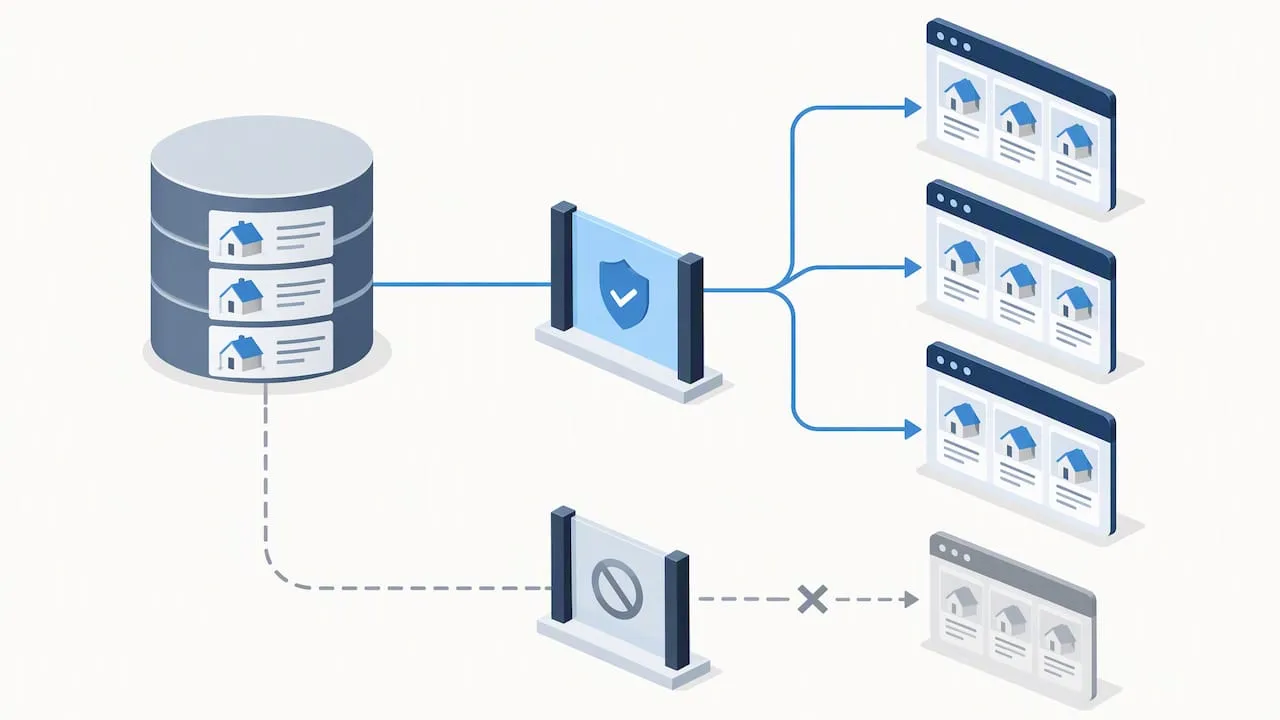
The FTC’s opinion in the Realcomp case explains why this matters commercially. It treats the MLS as a two-sided platform: its value to buyers and sellers rises with the number of listings and participants. A broker site without an IDX feed shows only that broker’s own inventory. A site with one shows the whole market, which is what a home buyer expects to search.
In practice, an integrated IDX feed gives a site:
- Searchable listings with filters for price, beds, baths, property type, and map area.
- Individual listing pages that can rank in search for neighborhood and address queries.
- Saved searches, alerts, and favorites that turn anonymous visitors into identified leads.
- Data you can pass into a CRM to trigger follow-up.
The licensing sequence: paperwork comes before code
Most delays in an IDX project come from approvals, not development. The order is the same in most markets, though each MLS has its own forms and portal.
- Confirm you are eligible. IDX display rights belong to MLS participants, meaning brokers. An agent usually works under the broker’s authority. If you are not a licensed participant, you cannot get a feed directly.
- Apply for an IDX data license. The broker of record applies through the MLS. Many MLSs have a vendor portal where you name the company that will host the data.
- Name your vendor or developer. MLSListings notes that a general IDX vendor can be an approved third-party provider with its own MLS license, or a broker can sign a data licensing agreement directly and authorize an outside consultant to host and manage the data. Check your MLS’s own process before you pick a path.
- Receive credentials. The MLS issues API credentials tied to your license.
- Connect and build. The feed is mapped to your site’s search and listing pages.
- Pass the MLS site review. The MLS inspects the live site against its display rules. Fix what it flags, then go live.
Start the license request before design work. Approval times vary by MLS, and your build schedule should follow the approval, not the other way around.
RESO Web API, RETS, and why the standard matters
For years, listing data moved over RETS. That protocol is on its way out. The RESO Web API is the current standard, built on open technology and OAuth 2.0 authentication, which is more secure than the basic authentication used in legacy RETS feeds. RESO also publishes a transition leaderboard with timelines for MLSs moving fully to the Web API and sunsetting RETS.
What this means for your project:
- Ask your MLS which standard it supports now. If it is mid-transition, you may be offered both for a while.
- Do not build on RETS. Any vendor or developer proposing a new RETS integration is building on a protocol being retired.
- Understand replication. RESO explains replication as copying an MLS’s database onto the vendor’s own systems so it can serve the data to many sites quickly. Replicated data lets your site run fast local searches instead of waiting on a remote query for each page view.
- Plan for credentials and security. OAuth tokens belong on the server, never in front-end code.
Compliance: what MLS reviewers flag
IDX rules are set by NAR policy and then tightened by each MLS. The national floor is that participants refresh automatically fed MLS data at least every 12 hours. Individual boards can require more frequent updates, and their rule wins. NAR’s policy also requires you to honor seller opt-out requests for listings that must not appear on the internet.
The display side is where most sites fail. CRMLS’s IDX and listing credit FAQ points to three common errors:
- Using generic “Courtesy of” language instead of the required, specific brokerage and agent attribution.
- Making contact information less prominent than the property description.
- Leaving out the required disclaimer on a page where listing data appears.
Treat the MLS rules document as a specification. A representative example is the Mid-America Real Estate Alliance IDX rules, which define IDX display authorization and the media it covers. Your MLS has its own version. Get it before design begins, and put these items in the build checklist:
| Requirement | Where it appears | Common failure |
|---|---|---|
| Listing broker attribution | Search results and detail pages | Generic credit line |
| Required disclaimer | Every page with listing data | Missing on map or alert pages |
| Data refresh interval | Feed sync job | Sync runs less often than the MLS requires |
| Seller opt-outs | Feed filter | Withheld listings still appear in cache |
| Participant contact details | Next to listing description | Small, hidden, or below the fold |
| Allowed fields only | Templates | Showing fields excluded from the IDX feed |
Fair Housing and algorithmic display
A listing site is also an advertising surface. HUD’s guidance on digital platforms states that the Fair Housing Act applies to housing advertising through digital platforms, and that targeting, algorithmic delivery, and automated recommendations can produce discriminatory outcomes. If your site ranks, recommends, or personalizes listings, test it end to end and keep a record. For legal questions on a specific feature, ask a real estate attorney or your broker’s compliance officer.
What IDX integration costs
There are two cost layers: what the MLS charges and what the vendor or developer charges.
On the MLS side, one 2026 cost breakdown reports general MLS access fees of about $20 to $50 per month, with Bright MLS charging as much as $148 per month. It also puts IDX data connections at $10 to $70 monthly depending on the MLS. Treat these as ranges, and read your own MLS’s fee schedule.
On the build side, options fall into three types:
| Approach | Best for | Trade-offs |
|---|---|---|
| Hosted IDX search (iframe or widget) | Agents who need search live quickly | Listing pages often live on the vendor’s domain or look generic. Limited control of UX and SEO |
| Template site or plugin with IDX | Solo agents on a tight budget | Template constraints, plugin updates, page weight |
| Custom-coded site with licensed feed | Teams and brokerages that compete on brand and lead quality | Higher upfront investment, full control of speed, search UX, SEO, and lead routing |
No option removes the MLS fees. The decision is how much of the experience you want to own.
Where IDX sites lose leads
A working feed is table stakes. Every competing agent in your market has one. Leads are lost in the gaps around it:
- Slow pages. Search pages with heavy scripts and unoptimized images lose visitors before results render.
- Registration walls in the wrong place. Forcing sign-up before the first search drives people back to the portals. Prompting after a few views or on a saved-search action works better.
- Leads that go nowhere. A saved search with no routing rule, no instant notification, and no follow-up sequence is a dead lead.
- No CRM link. Without listing views and saved searches recorded against the contact, follow-up is generic.
- Weak listing pages. Indexable listing pages need unique neighborhood content around the feed data, clean URLs, and structured data. Many IDX setups serve listing content in ways search engines struggle to index.
The CRM-with-IDX discussion in current search results echoes the same point: tracking saved searches, alerts, and repeat views matters more than the existence of a search box. Build the lead path first, then the pages.
Search visibility for IDX pages
Listing pages from a feed are duplicate-prone by nature, since every broker in the market can show the same data. What you add decides whether they rank: neighborhood guides, market stats, school and commute context, and your own agent profile. Technical SEO needs the same attention, including crawlable URLs, sitemaps for listing pages, and fast rendering. For publishing and tracking this kind of content at scale, an AI-driven SEO platform for keyword planning, content and technical audits can cover the content workflow while your developer handles the feed and templates.
AI search is a second channel. Buyers now ask assistants about neighborhoods and agents. Our AI search optimization service addresses structuring your site so it can be cited there.
Our perspective
We build custom-coded sites for service businesses, and real estate agents are one of the groups we serve. Our background is enterprise CRM and lifecycle marketing, with work for brands including Ring, Blink, and Audible during in-house enterprise work at Amazon. That shapes how we look at IDX.
Most agents treat IDX as a feed problem: get the listings on the page. We treat it as a lead system problem. The feed is a commodity every competitor has. What differs is what happens after a visitor saves a search.
Three positions we hold:
- Start with the license, then design. The MLS rules set the display requirements. A design that ignores them gets sent back.
- Treat each saved search as a lifecycle trigger. A saved search is a stated intent. It should create a CRM record, route to the right agent, and start a sequence based on what the person searched.
- Own the front end. Template and page-builder sites carry weight and constraints that hurt speed and SEO. Custom React frontends let us control rendering, structure, and conversion paths.
We do not replace your MLS relationship. Your broker holds the license. We build what sits on top of it.
- Jeremy
Choosing a provider: criteria that matter
Whether you hire a developer, an agency, or buy a hosted product, check these points before signing:
- Which MLSs are approved? Confirm the provider is already approved by your MLS, or will handle approval with your broker.
- Which data standard? Web API, with a plan for any remaining RETS dependency.
- Who owns the site and the data connection? If you leave, can you keep the domain, content, and listing pages?
- How is compliance handled? Ask how attribution, disclaimers, and opt-outs are implemented, and who fixes review findings.
- How are leads routed? Look for CRM integration, instant alerts, and follow-up automation.
- What does performance look like? Ask for page speed measurements on a live search page, not a home page.
- Who maintains it? Feeds change, credentials rotate, and MLS rules update. Someone must own that.
Maintaining an IDX site
A live IDX site needs ongoing care: feed monitoring, security updates, credential rotation, and fixes when the MLS changes a field or rule. Our maintenance plans are published: Managed Hosting at $99 per month, Webmaster at $250 per month, and Performance Plus at $750 per month. You can compare them on the website maintenance page.
A practical launch checklist
- Broker confirms IDX eligibility and applies for the data license.
- Obtain the MLS’s IDX rules and display requirements.
- Pick a data path: approved vendor or direct license with a named developer.
- Define lead flows: registration triggers, routing rules, CRM fields, and alerts.
- Build the search, listing pages, and compliance elements.
- Test on mobile, check page speed, and audit the display against the rules.
- Submit for MLS review and fix findings.
- Launch, then monitor feed sync, uptime, and lead response times.
Build the lead system, not just the feed
If you need a custom real estate site with a licensed feed, CRM routing, and automated follow-up, our team scopes projects on the services page. Web design, CRM and email development, and AI automation are priced per project and are not published as fixed rates.
FAQ
What are IDX sites in real estate?
An IDX site is a broker or agent website that displays MLS listings from other brokers through a licensed data feed. Visitors can search the whole market without leaving the site. The broker keeps the lead, and the MLS’s display rules govern how listings are shown.
Can I get access to the MLS without being a realtor?
Generally no. IDX feeds are licensed to MLS participants, which means brokers, and agents typically work under their broker’s license. Rules vary by MLS, so contact the MLS or your broker for eligibility.
How often must IDX listing data update?
NAR’s national floor is a refresh of automatically fed data at least every 12 hours. Your MLS may require a shorter interval, and the local rule takes precedence. Your vendor or developer should schedule syncs to the stricter requirement.
Do I need a custom site for IDX?
No. A hosted search or template site can meet the rules. Custom makes sense when you want control over speed, search experience, SEO, and how leads flow into your CRM.
Sources
- IDX FAQ, MLSListings Support
- Opinion of the Commission, FTC (Realcomp)
- RESO Web API
- Web API Transition Leaderboard, RESO
- Moving to Replication via the RESO Web API, RESO
- Internet Data Exchange (IDX) policy, NAR
- IDX and Listing Credit FAQs, CRMLS Knowledgebase
- IDX Rules, Mid-America Real Estate Alliance
- HUD guidance on advertising through digital platforms
- Custom Real Estate CRM Costs, BatchData