First Party Data for Marketers: Collect, Unify, Govern, Activate

A first-party data strategy is a privacy-first plan to collect, unify, govern, and activate the customer data you already own so you can personalize experiences and buy ads without relying on third-party cookies. The core benefit is durability: signals you collect directly from your customers, with consent, survive browser restrictions and regulatory changes that keep eroding third-party tracking. Done right, it also becomes the proprietary training data your AI and measurement systems need.
TL;DR:
- Building a high-signal first-party data program should prioritize sources like transaction history, product telemetry, and website events before expanding.
- Organize and standardize data collection with clear schemas and resolve identity across systems to ensure accurate customer profiles and compliance.
- Start with small activation pilots focusing on revenue-related touchpoints such as email personalization and retargeting to prove value early.
- Assign dedicated ownership for data governance, conduct regular audits, and integrate organizational efforts to prevent silos and maintain data quality.
- The future of first-party data depends on tighter AI integration, granular consent management, and customized infrastructure that aligns with specific business needs.
Table of Contents
- What Counts as First-Party Data (and What Doesn’t)
- Why First-Party Data Matters More in 2026 Than It Did Five Years Ago
- Where First-Party Data Pays Off First
- Building the Strategy: Collect, Unify, Govern, Activate
- Choosing Your Technology Stack: CRM, CDP, and Clean Rooms
- Where First-Party Data Programs Break Down
- Proving the Program Is Working
- Keeping Data Clean and Making It More Useful Over Time
- Getting the Whole Organization on Board
- What’s Coming Next for First-Party Data Programs
- The Uncomfortable Truth About Most First-Party Data Programs
- How Forefront Industries Builds First-Party Data Infrastructure That Works
- Where to Go Deeper on First-Party Data Strategy
- Sources
What Counts as First-Party Data (and What Doesn’t)
Marketers throw around “first-party,” “zero-party,” “second-party,” and “third-party” data as if they’re interchangeable. They aren’t, and the distinction determines what you can legally do with each type.
First-party data is anything a customer generates through direct interaction with your business: purchase history, website behavior, app usage, support tickets. Zero-party data is a subset customers hand you voluntarily, on purpose, like a quiz answer, a stated size preference, or a profile they build during onboarding. Second-party data is another company’s first-party data shared through a direct partnership. Third-party data comes from aggregators who compiled it from sources with no direct relationship to your customer at all, which is exactly why regulators and browsers have turned against it.
Here’s how those categories map to real touchpoints most marketing teams already have:
- Website and app events: page views, add-to-cart actions, search queries, scroll depth
- Transaction history: order value, frequency, product mix, return rate
- CRM notes and sales interactions: call summaries, deal stage, objections raised
- Email and SMS engagement: opens, clicks, unsubscribes, reply sentiment
- Loyalty and account data: tier status, points balance, referral activity
- Product telemetry: feature usage, session length, in-app events for SaaS or connected products
Not all of it carries equal weight. Transaction history and product telemetry tend to be the highest-signal inputs for personalization because they reflect actual behavior rather than stated intent. Email engagement and zero-party survey data are useful for segmentation but weaker as standalone predictors of future purchases.
Why First-Party Data Matters More in 2026 Than It Did Five Years Ago
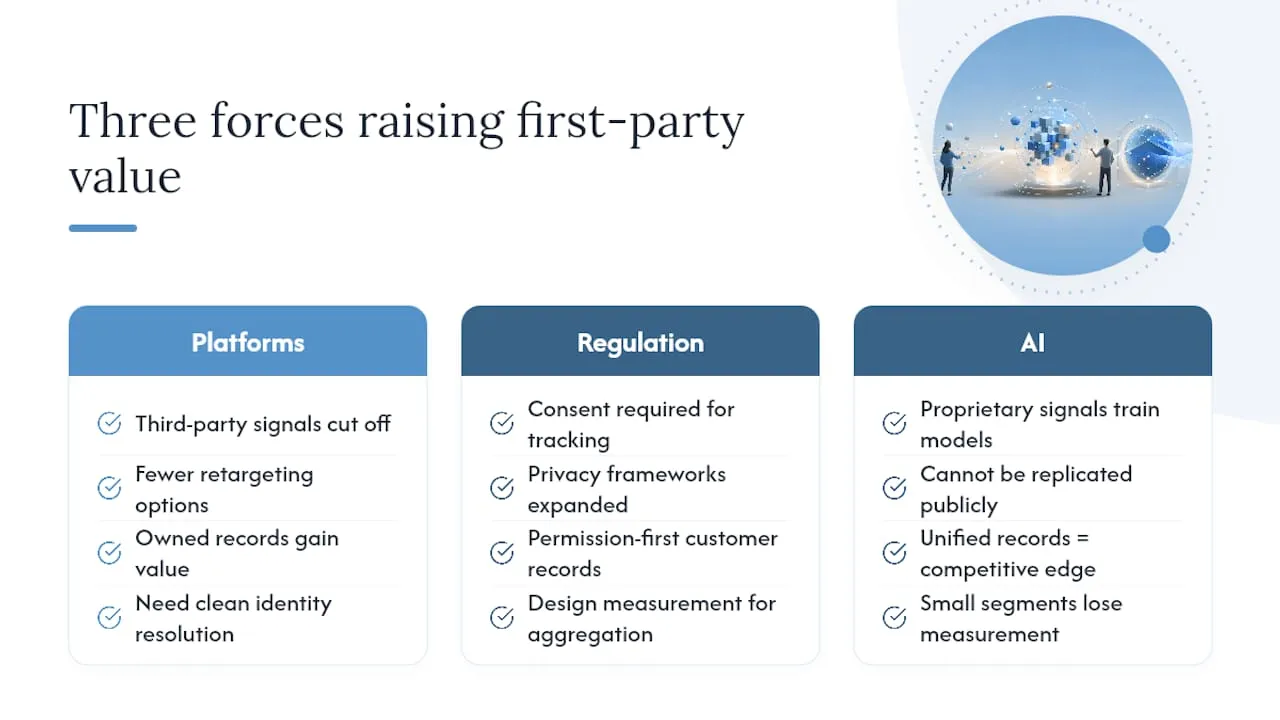
Three forces converged to make owned data the center of gravity in marketing, and none of them are reversing.
Browser and platform changes have steadily cut off the third-party signals marketers used to lean on for retargeting and lookalike modeling. Regulatory frameworks in multiple markets now require explicit consent before that kind of tracking can happen at all. The practical result: a customer record you built yourself, with permission, is worth more than it was three years ago, because fewer alternatives exist.
Privacy has also become a value exchange rather than a compliance checkbox. Customers share data when they understand what they get in return, whether that’s a better product recommendation or faster checkout. Building that trust based, two-way exchange, where transparency and a clear customer benefit come before the ask, is the most reliable way to increase voluntary data sharing, according to PayPal’s guidance on the topic.
There’s a third factor that gets less attention: AI. Proprietary first-party signals train your models and cannot be replicated from public data, which makes unified customer records a genuine competitive advantage in an AI-driven market.
Ads Data Hub and comparable privacy-first measurement platforms only release results once they meet a minimum aggregation threshold to protect individual identity, which protects individual identity while still letting advertisers measure campaign performance. That constraint shapes how you design measurement from the start. If your audience segments are too small, you won’t get usable output, which is one more reason clean identity resolution matters before you scale activation.
Where First-Party Data Pays Off First
Not every use case deserves equal investment on day one. Some deliver measurable lift within a quarter; others take longer to prove out. Prioritize the ones that touch revenue directly before moving to broader personalization plays.
- Website and email personalization. Product recommendations based on purchase history, dynamic homepage modules keyed to browsing behavior, and email journeys triggered by cart abandonment or renewal dates are the fastest wins because the infrastructure (a CRM or CDP feeding your email platform) already exists in most stacks.
- Advertising activation. Deterministic first-party data powers retargeting lists and lookalike audiences that don’t depend on third-party cookies. Match rates here are the metric to watch. Feed a platform a clean, consented customer list and you’ll typically see stronger lookalike performance than one built on modeled or third-party inputs.
- Incrementality and lift measurement. Randomized holdout groups tell you whether a campaign actually drove revenue or just reached people who would have bought anyway. This matters more as device-level tracking gets harder.
- Cross-channel orchestration. A CRM that understands a customer just opened a support ticket can suppress that person from a promotional email the same day. That kind of sequencing prevents the tone-deaf messaging that erodes trust fast.
Pro Tip: Start advertising activation with your highest-value existing customers, not your full list. A tight, deterministic segment of repeat buyers produces cleaner lookalike audiences than a broad export of every email address you’ve ever collected.
Measurement deserves its own discipline here. Pair every activation pilot with a control group from day one, even a small one, so you have a lift number to point to before you ask for budget to expand.
Building the Strategy: Collect, Unify, Govern, Activate
A practical first-party data strategy follows a specific sequence, and skipping steps or reordering them is the most common reason these programs stall. Activation before identity resolution and governance produces messy audiences and compliance risk. Here’s the order that works.
1. Set objectives and KPIs before touching any tooling. Decide what you’re actually trying to move: customer lifetime value, retention rate, return on ad spend, or match rate on ad platforms. Vague goals like “get better data” produce vague roadmaps.
2. Audit your existing sources. Map every touchpoint that generates customer data: website analytics, CRM, email platform, point of sale, support tickets, product telemetry. Most organizations are surprised by how much they already collect and how little of it talks to anything else.
3. Prioritize high-signal collection points. Not every data source deserves equal engineering investment. Rank sources by how directly they predict revenue behavior, then build collection infrastructure for the top few before chasing the long tail.
4. Standardize your event schema. Inconsistent naming (one team logs “purchase,” another logs “order_complete”) breaks downstream analytics before it starts. Agree on a taxonomy early and document it.
5. Resolve identity across systems. Decide whether a CRM, a customer data platform, or your own data warehouse will serve as the source of truth for matching a single customer across devices and channels. Smaller catalogs of customer data often live comfortably in a CRM; organizations juggling dozens of source systems typically need a CDP or warehouse-based identity layer to reconcile it all.
6. Build governance before you build audiences. Tie consent metadata to every record, define retention windows, set access controls by role, and build an easy opt-out path. Practical governance means linking consent status to the record itself, not tracking it in a separate spreadsheet that nobody maintains.
7. Run a small activation pilot. Pick the highest-signal, lowest-effort play, whether that’s an email trigger or a retargeting list, and measure lift before expanding it. A successful pilot gives you the internal case study you need to justify the next phase.
8. Set a review cadence. Revisit match rates, data quality metrics, and pilot results monthly at first, then quarterly once the program stabilizes.
Checklist for the audit phase:
- List every system that captures customer interaction data
- Flag which systems already share data and which are isolated
- Identify duplicate or conflicting customer records
- Document current consent capture points and gaps
- Rank data sources by predictive value for your top three KPIs
Choosing Your Technology Stack: CRM, CDP, and Clean Rooms
The build versus buy conversation trips up a lot of teams because it gets framed as an either/or decision. It rarely is.
A CRM works well as your system of record when your customer base is manageable in size and your primary need is sales and lifecycle communication. Enterprise-grade platforms like Salesforce Marketing Cloud or Braze can handle sophisticated journey orchestration once your CRM data is clean and unified, and pairing that with custom CRM and email system engineering tends to outperform an out-of-the-box template setup because the workflows match how your actual sales and marketing teams operate.
A customer data platform earns its place when you’re stitching together a dozen or more source systems and need real-time identity resolution across web, app, and offline touchpoints that a CRM alone can’t reconcile.
Clean rooms and platforms like Ads Data Hub let you collaborate with ad platforms and partners on measurement without exposing raw customer identifiers, which preserves data sovereignty while still enabling joint analysis. This matters increasingly as aggregation thresholds tighten across ad platforms.
A few architecture principles worth locking in early:
- Standardize event names and properties across every system before scaling collection
- Document data lineage so a data quality problem can be traced to its source
- Integrate email platforms, analytics, point of sale, and product telemetry into a single identity graph rather than letting each report separately
- Choose a stack sized for your data complexity, not your budget headlines
Where First-Party Data Programs Break Down
Most failures aren’t technical. They’re organizational, and they’re predictable enough that you can plan around them before they happen.
The silo trap is the most common one: email data lives in one platform, analytics in another, CRM notes nowhere anyone can query them. Consolidating into a single source of truth with clear cross-functional ownership is the fix, but it requires someone with authority to force the integration, not just a recommendation in a slide deck.
Data quality erodes quietly. Duplicate records, inconsistent formatting, and missing metadata compound over time until your personalization engine is working off bad inputs. Validation, deduplication, and documented data lineage catch these problems before they reach production.
Consent drift happens when preference centers go stale and customers who opted out months ago still receive targeted messages. Audit consent records quarterly, not annually.
- Assign one team clear ownership of data governance, not a committee
- Build a preference center customers can actually find and update easily
- Schedule quarterly data quality audits, not just annual ones
- Decide early which capabilities to build in house and which to hire out
Pro Tip: If your team lacks CRM engineering depth, bringing in specialists for the identity resolution and schema work upfront costs less than untangling a messy homegrown system two years later.
Proving the Program Is Working
Executives will ask for numbers within the first two quarters, so build the measurement plan before you need it, not after.
Track lifetime value, retention rate, return on ad spend, and match rate on advertising platforms as your primary KPIs. Secondary metrics like email engagement or on-site personalization click-through rates help diagnose why the primary numbers move.
Randomized holdout groups remain the most reliable way to prove incrementality: hold back a control group from a campaign and compare outcomes against the group that received it. When device-level data is limited, triangulate across multiple weaker signals rather than betting everything on one measurement method.
- Set a monthly cadence for match rate and data quality metrics
- Reserve quarterly reviews for lifetime value and retention trends
- Build dashboards that show trend lines, not just point-in-time snapshots
- Always pair a new activation with a control group before scaling it
Unified customer profiles cut the manual prep work that eats into analyst time, and that time savings compounds fast: many analysts report spending over half their working hours just preparing data before they can even start analysis. Reclaiming that time is often the most underrated ROI of a well-built program.
Keeping Data Clean and Making It More Useful Over Time
Data quality isn’t a one-time project. It’s an ongoing discipline that determines whether every downstream personalization and measurement effort actually works.
Build validation rules at the point of collection, not after the fact. A form field that accepts any string instead of validating email format creates cleanup work for someone six months later. Deduplication logic should run on a schedule, not just when someone notices duplicate records causing problems. Metadata tagging, recording where a data point came from and when, makes root-cause analysis possible when something looks wrong downstream.
Enrichment adds value once your core data is trustworthy. Appending firmographic details to a B2B contact record, inferring purchase intent from browsing patterns, or layering in loyalty tier status all make existing records more useful for segmentation and personalization. But enrichment on top of dirty base data just scales the mess faster.
A few habits separate teams with usable data from teams drowning in it:
- Validate formats and required fields at the point of entry
- Run deduplication logic on a fixed schedule, not reactively
- Tag every record with source and timestamp metadata for traceability
- Enrich only after core fields pass a quality check
- Retire stale records on a defined schedule instead of letting them accumulate indefinitely
Treat your customer data the way a product team treats its codebase: with version control discipline, documented standards, and someone accountable for its condition.
Getting the Whole Organization on Board
A first-party data strategy fails as often from politics as from bad architecture. Marketing, IT, legal, and sales all touch customer data, and each team has different incentives around it.
Marketing wants activation speed. Legal wants airtight consent tracking. IT wants a stable, maintainable schema. Sales wants CRM data that doesn’t slow down their daily workflow. Without a shared owner, these priorities collide, and the data program becomes the place where competing agendas get resolved badly.
The fix is a named cross-functional owner, not a committee that meets quarterly and accomplishes little. That person needs enough authority to force integration decisions across departments and enough context to translate between legal’s consent requirements and marketing’s activation timelines.
Change management matters just as much as the technical build. Sales reps who’ve entered notes into a CRM the same way for five years won’t change their habits because a new schema requirement showed up in an email. Training, clear documentation, and a visible executive sponsor make adoption stick. Without that sponsor, the program becomes optional in practice, even when it’s mandatory on paper.
Start small and prove value before asking for a company-wide rollout. A single successful pilot, with a measurable lift number attached, does more to win organizational buy-in than any strategy document. Once one team can point to a real result, cross-functional cooperation gets dramatically easier to secure.
What’s Coming Next for First-Party Data Programs
The trajectory over the next few years points toward tighter integration between first-party data and AI systems, and toward even less tolerance for ambiguous consent.
Expect identity resolution to keep shifting toward probabilistic and privacy-preserving methods as deterministic matching gets harder across a fragmented device landscape. Clean room technology will likely expand beyond advertising measurement into broader partner data collaboration, letting companies share insights without ever exposing raw customer records to each other.
Consent management will keep getting more granular. Customers increasingly expect to control not just whether they’re tracked, but which specific uses of their data they’re comfortable with, which means preference centers built for a single opt-in checkbox will need a redesign.
The organizations that will pull ahead are the ones treating their customer data as a genuine long-term asset rather than a compliance obligation. That means investing now in the unification and governance work that feels unglamorous but pays off when the next round of platform restrictions arrives, because it always does.
The Uncomfortable Truth About Most First-Party Data Programs
Most companies talking about first-party data strategy in 2026 are still describing an aspiration, not a functioning system. They’ve bought a CDP, maybe migrated a CRM, and called it done. But a license doesn’t produce identity resolution, and a dashboard doesn’t produce governance. The gap between owning the tools and running the sequence, collect, unify, govern, activate, in the right order is where most of these programs quietly stall.
Here’s what gets underestimated: the unification and governance stages are unglamorous work with no immediate campaign to show for it, so they get deprioritized in favor of activation projects executives can see. That’s backward. Activation built on unresolved identity and shaky consent tracking produces audiences that look fine in a dashboard and perform poorly in market, and nobody can figure out why until someone finally audits the underlying data.
The teams that get this right treat CRM and CDP architecture as infrastructure worth building custom, not a template to configure and walk away from. A generic implementation handles generic use cases. It doesn’t handle the specific way your sales team qualifies leads or the exact sequence your lifecycle emails need to fire in. That’s a build problem, not a settings problem, and no amount of software licensing solves it on its own.
- Jeremy
How Forefront Industries Builds First-Party Data Infrastructure That Works
Most agencies hand you a CDP license and call the job done. Custom infrastructure can include React frontends engineered to capture clean event data from day one, CRM and email systems built on platforms like Salesforce Marketing Cloud and Braze, and AI workflow automation that connects collection to activation without the manual handoffs that cause data to go stale.
If your first-party data program is stalled because your CRM, website, or email systems weren’t built to talk to each other, custom web development designed around your specific data model is the fix, not another point solution layered on top of the mess. Reach out to scope what your identity resolution and activation architecture actually needs.
Where to Go Deeper on First-Party Data Strategy
The technical and legal detail behind a first-party data program runs deep, and a few sources are worth bookmarking beyond this guide. Think with Google’s first-party data playbook covers privacy-safe measurement and aggregation thresholds in more technical detail. LiveRamp’s strategy framework breaks down the collect, unify, govern, activate sequence step by step. PayPal’s guide focuses on the consent and value exchange side of the equation. For the data engineering fundamentals behind collection and validation, TechTarget’s overview of big data collection is a solid technical reference. Marketers building out audience segmentation work may also find value in this resource on understanding audience needs.
Sources
- 8 Steps to Create a First-Party Data Strategy | LiveRamp
- How To Build a First-Party Data Strategy | PayPal
- How big data collection works - TechTarget