CDN Benefits for Businesses: 2 Metrics, Lower Costs, Fewer Outages

A content delivery network speeds delivery, reduces origin load, and improves resilience and security for most web and media workloads. These gains show up in measurable terms: lower Time to First Byte, better Core Web Vitals scores on PageSpeed Insights, and fewer outages during traffic spikes. The sections below break down the mechanics behind each benefit and how to measure them.
TL;DR:
- Start by caching static assets with clear response headers, then enable Brotli and HTTP/2 or HTTP/3 before expanding cache coverage.
- Compare Lighthouse diagnostics with Chrome User Experience Report field data, and track Largest Contentful Paint, Time to First Byte, cache hit ratio, and uptime.
- Keep origin fallback active during the first two weeks, stage the rollout, and load test before full cutover to catch cache errors before outages.
- For video and large files, test sustained throughput under load, monitor cache hit rates, and use signed URLs plus range requests for secure delivery.
- Estimate infrastructure savings by multiplying monthly bandwidth by the expected cache hit ratio; paid tiers may be needed for high traffic, streaming, or security needs.
Table of Contents
- How CDNs speed up content delivery
- Cost and infrastructure savings from a CDN
- Keeping sites available during spikes and attacks
- Security features a CDN adds at the edge
- Benefits for streaming and large file delivery
- CDN impact on Core Web Vitals and search performance
- Implementation checklist for rolling out a CDN
- How Forefront Industries approaches CDN and performance strategy
- Get CDN rollout and performance tuning done for you
- FAQ
- Sources
How CDNs speed up content delivery
A CDN stores copies of static files, images, scripts, and style sheets on servers positioned near the visitor, so each request travels a shorter distance. That proximity cuts round-trip time and lowers Time to First Byte, since the edge server answers instead of a single origin location half a world away.
Connection setup benefits too. Many CDNs keep warm, pre-established links between edge nodes and origin servers, which removes repeated handshake delays for content that cannot be cached. Modern protocol support adds another layer: HTTP/2 and HTTP/3 allow multiplexed requests over one connection, TLS 1.3 shortens the security handshake, and Brotli compression shrinks file sizes before they ever leave the edge.
- Edge caching cuts the physical distance data travels, lowering round-trip time.
- Pre-warmed connections reduce handshake delays for dynamic, uncacheable requests.
- HTTP/3 and Brotli compression together reduce load times and transfer sizes.
Largest Contentful Paint and Time to First Byte are the two metrics most directly affected by a CDN rollout, and both should move in a faster direction once edge caching and modern protocols are active, according to Azure’s CDN guidance.
Cost and infrastructure savings from a CDN
Every request a CDN answers from cache is a request your origin server never has to process. That offload reduces bandwidth bills, since the CDN handles the bulk egress traffic, and it lowers origin compute needs, which means smaller autoscaling budgets and fewer emergency server upgrades during busy periods.
Web.dev’s CDN overview notes that CDNs reduce server load and can lower hosting costs while also improving throughput through protocol-level optimizations. The more of your traffic the CDN serves, the larger the savings tend to be.
- Bandwidth offload reduces origin egress costs directly.
- Lower compute demand on the origin server reduces autoscaling and hardware spend.
- Fewer traffic emergencies mean less engineering time spent on incident response.
Pro Tip: Estimate savings by multiplying your monthly bandwidth by your expected cache hit ratio: a high hit ratio on a high-traffic site shifts most delivery cost away from your origin infrastructure.
Keeping sites available during spikes and attacks
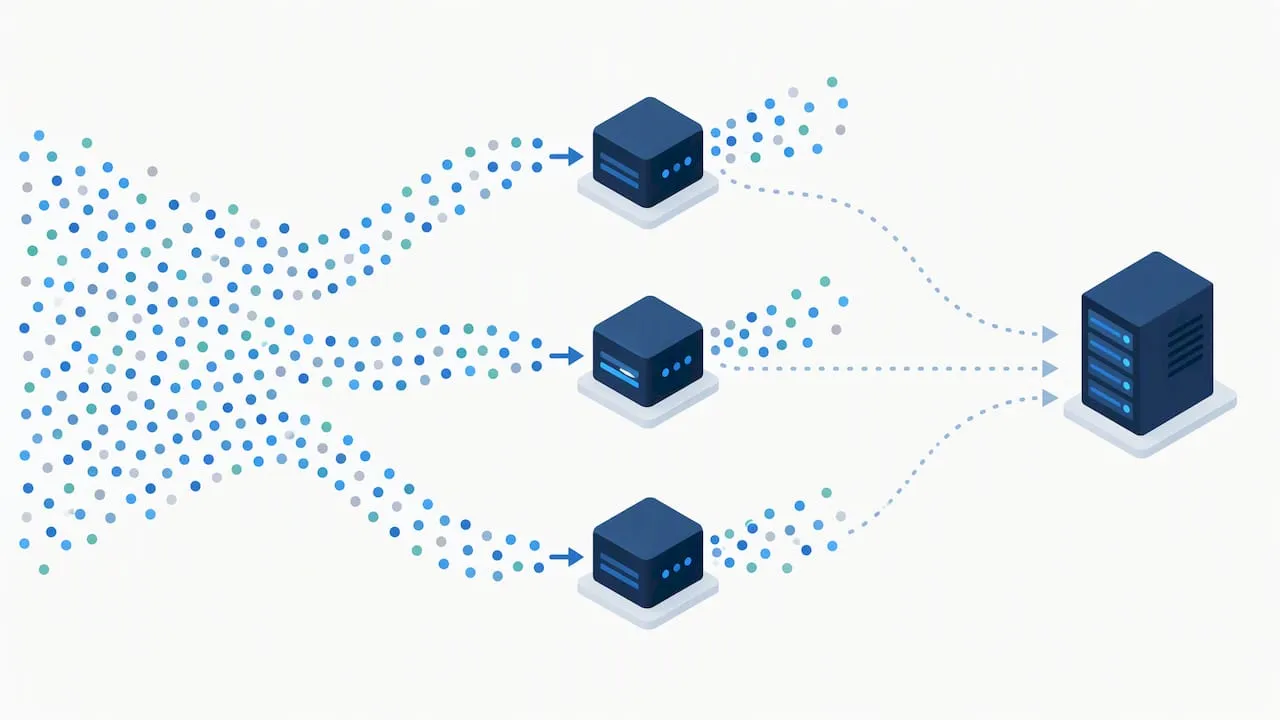
Distributing requests across many edge servers prevents any single point from becoming an overload target. When traffic surges, whether from a product launch or an unplanned viral moment, the CDN absorbs the volume instead of funneling it all to one origin.
This same distribution helps with traffic resilience against DDoS attacks, since malicious request floods get spread and filtered at the edge rather than reaching the origin directly. Many CDNs also serve cached content even when the origin is degraded or temporarily offline, buying time for automated failover to kick in.
- Request distribution across edge nodes prevents single-point origin failures.
- Edge-level filtering absorbs and mitigates DDoS traffic before it reaches the origin.
- Cached responses keep pages available even during origin outages or maintenance windows.
A product launch that drives a sudden traffic spike is the clearest real-world test: an origin server alone often buckles, while a CDN simply serves more cached copies from the edge.
Security features a CDN adds at the edge
Edge TLS termination handles the encryption handshake closer to the visitor, which shortens connection setup time and removes certificate management from the origin server. Beyond encryption, most CDNs bundle a web application firewall with managed rule sets that block common attack patterns like SQL injection and cross-site scripting before they ever reach your application code.
Bot management and rate-limiting add another layer, throttling scraper traffic and credential-stuffing attempts at the edge instead of letting them consume origin resources.
- Edge TLS termination offloads certificate handling and speeds up the handshake.
- WAF rule sets block common application-layer attacks before they reach origin servers.
- Bot management and rate-limiting reduce automated abuse and scraping traffic.
Enable logging and alerting on these features from day one. A WAF or bot rule that blocks legitimate traffic by mistake is easier to catch within hours than after weeks of lost conversions.
Benefits for streaming and large file delivery
Video and large downloads strain origin servers in ways static pages never do, and this is where edge distribution matters most. Spreading video segments and large files across edge locations reduces buffering for viewers and increases sustained throughput for everyone watching at once.
Adaptive bitrate streaming, range-request support, and signed URLs for access control let a CDN serve video securely without funneling every stream through a single origin. The same infrastructure handles large software and firmware distribution efficiently, which matters for any business pushing updates to many devices at once, a use case Azure’s architecture guidance calls out specifically for IoT and software rollouts.
- Edge distribution reduces buffering and raises sustained throughput for video.
- Signed URLs and range-request support keep large media secure and efficient to stream.
- Large-scale software and firmware updates benefit from the same distribution model.
During implementation, test sustained throughput under load and track cache hit rates for your largest files, not just your homepage assets.
CDN impact on Core Web Vitals and search performance
A CDN most directly influences Largest Contentful Paint and Time to First Byte, two metrics that measure how quickly meaningful content appears for a visitor. Faster edge responses push both numbers in the right direction, which is the outcome Google’s Core Web Vitals and PageSpeed Insights framework is built to measure.
Lab data from Lighthouse is useful for diagnosing a specific page before launch, while field data from the Chrome User Experience Report, surfaced through PageSpeed Insights, shows what real visitors actually experience at the 75th percentile. Use both: Lighthouse to fix issues pre-launch, field data to confirm the fix worked for real traffic.
- Track LCP and TTFB before and after rollout to confirm the CDN is working as expected.
- Use Lighthouse for diagnostics and CrUX field data for real-user validation.
- Watch cache hit ratio and uptime alongside Core Web Vitals for a complete picture.
Faster, more consistent response times also support healthier crawling, since Google’s crawl budget guidance rewards sites that respond quickly and avoid errors, allowing more of a site’s content to get crawled efficiently.
Implementation checklist for rolling out a CDN
A CDN rollout works best staged, not flipped on all at once. The order below reflects the quickest wins first.
- Cache static assets first: images, scripts, and style sheets with clear cache-control headers.
- Enable Brotli compression and HTTP/2 or HTTP/3 support at the CDN layer.
- Define a cache-key strategy and a purge process for content updates.
- Use signed URLs for any private or paid content served through the CDN.
- Set a measurement baseline with PageSpeed Insights and CrUX field data before changes go live.
- Monitor cache hit rate, LCP, TTFB, and error rates after rollout.
- Roll out in stages with origin fallback enabled, and load test before full cutover.
Pro Tip: Keep origin fallback active during the first two weeks of any rollout: it catches misconfigured cache rules before they cause a visible outage.
How Forefront Industries approaches CDN and performance strategy
We build CDN configuration into every custom site we deliver, drawing on our experience in CRM and marketing systems. Performance decisions get tied directly to lead quality and conversion goals, not treated as a separate technical task bolted on after launch.
- Jeremy
Get CDN rollout and performance tuning done for you
We handle CDN configuration, monitoring, and ongoing optimization as part of our Website Maintenance work, so you get the speed and security benefits without managing the technical details yourself. Our Managed Hosting, Webmaster, and Performance Plus plans each bundle a different depth of ongoing performance support, from basic hosting to full monitoring and optimization.

If your site is slow, your origin is overloaded during traffic spikes, or you are not sure what your Core Web Vitals scores actually mean for conversions, a performance audit is the place to start. Book a site audit and we will show you exactly where a CDN and related infrastructure work would move the numbers that matter for your business.
FAQ
What is AT&T’s content delivery network?
AT&T operates network infrastructure and connectivity services, but it is not one of the primary CDN providers decision-makers evaluate for website or streaming delivery. Most businesses choose dedicated CDN providers built specifically for edge caching, security, and content distribution.
Can I use a CDN for free?
Many CDN providers offer free tiers that cover basic static asset caching and limited bandwidth, which work for small sites or low-traffic projects. Businesses with higher traffic, streaming needs, or security requirements typically need a paid tier to get WAF protection, higher bandwidth allowances, and dedicated support.
How do CDNs make money?
CDN providers generally charge based on bandwidth usage, number of requests, and premium features like advanced security rules or dedicated support tiers. Free tiers usually act as an entry point that encourages upgrades once traffic or feature needs grow.
What should I check before choosing a CDN?
Before choosing a CDN, check its cache hit ratio performance, its support for modern protocols like HTTP/3 and Brotli, and whether its security features cover your needs for TLS, WAF, and bot protection. It also helps to confirm how the provider handles origin fallback and failover during outages, since that affects how resilient your site stays under pressure.