30–90 Day API Integration Strategy That Ships for CIOs and Developers

An API integration strategy is a documented plan that ties each API and integration pattern to a specific business outcome. It starts with an inventory of what you already have, a clear map of who consumes each endpoint, and 2 to 4 measurable success metrics. Before writing another line of integration code, get those three things on paper.
TL;DR:
- A documented API strategy should start with an inventory, a map of consumers, and clear success metrics before any integration development begins.
- Proper governance, platform choices, and measurement should be decided upfront, with automation supporting scale past 20-100 APIs.
- Selecting the correct integration pattern depends on traffic shape and failure tolerance, with common options including REST, webhooks, message queues, and backend-for-frontend.
- Building a governed approach involves a quick pilot of high-impact, risky integrations, applying standards, and measuring results before expanding across all APIs.
- Operational discipline, such as retries, token management, and versioning, is critical to prevent outages and ensure maintainability of integrations over time.
Table of Contents
- What Is an API Integration Strategy, and Why Does It Matter?
- Core Components Every API Integration Strategy Must Define
- Which Integration Pattern Fits Your Use Case?
- Operational Best Practices That Prevent Production Incidents
- A 30 to 90 Day Rollout Checklist for API Integration Strategy
- How Forefront Industries Approaches API Integration Work
- Why Most API Strategy Advice Skips the Hard Part
- Ready to Turn Your API Strategy Into a Working System?
- Sources
What Is an API Integration Strategy, and Why Does It Matter?
An API strategy is a documented, high-level plan that governs how an organization designs, builds, exposes, and operates APIs to align with business goals. That’s the definition IBM uses, and it draws a hard line between “we have APIs” and “we have a plan for our APIs.” Most organizations have the former. Few have the latter.
Ad-hoc API growth produces predictable failure modes: shadow APIs nobody documented, three different auth schemes across teams, and version changes that break a partner’s integration without warning. A real strategy prevents this by forcing decisions upfront instead of during a production incident.
The payoff shows up in business terms, not just engineering ones:
- Lower support cost, because fewer integrations break silently
- Faster onboarding for new partners and internal teams
- A platform other systems, and increasingly AI agents, can actually build on.
Core Components Every API Integration Strategy Must Define
A complete API strategy covers audience and value, governance, platform decisions, and measurement, according to Moesif’s framework. Treat these as four decisions you write down, not four things you’ll figure out later.
Audience segmentation. Internal teams, partners, external developers, and AI or agent consumers each need different rate limits, documentation depth, and support levels. An internal service call and a public-facing partner integration should never share the same access tier.
Governance baseline. This means agreeing on auth standards, naming conventions, a consistent error response format, and a deprecation policy before you have 40 endpoints that each do things differently. Security here is a strategic decision, not a checklist item: decide upfront which auth patterns (OAuth2, mTLS, or API keys) apply to which audience, and how credential rotation and revocation work at scale.
Platform stack. Gateway, developer portal, observability tooling, and monetization support each carry trade-offs in cost and control. Monetization especially reshapes the technical requirements: a free public API needs different abuse prevention than a paid one that requires per-customer billing and SLA reporting.
Measurement. Pick 2 to 4 metrics tied directly to business outcomes, not just uptime.
- Time to integrate a new partner
- Support tickets per API per month
- Revenue or retention tied to a specific integration
- Adoption rate among target consumers
Pro Tip: Map every metric to a business owner who actually cares about it. A latency dashboard nobody reads is not a metric, it’s decoration.
Which Integration Pattern Fits Your Use Case?
Choosing the right pattern is less about preference and more about traffic shape and failure tolerance. Practical integration work clusters into a handful of patterns, each suited to different architectural situations.
- Synchronous REST works best for low-latency lookups where the caller needs an answer immediately, like checking inventory or validating an address.
- Event-driven webhooks suit high-volume, asynchronous updates. Build in signature verification so you know a payload actually came from the sender, idempotency so a retried delivery doesn’t double-process an order, and a dead-letter queue so failed events don’t just vanish.
- Message queues handle high-volume writes and buffer traffic spikes without forcing the sender to wait on the receiver.
- Backend-for-frontend (BFF) centralizes auth and normalizes error handling for a specific client, keeping secrets server-side instead of scattered across mobile apps or single-page frontends.
Each pattern trades something for something else. REST is simple but couples caller and callee in time. Queues decouple them but add infrastructure and latency. Webhooks are efficient but push the burden of reliability onto the receiver. Pick the pattern that matches your actual traffic, not the one that’s trendiest in your stack.
Operational Best Practices That Prevent Production Incidents
Reliable integrations get built for failure from day one, not patched for it after the first outage. That means idempotency keys on every write operation, retries with exponential backoff and jitter, and a clear split between 4xx errors (fix the request) and 5xx errors (retry the request).
- Respect
Retry-Afterheaders on 429 responses instead of hammering a rate-limited endpoint - Throttle outbound traffic proactively during large syncs rather than waiting to get throttled
- Manage token lifecycles actively; refresh before expiry, not after a failed call
Versioning deserves its own discipline. Use MAJOR.MINOR.PATCH semantics, where MINOR changes stay additive and MAJOR changes signal a breaking change, and design tolerant readers that ignore unknown fields instead of crashing on them. Schema drift is inevitable across a portfolio of integrations; the goal is to make it survivable.
Governance automation stops being optional once a portfolio grows. Manual governance typically breaks down somewhere between 20 and 100 APIs, which is earlier than most teams expect. Past that point, invest in automated spec linting, discovery tooling, and contract tests running in CI, alongside request IDs and upstream latency metrics so a failure surfaces in a dashboard before it surfaces in a support ticket.
A 30 to 90 Day Rollout Checklist for API Integration Strategy
Moving from scattered integrations to a governed program doesn’t require a year-long transformation project. It requires a sequence.
- Inventory every API and integration currently in production. Record the owner, the consumers, and any SLA commitments, even informal ones.
- Prioritize by business impact and fragility. An integration that’s both high-value and brittle is your pilot candidate, not your afterthought.
- Run one pilot end to end, applying the governance baseline (auth standard, error format, versioning policy) to that single integration before rolling it out anywhere else.
- Deploy governance as code. Spec linting and CI checks catch drift automatically instead of relying on someone remembering the standard.
- Measure the pilot against your chosen metrics, then expand to the next priority integration using the same playbook.
- Schedule an annual review of platform choices; gateway and portal decisions that made sense at 15 APIs rarely still fit at 150.
Pro Tip: Don’t pilot your easiest integration. Pilot your riskiest one that’s still contained enough to fail safely. That’s where governance actually earns its keep.
Design contracts and canonical models at your system boundaries as you go. It’s a smaller lift now than untangling pairwise mappings later, once your connector count has multiplied.
How Forefront Industries Approaches API Integration Work
Forefront Industries builds custom digital growth infrastructure for service businesses, including CRM and email system engineering on platforms like Salesforce Marketing Cloud and Braze, alongside AI workflow automation. That work is API integration strategy in practice, not theory.
- Custom lead routing and lifecycle journey automation depend on well-governed API connections between marketing systems and business tools
- Some clients report improvements in inbound lead quality when integration and automation work is done deliberately rather than bolted on.
- A typical engagement may follow a sequence of discovery, a small pilot, observability instrumentation, and then scaling, mirroring the rollout sequence described above.
That sequence matters more than any single tool choice, especially for teams layering AI automation onto existing systems.
Why Most API Strategy Advice Skips the Hard Part
Most guidance on API strategy stops at the framework: define your audience, pick a governance model, choose a platform.
The conventional advice underrates operational discipline and overrates architecture diagrams. A perfectly designed BFF pattern doesn’t help you if nobody’s watching the dead-letter queue. A beautifully versioned API doesn’t matter if your tolerant readers aren’t actually tolerant, because nobody tested them against a real schema change.
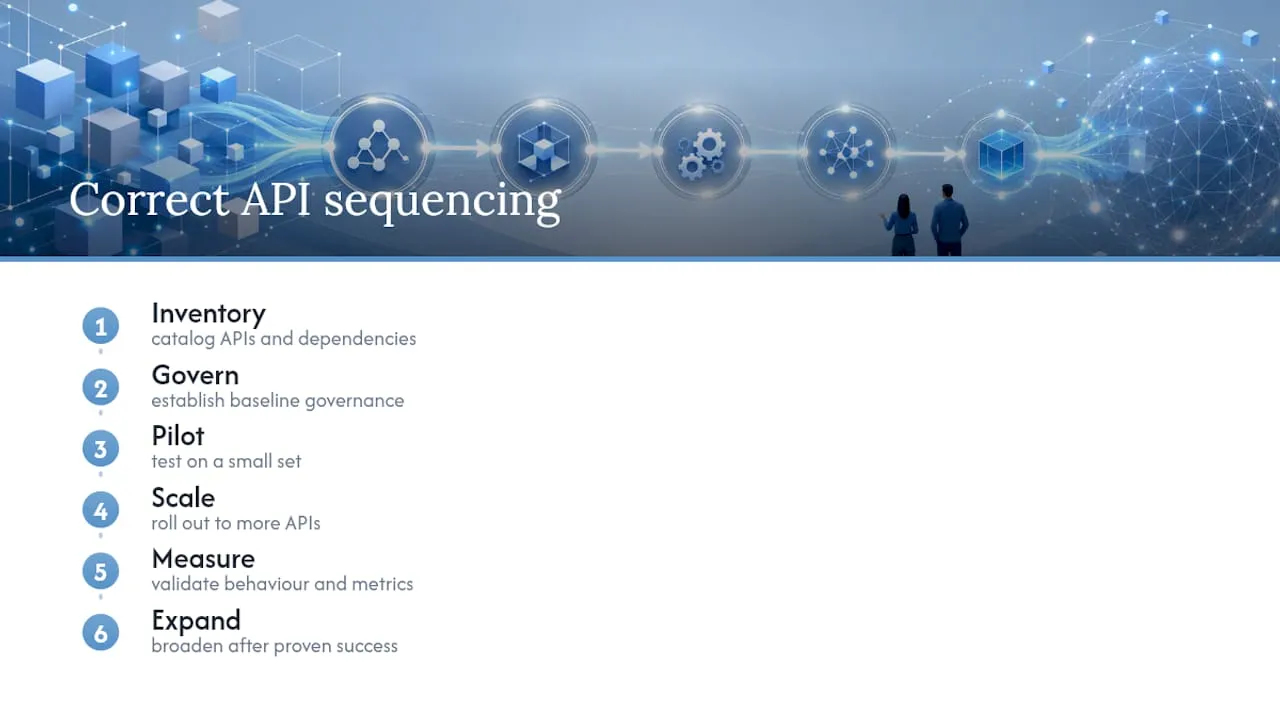
If you take one thing from this guide, take the sequencing: inventory before you govern, pilot before you scale, and measure before you expand. Skipping straight to platform selection is the single most common mistake I see. Teams buy a gateway before they know which of their 40 APIs actually need one. Fix the sequence first. The tools will follow, and they’ll follow faster than you expect once the governance baseline is real instead of aspirational.
- Jeremy
Ready to Turn Your API Strategy Into a Working System?
If your integrations were built one urgent request at a time, you already know the cost: brittle connections, undocumented auth, and a support queue that never empties. Some companies build custom-coded systems that replace that patchwork, from CRM and email engineering on platforms like Salesforce Marketing Cloud and Braze to AI workflow automation that handles the routing and follow-up your team shouldn’t have to do by hand.

The path in is straightforward: an audit of what you’re running today, a contained pilot on your highest-impact integration, and, if the pilot proves out, a retainer build engagement to scale it properly. That’s the same discovery-pilot-scale sequence covered above, just applied to your systems instead of a hypothetical one. If measurement is part of your gap, a resource like Baby Love Growth’s take on SEO performance metrics is worth a look for mapping technical metrics to business outcomes. Start by reviewing Forefront Industries’ full service list or go straight to a custom development conversation about your first pilot.
Sources
- API Strategy Best Practices | IBM
- API Strategy in 2026: A Practical Framework | Moesif Blog
- API Strategy: How to Build, Scale, and Govern an API Program | Treblle