LLM Workflow Automation for Service Businesses: Pilot in Several Weeks

The recommended approach for LLM workflow automation is pragmatic build-and-buy orchestration: pair a lightweight orchestrator with retrieval-augmented workflows and strict governance. The three initial decisions that determine success are the orchestration pattern (chained or supervisor), the memory and retrieval strategy, and the human-approval policy for high-risk actions.
TL;DR:
- Most successful LLM workflows use a build-and-buy approach, combining lightweight orchestration with strict governance and retrieval strategies.
- Deployment patterns like chained requests, single-agent tool access, supervisor hub-and-spoke, and multi-agent teams address different complexity levels and control needs.
- Reliable production requires durable checkpointing, human approval gates, cost-aware routing, token tracking, and rigorous safety measures including redaction and verification.
- Governance involves clear ownership, data mapping, performance monitoring, and independent evaluations, with vendor contracts confirming data handling and support levels.
- Prioritize operational scaffolding such as idempotent tools, audit logs, and approval policies over complex orchestration patterns, as these are common failure points in production.
Table of Contents
- What an LLM workflow is and common task patterns
- Architectural and orchestration patterns that work in production
- Production engineering: reliability, cost control, observability, and safety
- Governance, risk management, and vendor evaluation
- How to choose tools and design a pragmatic build-and-buy strategy
- Implementation checklist: an actionable starter plan for pilot to production
- Forefront Industries perspective: practical experience and outcomes
- What the research actually supports about LLM automation
- How Forefront Industries can help
- Sources
- FAQ
What an LLM workflow is and common task patterns
An LLM workflow chains model calls, tools, and data sources into a defined process, distinct from RPA (which follows fixed rules) or classic ML (which predicts from static features). LLM workflows reason over unstructured input and adapt output based on context, which makes them suited to tasks that resist hard-coded logic.
Common task types include:
- Intent routing: classifying incoming requests to the correct handler or queue.
- Extraction: pulling structured fields from documents, emails, or forms.
- Summarization: condensing long text into a fixed format for review.
- Retrieval-augmented generation (RAG): grounding answers in a knowledge base before generating a response.
- Decision support: scoring options against criteria for a human to approve.
- Code generation: producing scripts or queries from natural-language instructions.
- Evaluator loops: one model checks or scores another model’s output before it proceeds.
Automation maturity is often described in levels. Level 3 (L3) automates a single task inside a larger process, such as extracting invoice line items while a person still routes and approves the invoice. Level 4 (L4) automates the full process end to end, including routing, exception handling, and approval, with humans reviewing only flagged cases. Most organizations start L3 pilots on document processing or support triage, then graduate specific processes to L4 once error rates and audit trails prove stable enough for reduced oversight.
Architectural and orchestration patterns that work in production
Four patterns cover most production deployments, each with a different complexity-to-control tradeoff.
- Chained requests: a fixed sequence of model calls, each feeding the next. Simple to debug, predictable cost, best for linear processes like document intake and summarization.
- Single-agent with tool access: one model call decides which tools to invoke (search, database lookup, calculator) within a bounded loop. Good for support and research tasks where the path varies but the domain is narrow.
- Supervisor hub-and-spoke (multi-agent): a coordinating agent delegates subtasks to specialized agents and assembles the result. Suited to complex processes spanning multiple domains, such as claims processing that touches policy lookup, fraud scoring, and correspondence drafting.
- Multi-agent teams: peer agents negotiate or hand off work without a central coordinator. Powerful for open-ended research but harder to audit and more prone to runaway loops.
State and memory choices matter as much as the orchestration pattern. Teams already running Postgres often add pgvector for retrieval, keeping transactional and vector data in one system; teams with heavier retrieval loads or larger embedding volumes tend to reach for a dedicated vector store instead. Either choice should support versioned embeddings so retrieval quality can be audited over time.
Tool decoupling, following an MCP-style (Model Context Protocol) approach, keeps tool definitions separate from orchestration logic so a tool can be swapped, sandboxed, or revoked without redeploying the whole workflow. Production reference implementations such as ForgeFlow converge on the same core controls: durable checkpointed state, human-in-the-loop approval gates before consequential actions, and idempotent task execution so a retried step never double-books an order or double-sends an email.
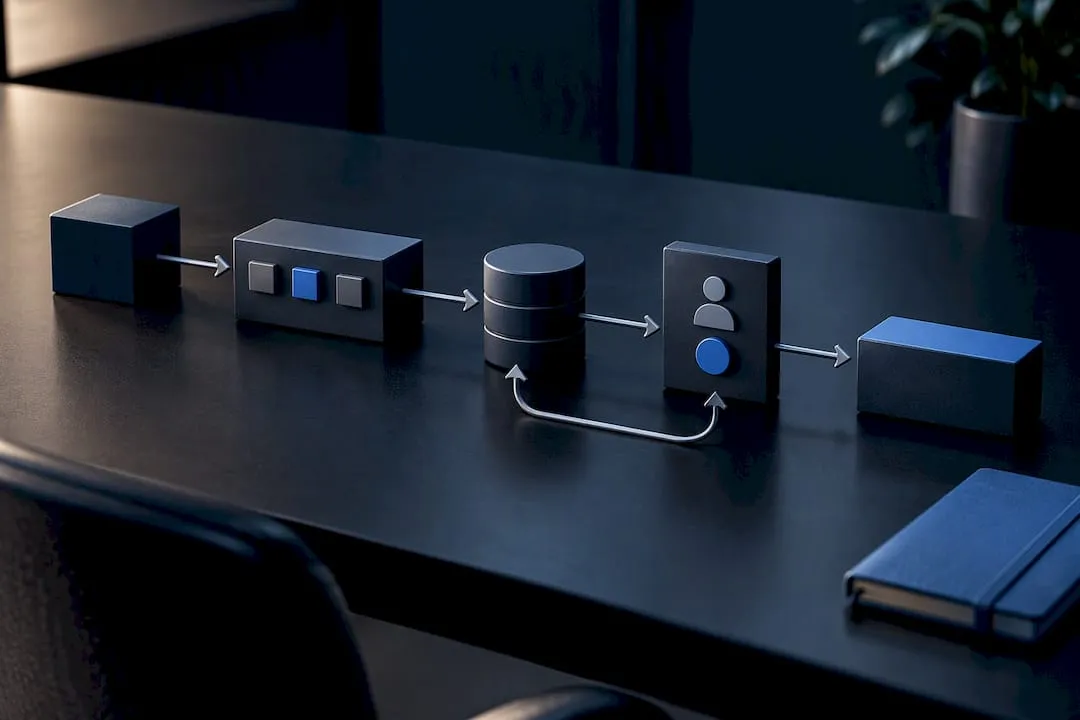
Pro Tip: Design every tool call to be idempotent from day one; retrofitting idempotency after a production incident costs far more than building it in up front.
Production engineering: reliability, cost control, observability, and safety
A workflow that works in a demo and a workflow that survives production load are different engineering problems. Reliability requires circuit breakers that stop calling a failing dependency, budget guards that cap spend per run, checkpointing so a crashed run resumes instead of restarting, and retry/backoff logic tuned to avoid hammering a rate-limited API.
Cost control follows a similar logic to reliability: route cheap, well-defined tasks to smaller models and reserve larger models for steps that need deeper reasoning.
- Model tiering: assign task complexity to the smallest model that handles it reliably.
- Model routing: dynamically select a model per agent or persona based on the task at hand.
- Token accounting: track token spend per run and per workflow stage, not just in aggregate.
- Fallbacks: degrade to a cheaper model rather than failing the run outright, a pattern implemented in projects like go-orca.
Observability separates a debuggable system from a black box: distributed tracing across model calls and tool invocations, metrics on latency and token spend per step, immutable audit logs for every decision and approval, and periodic LLM-as-judge scoring to catch quality drift between full evaluations.
Safety controls include PII redaction before data reaches a model, defenses against prompt injection in retrieved or user-supplied content, and structured TEVV (test, evaluation, validation, verification) with red-teaming exercises before a workflow touches production data. Cybersecurity and IT functions show some of the most mature GenAI ROI reported so far, largely because those environments already have the structured, measurable tasks that make safety controls easier to verify. That pattern suggests starting pilots in similarly structured domains before extending to less predictable business processes.
Governance, risk management, and vendor evaluation
Governance is not a document that sits beside the workflow. It is the set of checks that decide whether a workflow is allowed to touch production data and take real-world actions. The NIST Generative AI Profile organizes this into four functions that map cleanly to organizational steps:
- Govern: assign clear ownership for each workflow, document acceptable use, and set escalation paths before launch.
- Map: catalog where the workflow touches sensitive data, external tools, and irreversible actions.
- Measure: define accuracy, latency, and safety metrics, then test against them before and after each change.
- Manage: monitor in production, respond to incidents, and retire or retrain workflows that drift out of tolerance.
Vendor evaluation for any tool or model provider in the stack should confirm data provenance and retention terms, service-level agreements for uptime and support response, incident notification timelines, intellectual property terms for generated output, and the vendor’s own red-teaming or TEVV practices.
Risk tiers should determine how much human oversight a workflow gets: low-risk internal drafts might run unsupervised, while workflows that send customer communications or modify financial records warrant an approval gate before every action. The NIST AI Risk Management Framework recommends scheduling periodic reviews and independent evaluations proportional to that risk tier, not as a one-time launch gate.
Pro Tip: Write the escalation path before the workflow ships, not after the first incident forces you to improvise one.
How to choose tools and design a pragmatic build-and-buy strategy
Tool selection should follow the workflow’s actual requirements rather than a vendor’s feature list. Four decision axes cover most cases: how complex the orchestration needs to be, what compliance obligations apply to the data involved, how much scale the workflow must handle, and how much customization the process genuinely requires.
Categories worth comparing:
- Low-code orchestrators: visual workflow builders suited to teams without deep engineering resources, useful for routing and approval-heavy processes.
- Self-hosted orchestration engines: code-first frameworks for teams that need full control over state, tools, and deployment.
- Vector stores and retrieval layers: dedicated systems or database extensions that ground responses in enterprise knowledge.
- Monitoring and TEVV suites: tooling for tracing, evaluation, and audit logging across the workflow lifecycle.
Industry guidance increasingly favors a hybrid path: rather than building every component from scratch, customize prebuilt models and platforms to enterprise data and centralize AI leadership across teams to avoid duplicated pilots. A pilot-to-procure approach fits most organizations best: run a small pilot with clear success metrics on accuracy, cost per task, and time saved, then use those numbers to negotiate procurement terms rather than committing to a platform before proving the workflow works.
Implementation checklist: an actionable starter plan for pilot to production
A structured pilot removes the guesswork from scaling decisions. The following sequence works for most first LLM workflow projects.
- Prioritize one or two use cases with clear, measurable success criteria.
- Build a minimal architected pilot: single orchestration pattern, one data source, one tool.
- Add human-in-the-loop approval gates for any action that touches customer data or money.
- Run TEVV against a held-out test set before expanding scope.
- Measure cost per task and accuracy weekly, not just at launch.
- Scale gradually: add data sources, tools, and volume in separate steps, not all at once.
A pilot timeline of several weeks typically provides enough runway for most teams to reach a genuine go or no-go decision.
| Week | Milestone | Gate criteria |
|---|---|---|
| 1-2 | Use case scoped, data mapped | Success metrics defined |
| 3-6 | Pilot built, HITL gates added | Accuracy meets threshold on test set |
| - | TEVV and red-team pass | No unresolved safety findings |
| - | Limited production run | Cost per task within target |
Starter monitoring metrics include task accuracy, cost per completed task, latency per step, and approval override rate.
Forefront Industries perspective: practical experience and outcomes
A digital agency builds custom infrastructure for service businesses, including web platforms, enterprise CRM and email systems, and AI automation, drawing on experience with lifecycle systems for consumer brands. That background shapes the approach to LLM workflow projects: custom-coded integrations rather than templated connectors, governance and TEVV built into the pilot rather than added after launch, and CRM/email systems designed to carry the workflow’s output into existing lead pipelines.
For service businesses specifically, the priority is connecting automation output to systems that already run the business, not standing up an isolated proof of concept.
What the research actually supports about LLM automation
The evidence points to a narrower conclusion than most vendor pitches suggest: LLM workflow automation succeeds fastest in structured, measurable domains, not in ambitious end-to-end reinventions of a business process. Cybersecurity and IT operations show the clearest early ROI precisely because the tasks are bounded and easy to score. The conventional advice to “start with your most complex process” gets this backward. Complexity is where governance overhead, approval gates, and error handling all compound at once, which is exactly where a first project is most likely to stall.
The bigger blind spot is treating orchestration pattern as the hard part. Pattern choice matters, but most production failures trace back to missing checkpointing, missing approval gates, or missing audit trails, not to picking chained requests instead of a supervisor pattern. Readers should prioritize the boring operational scaffolding first: idempotent tools, durable state, and a clear human-approval policy. The clever orchestration pattern can wait.
- Jeremy
How Forefront Industries can help
Forefront Industries turns the patterns in this article into working systems for service businesses that need automation connected to real revenue infrastructure, not a standalone chatbot.

- AI Automation & Consulting to design and build the orchestration, retrieval, and governance layer for your workflow.
- Email & CRM Development to route automated output directly into lifecycle campaigns and lead scoring.
- Custom integrations that connect existing business systems without forcing a platform migration.
A first engagement typically starts with a discovery call to scope one pilot use case, moves into a scoped build, and ends with a measured handoff into production. Visit the AI Automation & Consulting services page to start that conversation.
Sources
For readers who want to go deeper on governance and production patterns:
- NIST - Generative Artificial Intelligence Profile (AI RMF)
- Deloitte - State of Generative AI (press release)
- AWS Generative AI guidance (acc-inn-genai)
- ForgeFlow (production-grade multi-agent orchestrator) - GitHub
FAQ
What is an LLM-based workflow?
An LLM-based workflow chains large language model calls, tools, and data sources together to complete a multi-step task, such as extracting data from a document and then routing it for approval. Unlike fixed-rule automation, it adapts its output based on the specific content it receives at each step.
Which AI workflow automation tool is best?
There is no single best tool: the right choice depends on your orchestration complexity, compliance requirements, and scale, as outlined in the tool-selection criteria above. Most organizations do better evaluating a short list against a real pilot than picking a platform from a feature comparison alone.
Can ChatGPT automate tasks?
ChatGPT and similar consumer-facing tools can handle individual tasks like drafting text or summarizing a document, but production workflow automation typically requires an orchestration layer, tool integrations, and governance controls that consumer chat interfaces do not provide on their own. Most production deployments pair a model API with a dedicated orchestrator rather than relying on a chat interface directly.
What are examples of workflow automation?
Common examples include document intake and data extraction, customer support ticket routing, invoice processing with human approval gates, and retrieval-augmented answering over an internal knowledge base. Each of these fits the L3 automation pattern described earlier, where the LLM handles one task inside a larger human-managed process.
How do I keep an LLM workflow compliant with data privacy rules?
Compliance starts with mapping exactly where sensitive data enters the workflow and applying redaction or access controls before that data reaches a model, consistent with the mapping step in the NIST AI RMF. Vendor contracts should specify data retention and provenance terms so you understand how your data is stored and reused.