Five Phase CDP and CRM Playbook for Decision Makers

A CDP unifies behavioral and transactional data into persistent customer profiles; a CRM manages contacts, deals, and service records for sales and support teams. Neither replaces the other. The right move for most companies is integration, not selection: CRM alone covers high-touch B2B pipelines, but scaled personalization requires a CDP feeding that CRM real-time context. Start with an audit of your existing data before you buy anything.
TL;DR:
- A CDP unifies scattered behavioral and transactional data into persistent customer profiles that enable real-time personalization and segmentation, especially for high-volume use cases.
- Integration of a CDP with a CRM is crucial, with most companies benefiting from a two-way data flow that enhances both sales pipeline management and marketing activation.
- Building a scalable CDP requires an audit of all existing data sources, a focused pilot for high-impact use cases, and careful engineering for reliable data mapping and governance.
- A CRM excels in long-term pipeline forecasting, deal management, and customer relationship workflows but cannot efficiently handle high-velocity event streams or real-time triggers.
- Future improvements will center on AI-driven identity resolution, faster activation, and tighter system integration, making the decision more about how well they work together than choosing one over the other.
Table of Contents
- What a CDP Is: Data Sources, Identity Resolution, and Activation
- What a CRM Is: Objects, Workflows, and Where It Falls Short
- The Key Differences That Actually Drive the Decision
- When a CRM Is Enough, and When You Need a CDP
- How CDP and CRM Integration Works in Practice
- Forefront Industries’ Implementation Playbook
- Where CDP and CRM Advantages Actually Show Up
- Impact on Marketing Strategy and Customer Experience
- Limitations and Challenges Unique to Each System
- Where CDP and CRM Capabilities Are Headed
- A Practical Roadmap: Audit, Pilot, Scale
- Building the CDP-CRM Stack: Where Forefront Industries Fits
- Sources
- FAQ
What a CDP Is: Data Sources, Identity Resolution, and Activation
A customer data platform exists to solve one problem: your customer’s behavior is scattered across a dozen systems, and none of them talk to each other. A CDP pulls in web activity, app events, offline purchases, point-of-sale transactions, support tickets, and marketing engagement, then stitches them into a single profile per person.
That stitching process, called identity resolution, runs on two methods working together. Deterministic matching links records using hard identifiers like email addresses or logged-in user IDs. Probabilistic matching infers connections from patterns, device fingerprints, and behavioral overlap when no hard identifier exists. Get this wrong and you end up with duplicate or fragmented profiles that undermine every campaign built on top of them.
Once profiles are unified, a CDP activates them. Typical use cases include:
- Triggering a real-time email or push notification the moment someone abandons a cart
- Syncing high-value segments to ad platforms for suppression or targeted spend
- Building dynamic segments that update automatically as behavior changes
- Feeding personalization engines with recency and frequency signals
Scaling a CDP gets expensive fast, and the cost drivers are predictable: events processed per second, how long you retain raw event history, and the number of source and destination connectors you maintain. A CDP built for a mid-size e-commerce brand ingesting a few million events monthly looks nothing like one supporting an enterprise streaming billions of events, and pricing tends to track that difference closely.
Pro Tip: Before evaluating vendors, run a two-week audit of every system currently capturing customer behavior. Most teams discover substantially more data sources than they expected, and that number directly shapes your CDP sizing conversation.
What a CRM Is: Objects, Workflows, and Where It Falls Short
A CRM organizes the operational side of customer relationships around a small set of core objects: contacts, accounts, deals (or opportunities), and activities. Everything a sales or service team does gets logged against one of these records, which is why CRMs have remained the backbone of revenue operations for decades.
The workflows built on top of those objects are what make a CRM valuable day to day:
- Lead routing that assigns new prospects to the right rep based on territory, size, or product interest
- Deal-stage automation that moves opportunities through a pipeline and triggers tasks at each step
- Service-ticket management with SLA tracking so support issues don’t go stale
- Activity logging that gives managers visibility into calls, emails, and meetings tied to each account
Forecasting is where CRMs earn their keep. Pipeline reporting built on deal stages, close dates, and historical win rates gives revenue leaders a defensible number to bring to the board, something no behavioral data platform is designed to produce on its own. If your sales cycle is long and consultative, this reporting function alone can justify the CRM’s cost.
Where CRMs struggle is volume. They’re built on structured record models: rows, fields, related objects. Push a high-velocity stream of clickstream or app-event data at a CRM and you’ll hit performance walls, because forcing a CRM to handle event streams it wasn’t architected for can cause instability and degraded performance. That’s not a flaw in the CRM. It’s simply not the job it was built to do.
The Key Differences That Actually Drive the Decision
Once you get past the surface-level “one’s for marketing, one’s for sales” framing, the real differences show up in four technical areas: data model, identity, activation speed, and who inside the company depends on the system.
Data model. A CDP operates on an event store: a continuously growing log of timestamped behavioral signals, unstructured and semi-structured, designed to be queried at scale. A CRM operates on structured records with defined fields and relationships. CDPs ingest and unify behavioral, transactional, structured, and unstructured data into persistent profiles, while CRMs manage relationships, deals, and operational records, and that structural gap is why one can’t simply substitute for the other.
Identity resolution. CDPs resolve identity in near real time across devices and channels using deterministic and probabilistic matching. CRMs work off records that are typically created or updated manually or through form submissions, meaning identity is established once and rarely re-evaluated dynamically.
Activation speed. A CDP can trigger an action within seconds of a behavioral event. A CRM automates workflows too, but those workflows are usually tied to human-driven milestones (a deal moving stages, a ticket being closed) rather than millisecond-level behavioral triggers.
Retention and cost. CRMs retain records indefinitely at relatively low cost because record volume grows slowly. CDPs retain raw event data that grows continuously, and implementation costs scale directly with data volume and the complexity of real-time ingestion, which is the single biggest budget surprise for teams new to this category.
Here’s a side-by-side breakdown of where each system carries the most weight:
| Dimension | CDP | CRM |
|---|---|---|
| Primary users | Marketing, product, growth teams | Sales, support, account management |
| Data type | Behavioral, event-level, transactional | Structured records: deals, tickets, contacts |
| Identity resolution | Real-time, deterministic + probabilistic | Manual or form-based, static |
| Activation | Automated, millisecond to minute-level | Workflow-based, human-in-the-loop |
| Retention cost driver | Event volume and velocity | Record count (grows slowly) |
| Best for | Personalization, segmentation at scale | Forecasting, pipeline management |
The categories sit on a spectrum next to a third system worth naming once: CDPs create persistent identifiable profiles while DMPs work off anonymous identifiers for ad targeting, and CRMs sit apart from both by managing lifecycle records rather than audience segments. Knowing where DMPs fit keeps your CDP-versus-CRM decision from getting muddled by a third acronym that solves a different problem entirely.
When a CRM Is Enough, and When You Need a CDP
Budget constraints mean most companies can’t buy everything at once, so prioritization matters more than the comparison chart. The signals below tell you which system to fund first.
Choose CRM-first when:
- Your sales cycle is long, consultative, and relationship-driven (enterprise software, professional services, high-ticket B2B).
- Forecasting accuracy and pipeline visibility are your board’s top reporting demands.
- Your customer data is largely first-party and already lives in one or two systems - not fragmented across a dozen tools.
Choose CDP-first when:
- Customer behavior spans multiple channels (app, web, in-store, email) and no single system currently unifies it.
- Personalization at scale, real-time offers, or dynamic segmentation is a stated growth priority, not a nice-to-have.
- Your marketing team is manually exporting spreadsheets to stitch together a customer view, a sure sign the fragmentation has outgrown ad hoc fixes.
Pro Tip: If you’re resource-constrained, don’t buy a full CDP and try to unify everything at once. Analyst guidance on this consistently favors piloting one high-value use case, like abandoned-cart reactivation, before scaling to a full rollout, because the immediate ROI usually comes from targeted pilots rather than a broad-scope launch.
Engineering resourcing is the deciding factor teams underestimate most. A CRM rollout can often be handled by an admin with light technical support. A CDP implementation typically needs dedicated engineering time for connector setup, identity mapping, and QA, which is why timeline expectations should be set in months, not weeks.
How CDP and CRM Integration Works in Practice
Two architecture patterns dominate real-world CDP-CRM integrations, and which one you pick depends on where your data is strongest today.
Pattern A: CDP-first. The CDP ingests and unifies behavioral events from every channel, then pushes enriched, unified profiles into the CRM. Sales reps see a prospect’s browsing history, email engagement, and product usage directly inside their deal records, without leaving the CRM interface.
Pattern B: CRM-first. The CRM remains the system of record for contacts and deals, and its transaction and lifecycle events flow into the CDP to enrich behavioral profiles for marketing activation. This pattern fits companies with a mature CRM and a newer, less complete behavioral data picture.
Both patterns depend on the same underlying data flow:
- Webhooks or streaming APIs handle low-latency use cases where a delay of even a few minutes kills the relevance of a trigger.
- Batch syncs (hourly or nightly) handle lower-priority segments where cost control matters more than speed.
- A named data-governance owner, not a committee, approves what fields sync where and enforces consent rules across both systems.
Integrating a CDP with a CRM works as two-way enrichment: the CDP hands the CRM behavioral context on every contact, while the CRM hands the CDP transaction history and lifecycle stage data that sharpens segmentation and personalization on the marketing side.
That two-way flow is the entire point of running both systems, and it’s confirmed as a best practice by platforms built specifically to connect them. Skip the governance step and you’ll end up with sync conflicts, duplicate consent records, and a compliance headache that costs more to unwind than it would have to build correctly the first time.
Forefront Industries’ Implementation Playbook
Most CDP-CRM projects fail at the mapping stage, not the platform selection stage. Forefront Industries structures every engagement around five phases: discovery, data mapping, a scoped pilot, integration engineering, and QA before rollout. That order matters because governance and identity ownership are the most common reasons these projects stall, and assigning a clear data owner during discovery, not after launch, prevents scope creep before it starts.
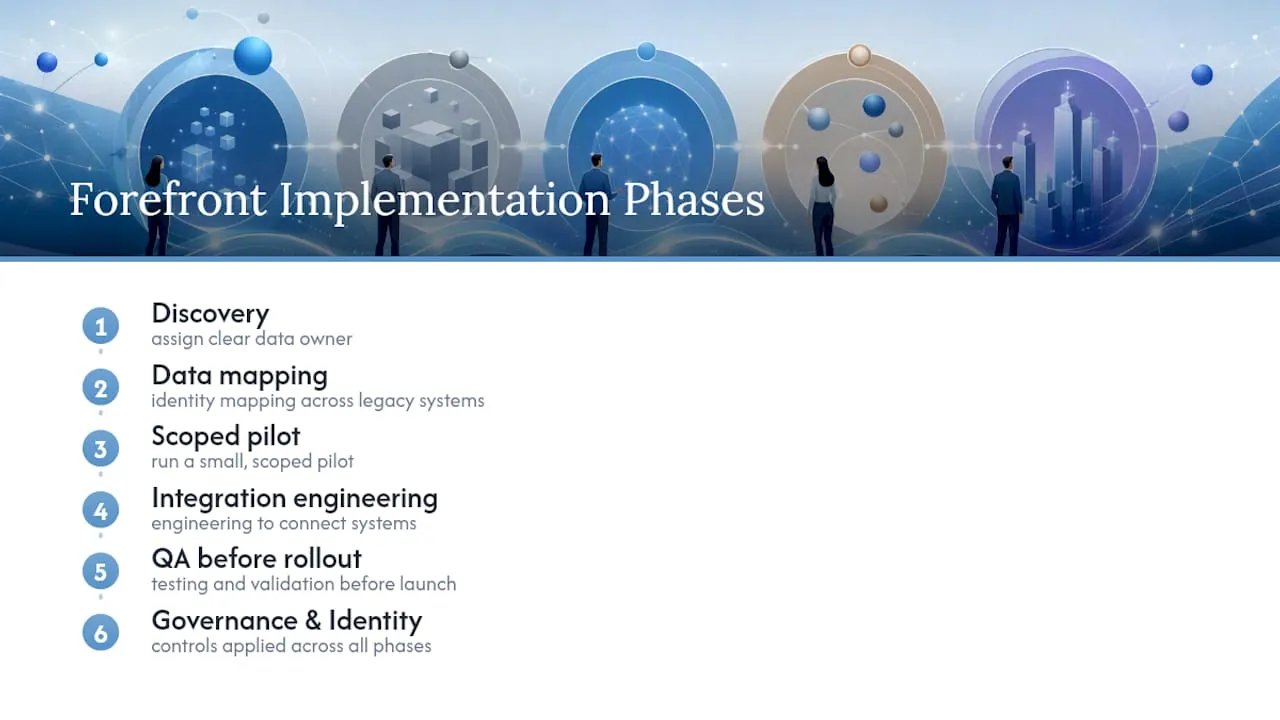
Timelines run longer than most teams expect, largely because identity mapping across legacy systems takes real engineering hours no vendor demo shows you.
Where CDP and CRM Advantages Actually Show Up
The clearest way to see the advantage of each system is to watch what happens when you use the wrong one for a given job.
A retail brand running a flash sale needs to suppress ads for anyone who already purchased in the last hour, sync a live “browsed but didn’t buy” segment to email, and personalize on-site banners by category interest, all within minutes. That’s a CDP use case. No CRM workflow engine operates at that latency or ingests that volume of anonymous and known browsing behavior.
Flip the scenario. An enterprise software company is closing a six-figure contract that involves four stakeholders, a procurement review, and a 90-day sales cycle. The rep needs to track every call, log objections, move the deal through stages, and generate an accurate forecast for the VP of sales. That’s a CRM use case, and a CDP has nothing useful to contribute to that workflow.
The advantage of combining both shows up in a mid-funnel scenario: a CDP identifies that a known contact has visited the pricing page five times in a week, then pushes that signal into the CRM so the assigned rep gets a real-time alert to reach out before the lead goes cold. Neither system alone produces that outcome. The CDP-to-CRM enrichment loop is what makes it possible.
Impact on Marketing Strategy and Customer Experience
Unified customer data changes what a marketing team can promise leadership, not just what tools it uses. Once behavioral and transactional data sit in one profile, campaigns shift from broad segments (“everyone who bought in the last 90 days”) to individual-level triggers (“this specific person browsed three times without buying”).
That shift changes customer experience measurably. Response and engagement rates on triggered, behavior-based campaigns consistently outperform static batch sends, because the message arrives while the intent is still active. A CRM alone can’t drive that kind of real-time relevance since it isn’t built to react to a browsing event as it happens.
The strategic implication for decision-makers: personalization budgets increasingly go toward integration and data infrastructure, not just creative and ad spend. A well-integrated stack, drawing on the kind of personalization tactics that compound engagement over time, tends to outperform teams that keep pouring budget into channel tools while ignoring the plumbing underneath them. The experience customers notice, faster responses, more relevant offers, fewer irrelevant touches, comes from the data architecture behind the scenes, not from any single campaign tactic.
Limitations and Challenges Unique to Each System
CDPs carry a specific set of headaches. Identity resolution is never perfect, and probabilistic matching can misattribute behavior, especially on shared devices or households. Data cleaning and mapping before launch routinely takes longer than teams budget for, and ongoing costs scale with event volume in ways that are hard to forecast precisely at the outset. Governance also gets harder as more destinations pull from the same profile, since every new connector is another place consent rules have to be enforced correctly.
CRMs face a different set of limits. They rely heavily on manual data entry or form capture, so record quality degrades without disciplined process enforcement from sales and support teams. They can’t natively process high-volume behavioral streams without hitting performance ceilings, and reporting is only as good as pipeline hygiene, meaning a CRM full of stale deals produces a forecast nobody should trust.
The shared challenge across both: neither system fixes a bad data culture. A CDP fed by inconsistent tracking implementation produces fragmented profiles regardless of how good the platform is. A CRM populated by reps who skip logging activities produces forecasts that look precise but aren’t. Platform selection matters less than most vendors imply. Data discipline matters more.
Where CDP and CRM Capabilities Are Headed
AI-driven identity resolution is the clearest near-term shift. Probabilistic matching models are getting better at resolving cross-device identity without relying purely on deterministic identifiers like email, which narrows the gap between “known” and “anonymous” visitors faster than manual rules ever could.
Real-time activation is also becoming table stakes rather than a premium feature. What used to require a dedicated CDP tier is increasingly built into mid-market platforms, pushing the CDP-versus-CRM decision earlier in a company’s growth curve than it used to sit.
On the CRM side, native AI features for lead scoring, next-best-action suggestions, and automated activity logging are closing some of the manual-entry gap that has always limited CRM data quality. That doesn’t turn a CRM into a CDP. It does mean the operational side of the stack is getting smarter about the data it already owns.
The likely trajectory for most mid-size and enterprise companies isn’t picking a winner between these categories. It’s tighter, faster, more automated integration between them, with AI doing more of the identity and enrichment work that used to require dedicated engineering hours.
A Practical Roadmap: Audit, Pilot, Scale
Run this in order: audit your current data sources and identify where personalization is failing today, pilot a CDP on one measurable use case with clear success metrics, then scale only after that pilot proves lift. Involve marketing ops, sales ops, engineering, and legal from day one. Keep scope tight. Governance built in after launch never catches up.
- Jeremy
Building the CDP-CRM Stack: Where Forefront Industries Fits
Most agencies will sell you a CDP or a CRM overhaul as a standalone project, then leave you to figure out how the two actually talk to each other. Forefront Industries builds the connective layer instead: data mapping, integration engineering, and the custom-coded front-end instrumentation that makes real-time personalization possible once your systems are unified.
Forefront’s background comes from enterprise CRM and lifecycle marketing work on platforms like Salesforce Marketing Cloud and Braze, applied to service businesses that need the same rigor without the enterprise price tag. Clients who have completed Forefront CRM and email-system builds have reported improvements in inbound lead quality, reflecting better data flow between marketing and sales rather than siloed disconnected tools.
If your team is fielding both platforms but seeing none of the two-way enrichment described above, that’s usually a mapping and engineering gap, not a platform problem. Start with a CRM and email development consultation to scope what an integrated build would actually take for your stack, or visit Forefront Industries to see the full range of custom web and automation work behind these results.
Sources
- Cdp
- CDP vs CRM - Best practices | Twilio blog
- What’s the difference between a CRM and a CDP? | CMSWire
- CDP vs CRM vs DMP | HubSpot blog
FAQ
Is Salesforce a CRM or a CDP?
Salesforce is fundamentally a CRM, built around contacts, accounts, and deal records, though it offers a separate CDP product for behavioral data unification and activation.
What are the 4 types of CRM?
CRMs are generally grouped into operational (workflow and process automation), analytical (data analysis and forecasting), collaborative (cross-team information sharing), and strategic (long-term customer relationship planning) categories.
Is a CDP part of a CRM?
No. A CDP is a separate system focused on unifying behavioral and transactional data into persistent profiles, while a CRM manages relationship and deal records; the two are typically integrated rather than bundled as one product.
Is Microsoft Dynamics a CDP?
Microsoft Dynamics is primarily a CRM and ERP suite, though Microsoft offers a companion CDP-style product for behavioral data unification.
Can a CDP replace a CRM?
No. A CDP lacks collaborative deal-forecasting and task-management features that CRMs provide, while a CRM lacks the real-time identity resolution and event ingestion a CDP handles at scale.